Dienes Lóránt, Kránitz Kinga, Juhász Eva, Gyenes Andrea, Takács Agnes, Miháltz Kata, Nagy Zoltán Z, Kovács Illés
Semmelweis University, Department of Ophthalmology, Budapest, Hungary.
Karl Landsteiner Institute of Process Optimalization and QM in Cataract Surgery, Vienna, Austria.
PLoS One. 2014 Oct 8;9(10):e108882. doi: 10.1371/journal.pone.0108882. eCollection 2014.
To assess the correlation between keratoconus severity and intereye asymmetry of pachymetric data and posterior elevation values and to evaluate their combined accuracy in discriminating normal corneas from those with keratoconus.
This study included 97 patients: 65 subjects with bilateral normal corneas (NC) and 32 with keratoconus (KC). Central corneal thickness (CCT), thinnest corneal thickness (ThCT) and posterior elevation (PE) at the thinnest point of the cornea were measured in both eyes using Scheimpflug imaging. Intereye asymmetry and its correlation with keratoconus severity were calculated for each variable. The area under the receiver operating characteristic curve (AUROC) was used to compare predictive accuracy of different variables for keratoconus.
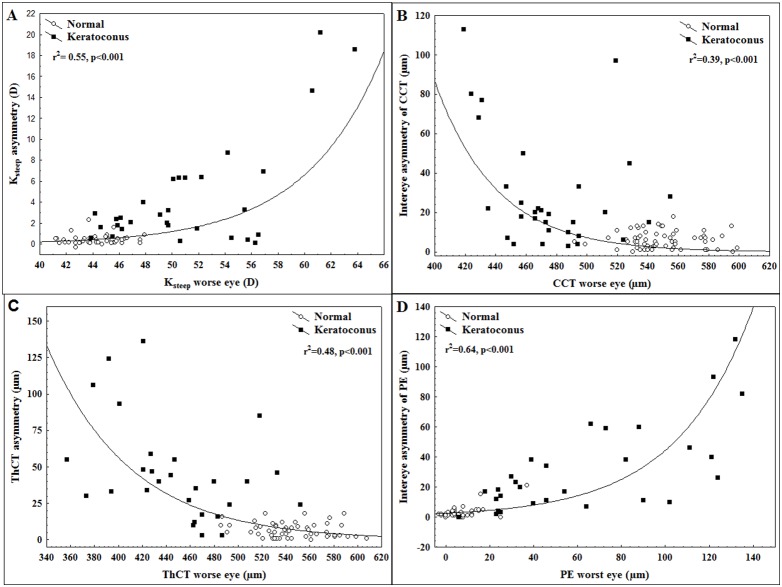
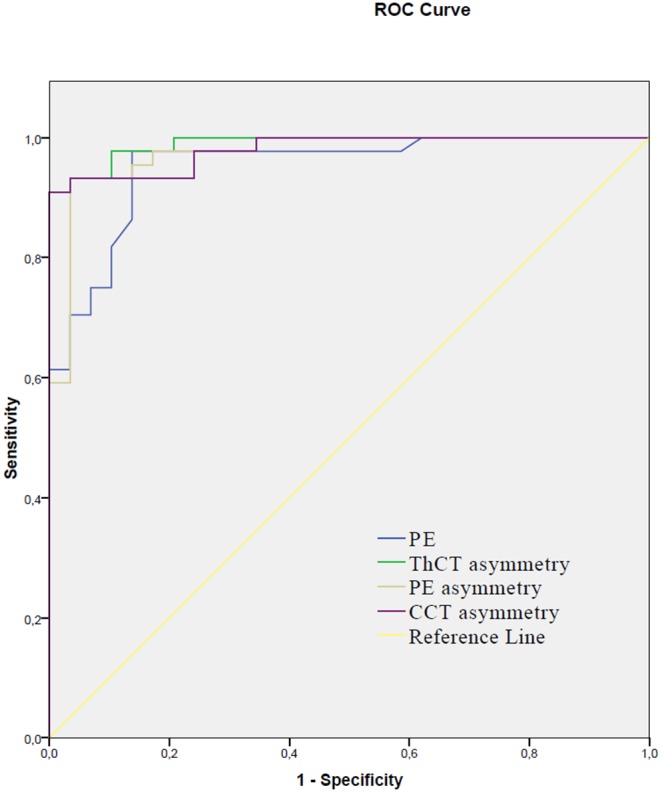
In normal eyes, intereye differences were significantly lower compared with the keratoconus eyes (p<0.001, for CCT, ThCT and PE). There was a significant exponential correlation between disease severity and intereye asymmetry of steep keratometry (r2 = 0.55, p<0.001), CCT (r2 = 0.39, p<0.001), ThCT (r2 = 0.48, p<0.001) and PE (r2 = 0.64, p<0.001). After adjustment for keratoconus severity, asymmetry in thinnest pachymetry proved to be the best parameter to characterize intereye corneal asymmetry in keratoconus. This variable had high accuracy and significantly better discriminating ability (AUROC: 0.99) for KC than posterior elevation (AUROC: 0.96), ThCT (AUROC: 0.94) or CCT (AUROC: 0.92) alone.
There is an increased intereye asymmetry in keratometry, pachymetry and posterior corneal elevation values in keratoconic patients compared to subjects with normal corneas. Keratoconus patients with more severe disease are also more asymmetric in their disease status which should be taken into account during clinical care.
评估圆锥角膜严重程度与角膜厚度测量数据及后表面高度值的双眼不对称性之间的相关性,并评估它们在区分正常角膜与圆锥角膜方面的综合准确性。
本研究纳入97例患者:65例双侧正常角膜(NC)受试者和32例圆锥角膜(KC)患者。使用Scheimpflug成像技术测量双眼的中央角膜厚度(CCT)、最薄角膜厚度(ThCT)以及角膜最薄点处的后表面高度(PE)。计算每个变量的双眼不对称性及其与圆锥角膜严重程度的相关性。采用受试者操作特征曲线下面积(AUROC)比较不同变量对圆锥角膜的预测准确性。
与圆锥角膜眼相比,正常眼中的双眼差异显著更低(对于CCT、ThCT和PE,p<0.001)。疾病严重程度与陡峭角膜曲率计的双眼不对称性(r2 = 0.55,p<0.001)、CCT(r2 = 0.39,p<0.001)、ThCT(r2 = 0.48,p<0.001)和PE(r2 = 0.64,p<0.001)之间存在显著的指数相关性。在对圆锥角膜严重程度进行校正后,最薄角膜厚度的不对称性被证明是表征圆锥角膜双眼角膜不对称性的最佳参数。该变量具有较高的准确性,对于圆锥角膜的鉴别能力(AUROC:0.99)显著优于单独的后表面高度(AUROC:0.96)、ThCT(AUROC:0.94)或CCT(AUROC:0.92)。
与正常角膜受试者相比,圆锥角膜患者在角膜曲率测量、角膜厚度测量和角膜后表面高度值方面的双眼不对称性增加。疾病更严重的圆锥角膜患者在疾病状态上也更不对称,这在临床护理中应予以考虑。