Kan Yajing, Danner Eric W, Israelachvili Jacob N, Chen Yunfei, Waite J Herbert
Jiangsu Key Laboratory for Design and Manufacture of Micro-Nano Biomedical Instruments, and School of Mechanical Engineering, Southeast University, Nanjing, China; Department of Chemical Engineering, University of California Santa Barbara, Santa Barbara, California, United States of America.
Biomolecular Science and Engineering, University of California Santa Barbara, Santa Barbara, California, United States of America.
PLoS One. 2014 Oct 10;9(10):e108869. doi: 10.1371/journal.pone.0108869. eCollection 2014.
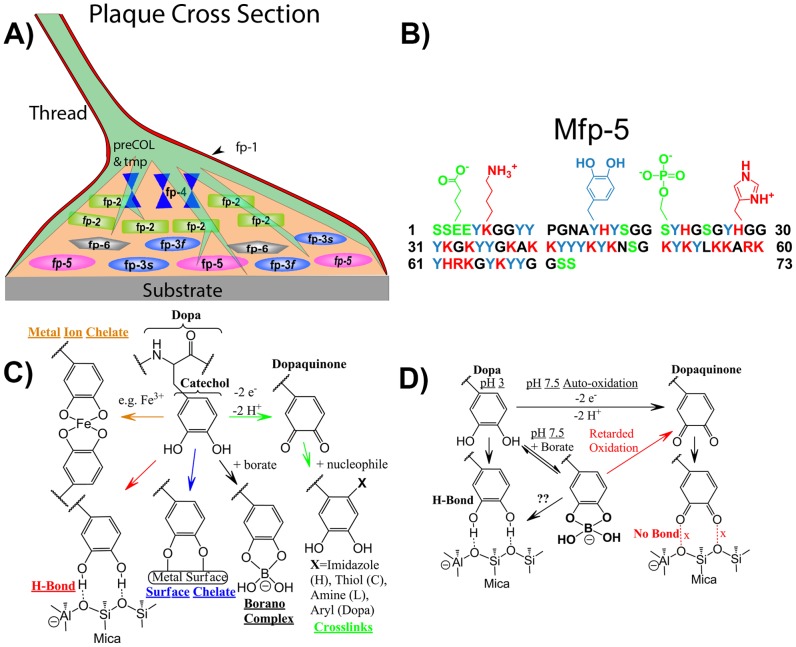
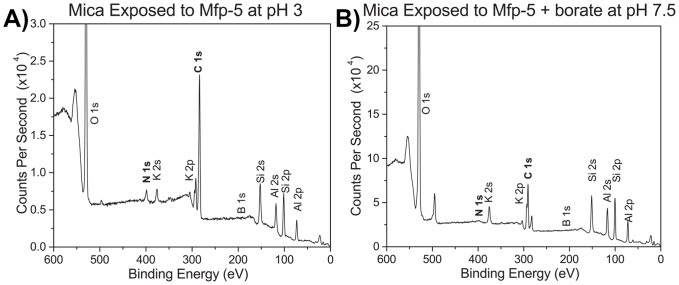
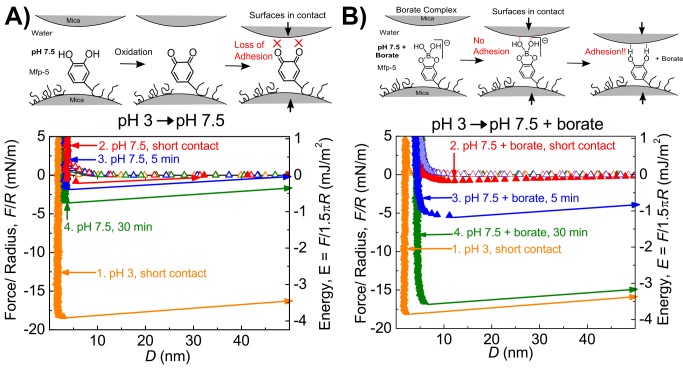
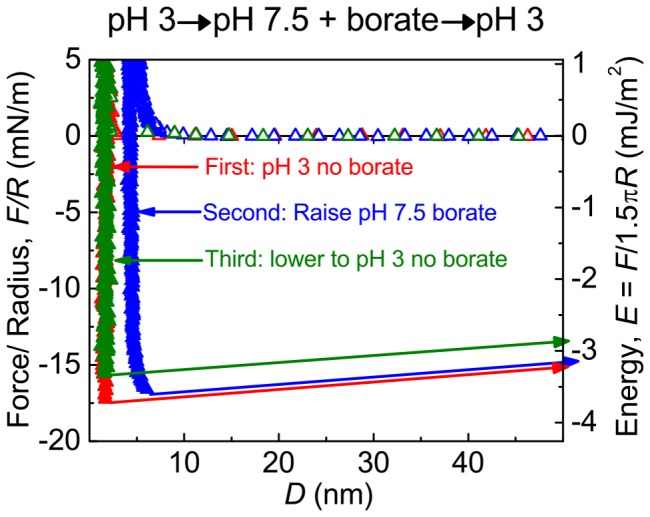
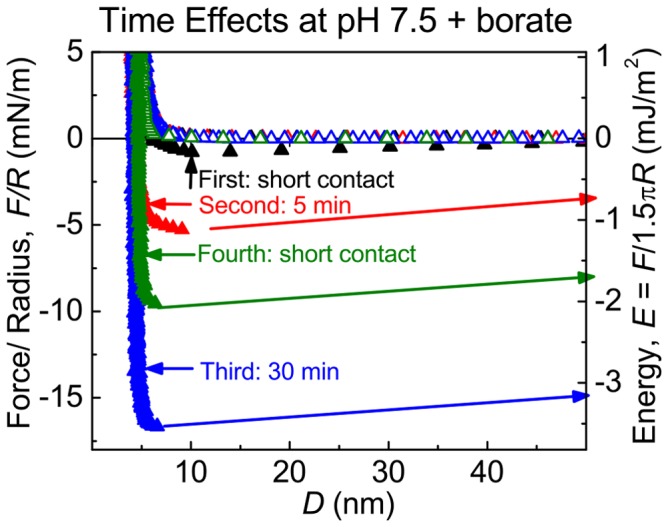
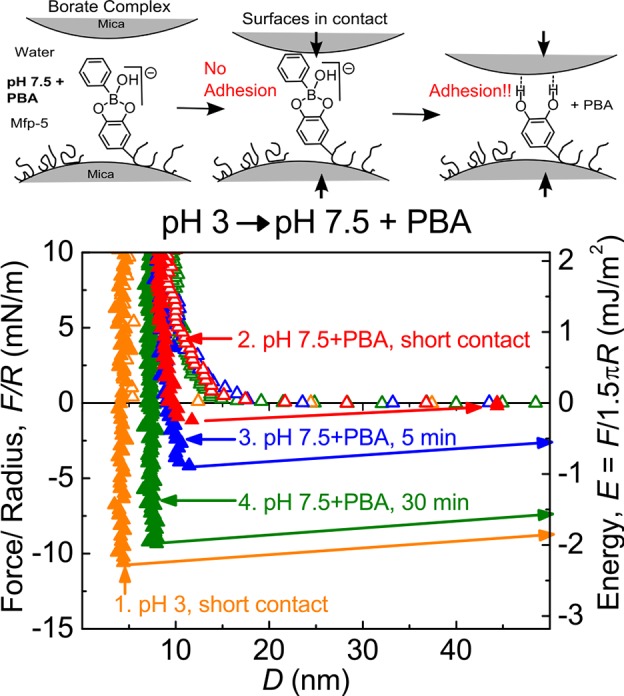
The biochemistry of mussel adhesion has inspired the design of surface primers, adhesives, coatings and gels for technological applications. These mussel-inspired systems often focus on incorporating the amino acid 3,4-dihydroxyphenyl-L-alanine (Dopa) or a catecholic analog into a polymer. Unfortunately, effective use of Dopa is compromised by its susceptibility to auto-oxidation at neutral pH. Oxidation can lead to loss of adhesive function and undesired covalent cross-linking. Mussel foot protein 5 (Mfp-5), which contains ∼ 30 mole % Dopa, is a superb adhesive under reducing conditions but becomes nonadhesive after pH-induced oxidation. Here we report that the bidentate complexation of borate by Dopa to form a catecholato-boronate can be exploited to retard oxidation. Although exposure of Mfp-5 to neutral pH typically oxidizes Dopa, resulting in a>95% decrease in adhesion, inclusion of borate retards oxidation at the same pH. Remarkably, this Dopa-boronate complex dissociates upon contact with mica to allow for a reversible Dopa-mediated adhesion. The borate protection strategy allows for Dopa redox stability and maintained adhesive function in an otherwise oxidizing environment.
贻贝黏附的生物化学原理启发了用于技术应用的表面底漆、粘合剂、涂层和凝胶的设计。这些受贻贝启发的体系通常专注于将氨基酸3,4-二羟基苯-L-丙氨酸(多巴)或儿茶酚类似物引入聚合物中。不幸的是,多巴在中性pH值下易发生自氧化,这会影响其有效利用。氧化会导致黏附功能丧失和不期望的共价交联。贻贝足蛋白5(Mfp-5)含有约30摩尔%的多巴,在还原条件下是一种极好的粘合剂,但在pH诱导氧化后会失去黏附性。在此我们报告,多巴与硼酸盐形成儿茶酚硼酸酯的双齿络合可用于延缓氧化。尽管将Mfp-5暴露于中性pH值通常会使多巴氧化,导致黏附力下降>95%,但加入硼酸盐可在相同pH值下延缓氧化。值得注意的是,这种多巴-硼酸盐络合物在与云母接触时会解离,从而实现可逆的多巴介导的黏附。硼酸盐保护策略可使多巴在氧化环境中保持氧化还原稳定性并维持黏附功能。