Xia Jing, Yuan Yi, Xu Xingjian, Wei Fenghua, Li Guiling, Liu Min, Li Jianqiang, Chen Rujuan, Zhou Zhengping, Nie Shaofa
Department of Epidemiology and Health Statistics, School of Public Health, Tongji Medical College, Huazhong University of Science and Technology, Wuhan 430030, China.
Institute of Schistosomiasis Control, Hubei Provincial Center for Disease Control and Prevention, Wuhan 430079, China.
Int J Environ Res Public Health. 2014 Oct 10;11(10):10406-18. doi: 10.3390/ijerph111010406.
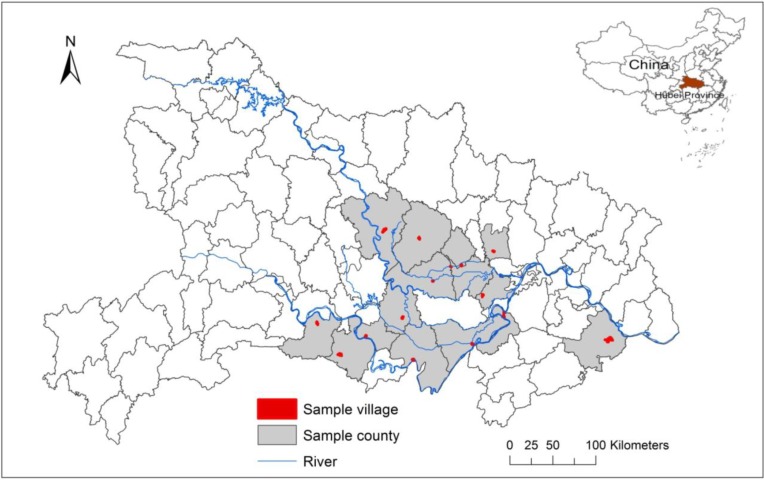
Oncomelania hupensis is the sole intermediate host snail of Schistosoma japonicum in China. Snail control by molluscicide remains one of the most effective measures of schistosomiasis japonica control. A 50% wettable powder of niclosamide ethanolamine salt (WPN) is widely used for snail control in China. However, WPN is costly and toxic to fish. A novel molluscicide named LDS, the salt of quinoid-2', 5-dichloro-4'-nitrosalicylanilide from niclosamide, has been developed. To evaluate the effects of large-scale field application of LDS on field snail control, tests were conducted in 15 counties of Hubei Province, China. Active adult snails, were immersed in 0.2, 0.4, and 0.6 g/m3 of 10% LDS, 1.0 g/m3 of 50% WPN was used as the molluscicide control, and then the mortality rates of snails were investigated after 1, 2, and 3 days. In addition, four active concentrations of 10% LDS (0.4, 0.6, 0.8 and 1.0 g/m2) were applied by spraying and powdering in the field. 1.0 g/m2 of 50% WPN was used as the molluscicide control, and then the mortality rates of snails were observed after 1, 3, and 7 days. The results indicated that 0.4 g/m3 LDS applied by the immersion or 0.6 g/m2 LDS applied by spraying and powdering achieved the same molluscicidal effect as that of WPN, regardless of exposure time. By using different methods, the snail mortality rates in the molluscicide groups were related to exposure time and concentration, respectively. LDS costs less than WPN; thus, LDS is suitable and applicable for use as a molluscicide in schistosomiasis japonica epidemic areas.
湖北钉螺是日本血吸虫在中国唯一的中间宿主螺。使用杀螺剂控制钉螺仍然是控制日本血吸虫病最有效的措施之一。氯硝柳胺乙醇胺盐50%可湿性粉剂(WPN)在中国广泛用于灭螺。然而,WPN成本高且对鱼类有毒。一种名为LDS的新型杀螺剂已被开发出来,它是氯硝柳胺的醌类-2',5-二氯-4'-亚硝基水杨酰苯胺盐。为了评估LDS大规模现场应用对现场钉螺控制的效果,在中国湖北省的15个县进行了试验。将成年活钉螺浸入0.2、0.4和0.6 g/m³的10% LDS中,以1.0 g/m³的50% WPN作为杀螺剂对照,然后在1、2和3天后调查钉螺死亡率。此外,通过在田间喷洒和撒粉施用四种活性浓度的10% LDS(0.4、0.6、0.8和1.0 g/m²)。以1.0 g/m²的50% WPN作为杀螺剂对照,然后在1、3和7天后观察钉螺死亡率。结果表明,无论暴露时间如何,通过浸泡施用0.4 g/m³ LDS或通过喷洒和撒粉施用0.6 g/m² LDS都能达到与WPN相同的杀螺效果。通过使用不同方法,杀螺剂组中的钉螺死亡率分别与暴露时间和浓度有关。LDS的成本低于WPN;因此,LDS适合并可用于日本血吸虫病流行区作为杀螺剂。