Santos Rodrigo I, Bueno-Júnior Lézio S, Ruggiero Rafael N, Almeida Mariana F, Silva Maria L, Paula Flávia E, Correa Vani M A, Arruda Eurico
Department of Cell Biology, University of Sao Paulo, School of Medicine at Ribeirao Preto, Ribeirao Preto, 14049-900, Brazil.
Department of Neurology and Behavioral Sciences, University of Sao Paulo, School of Medicine at Ribeirao Preto, Ribeirao Preto, 14049-900, Brazil.
Viruses. 2014 Oct 10;6(10):3827-36. doi: 10.3390/v6103827.
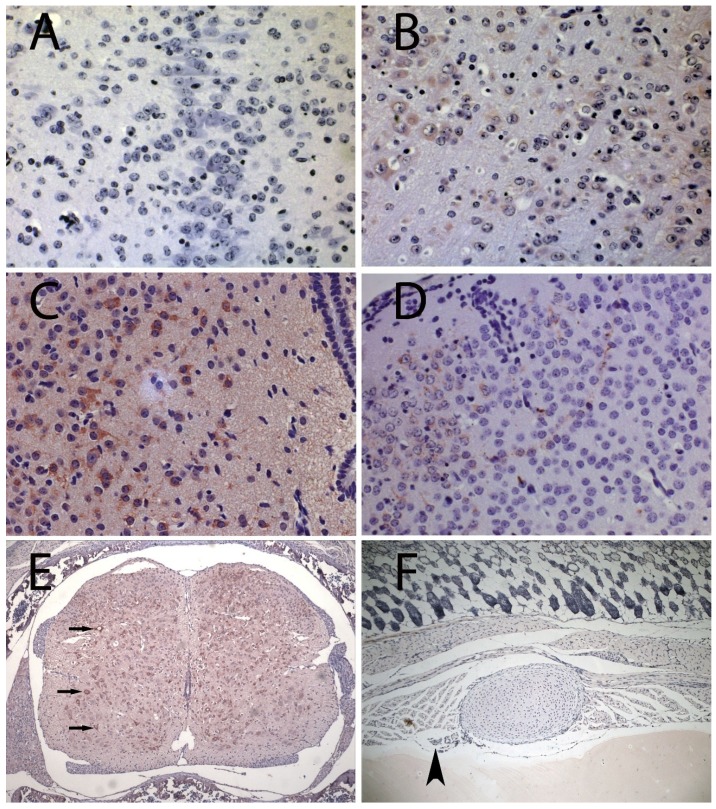
Oropouche virus (OROV) is an important cause of arboviral illness in Brazil and other Latin American countries, with most cases clinically manifested as acute febrile illness referred to as Oropouche fever, including myalgia, headache, arthralgia and malaise. However, OROV can also affect the central nervous system (CNS) with clinical neurological implications. Little is known regarding OROV pathogenesis, especially how OROV gains access to the CNS. In the present study, neonatal BALB/c mice were inoculated with OROV by the subcutaneous route and the progression of OROV spread into the CNS was evaluated. Immunohistochemistry revealed that OROV infection advances from posterior parts of the brain, including the periaqueductal gray, toward the forebrain. In the early phases of the infection OROV gains access to neural routes, reaching the spinal cord and ascending to the brain through brainstem regions, with little inflammation. Later, as infection progresses, OROV crosses the blood-brain barrier, resulting in more intense spread into the brain parenchyma, with more severe manifestations of encephalitis.
奥罗普切病毒(OROV)是巴西和其他拉丁美洲国家虫媒病毒病的重要病因,大多数病例临床表现为被称为奥罗普切热的急性发热性疾病,包括肌痛、头痛、关节痛和不适。然而,OROV也可影响中枢神经系统(CNS)并产生临床神经学影响。关于OROV的发病机制,尤其是OROV如何进入CNS,人们知之甚少。在本研究中,通过皮下途径给新生BALB/c小鼠接种OROV,并评估OROV扩散至CNS的进程。免疫组织化学显示,OROV感染从脑后部,包括导水管周围灰质,向前脑发展。在感染早期,OROV进入神经通路,到达脊髓并通过脑干区域向上进入大脑,炎症轻微。随后,随着感染进展,OROV穿过血脑屏障,导致更强烈地扩散至脑实质,出现更严重的脑炎表现。