Chowdhury Sandipan, Haehnel Benjamin M, Chanda Baron
Graduate Program in Biophysics and Department of Neuroscience, University of Wisconsin, Madison, WI 53705 Graduate Program in Biophysics and Department of Neuroscience, University of Wisconsin, Madison, WI 53705.
Graduate Program in Biophysics and Department of Neuroscience, University of Wisconsin, Madison, WI 53705 Graduate Program in Biophysics and Department of Neuroscience, University of Wisconsin, Madison, WI 53705
J Gen Physiol. 2014 Nov;144(5):457-67. doi: 10.1085/jgp.201411185. Epub 2014 Oct 13.
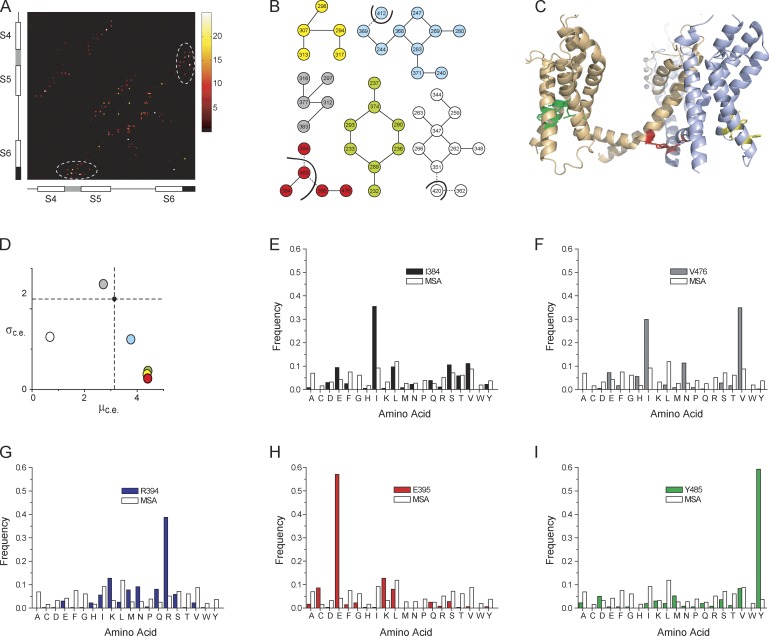
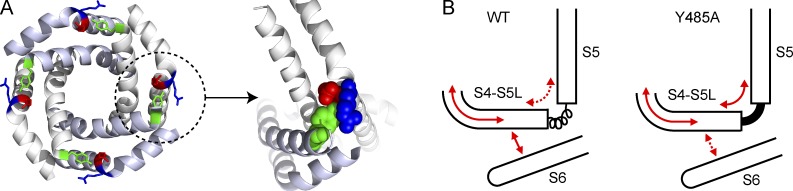
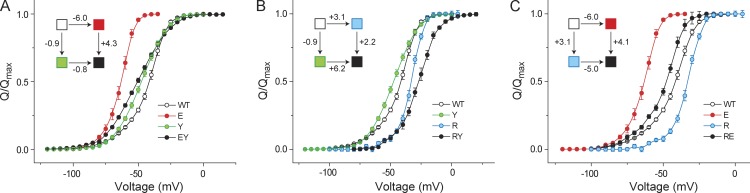
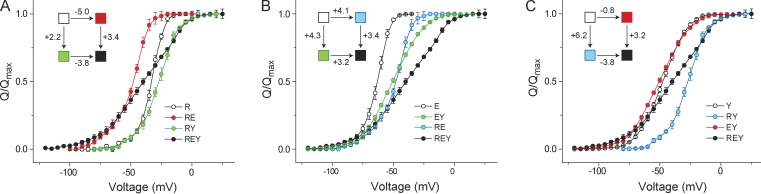
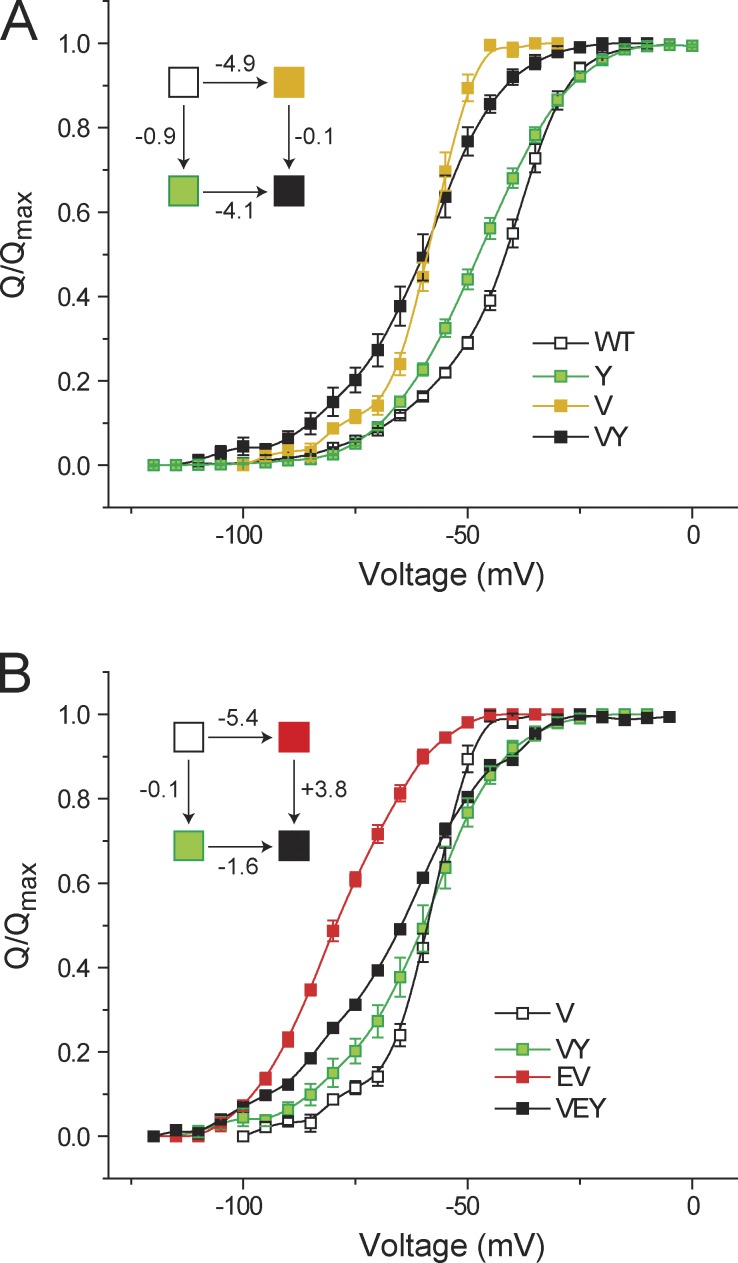
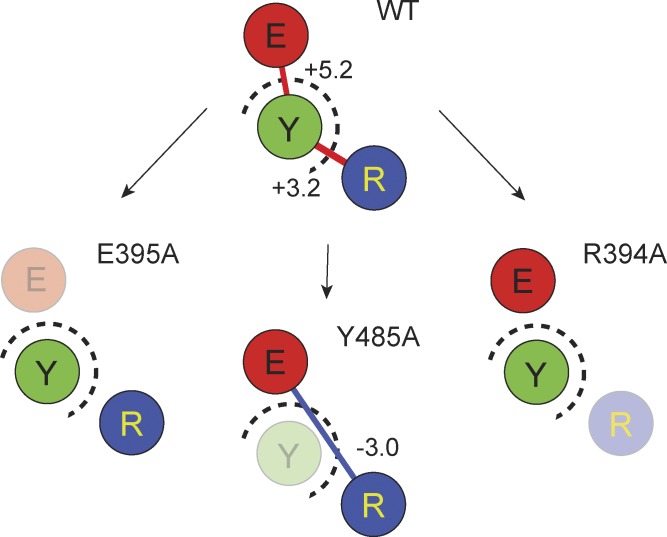
Voltage-dependent potassium channels play a crucial role in electrical excitability and cellular signaling by regulating potassium ion flux across membranes. Movement of charged residues in the voltage-sensing domain leads to a series of conformational changes that culminate in channel opening in response to changes in membrane potential. However, the molecular machinery that relays these conformational changes from voltage sensor to the pore is not well understood. Here we use generalized interaction-energy analysis (GIA) to estimate the strength of site-specific interactions between amino acid residues putatively involved in the electromechanical coupling of the voltage sensor and pore in the outwardly rectifying KV channel. We identified candidate interactors at the interface between the S4-S5 linker and the pore domain using a structure-guided graph theoretical approach that revealed clusters of conserved and closely packed residues. One such cluster, located at the intracellular intersubunit interface, comprises three residues (arginine 394, glutamate 395, and tyrosine 485) that interact with each other. The calculated interaction energies were 3-5 kcal, which is especially notable given that the net free-energy change during activation of the Shaker KV channel is ∼14 kcal. We find that this triad is delicately maintained by balance of interactions that are responsible for structural integrity of the intersubunit interface while maintaining sufficient flexibility at a critical gating hinge for optimal transmission of force to the pore gate.
电压依赖性钾通道通过调节钾离子跨膜通量,在电兴奋性和细胞信号传导中发挥关键作用。电压感应域中带电残基的移动会导致一系列构象变化,最终响应膜电位变化使通道开放。然而,将这些构象变化从电压传感器传递到孔道的分子机制尚未完全清楚。在这里,我们使用广义相互作用能分析(GIA)来估计在向外整流钾通道(KV通道)中,假定参与电压传感器与孔道机电耦合的氨基酸残基之间位点特异性相互作用的强度。我们使用一种结构导向的图论方法,在S4-S5连接子与孔道结构域的界面处鉴定出候选相互作用分子,该方法揭示了保守且紧密堆积的残基簇。其中一个这样的簇位于细胞内亚基间界面,由三个相互作用的残基(精氨酸394、谷氨酸395和酪氨酸485)组成。计算得到的相互作用能为3 - 5千卡,鉴于Shaker KV通道激活过程中的净自由能变化约为14千卡,这一点尤其值得注意。我们发现,这个三联体通过相互作用的平衡得以精细维持,这些相互作用既负责亚基间界面的结构完整性,又在关键的门控铰链处保持足够的灵活性,以便将力最佳地传递到孔道门。