Han Yeshan, Li Li, Zhang Yaping, Yuan Hong, Ye Linda, Zhao Jianzhong, Duan Dayue Darrel
Laboratory of Cardiovascular Phenomics, Department of Pharmacology, University of Nevada School of Medicine, Center for Molecular Medicine 303F, 1664 N Virginia Street/MS 318, Reno, Nevada 89557-0318, USA.
Curr Vasc Pharmacol. 2015;13(4):433-40. doi: 10.2174/1570161112666141014144829.
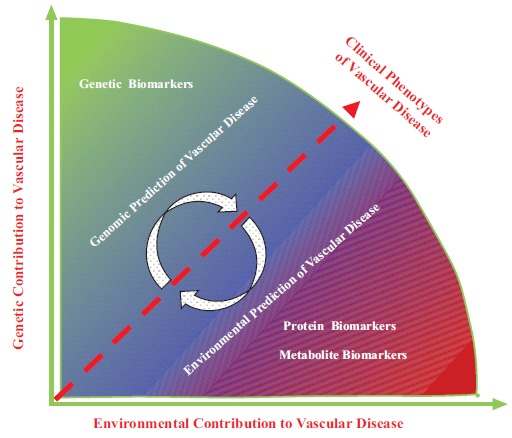
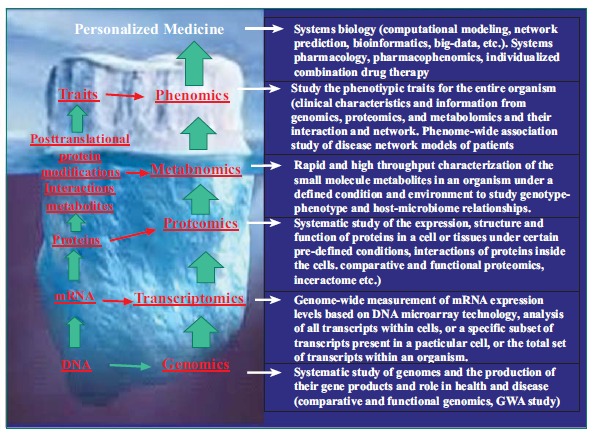
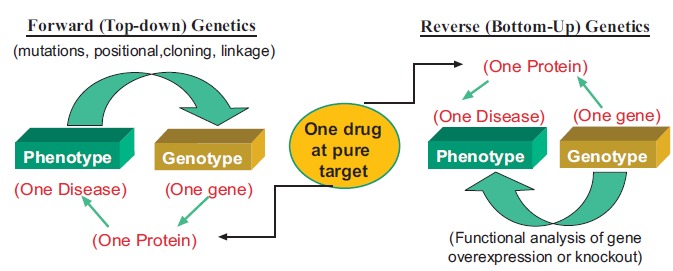
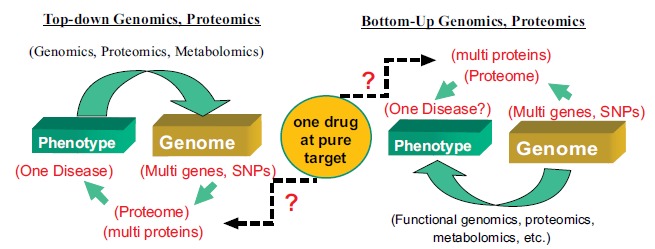
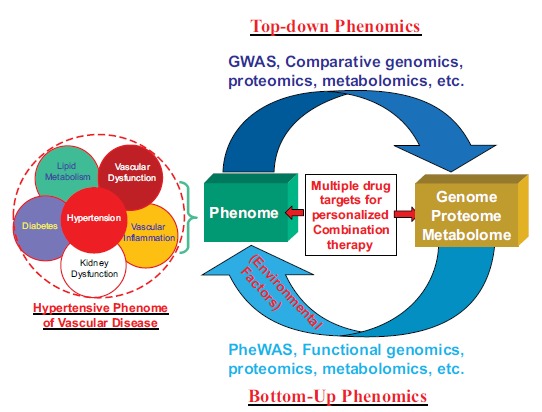
Vascular diseases are usually caused by multifactorial pathogeneses involving genetic and environmental factors. Our current understanding of vascular disease is, however, based on the focused genotype/phenotype studies driven by the "one-gene/one-phenotype" hypothesis. Drugs with "pure target" at individual molecules involved in the pathophysiological pathways are the mainstream of current clinical treatments and the basis of combination therapy of vascular diseases. Recently, the combination of genomics, proteomics, and metabolomics has unraveled the etiology and pathophysiology of vascular disease in a big-data fashion and also revealed unmatched relationships between the omic variability and the much narrower definition of various clinical phenotypes of vascular disease in individual patients. Here, we introduce the phenomics strategy that will change the conventional focused phenotype/genotype/genome study to a new systematic phenome/genome/proteome approach to the understanding of pathophysiology and combination therapy of vascular disease. A phenome is the sum total of an organism's phenotypic traits that signify the expression of genome and specific environmental influence. Phenomics is the study of phenome to quantitatively correlate complex traits to variability not only in genome, but also in transcriptome, proteome, metabolome, interactome, and environmental factors by exploring the systems biology that links the genomic and phenomic spaces. The application of phenomics and the phenome-wide associated study (PheWAS) will not only identify a systemically-integrated set of biomarkers for diagnosis and prognosis of vascular disease but also provide novel treatment targets for combination therapy and thus make a revolutionary paradigm shift in the clinical treatment of these devastating diseases.
血管疾病通常由涉及遗传和环境因素的多因素发病机制引起。然而,我们目前对血管疾病的理解是基于由“单基因/单表型”假说驱动的聚焦基因型/表型研究。针对参与病理生理途径的单个分子具有“纯靶点”的药物是当前临床治疗的主流以及血管疾病联合治疗的基础。最近,基因组学、蛋白质组学和代谢组学的结合以大数据方式揭示了血管疾病的病因和病理生理学,也揭示了组学变异性与个体患者血管疾病各种临床表型的更狭义定义之间不匹配的关系。在此,我们介绍表型组学策略,该策略将把传统的聚焦表型/基因型/基因组研究转变为一种新的系统表型组/基因组/蛋白质组方法,用于理解血管疾病的病理生理学和联合治疗。表型组是生物体表型特征的总和,这些特征表示基因组的表达和特定环境影响。表型组学是对表型组的研究,通过探索连接基因组和表型组空间的系统生物学,将复杂性状不仅与基因组中的变异性,还与转录组、蛋白质组、代谢组、相互作用组和环境因素中的变异性进行定量关联。表型组学和全表型组关联研究(PheWAS)的应用不仅将为血管疾病的诊断和预后鉴定一组系统整合的生物标志物,还将为联合治疗提供新的治疗靶点,从而在这些毁灭性疾病的临床治疗中实现革命性的范式转变。