Department of Environmental Health Sciences, Yale School of Public Health, Yale University, New Haven, CT, USA.
Collaboration for Research Integrity and Transparency (CRIT), Yale Law School, New Haven, CT, USA.
Hum Genomics. 2018 Jan 26;12(1):4. doi: 10.1186/s40246-018-0134-x.
Over the past 20 years, advances in genomic technology have enabled unparalleled access to the information contained within the human genome. However, the multiple genetic variants associated with various diseases typically account for only a small fraction of the disease risk. This may be due to the multifactorial nature of disease mechanisms, the strong impact of the environment, and the complexity of gene-environment interactions. Metabolomics is the quantification of small molecules produced by metabolic processes within a biological sample. Metabolomics datasets contain a wealth of information that reflect the disease state and are consequent to both genetic variation and environment. Thus, metabolomics is being widely adopted for epidemiologic research to identify disease risk traits. In this review, we discuss the evolution and challenges of metabolomics in epidemiologic research, particularly for assessing environmental exposures and providing insights into gene-environment interactions, and mechanism of biological impact.
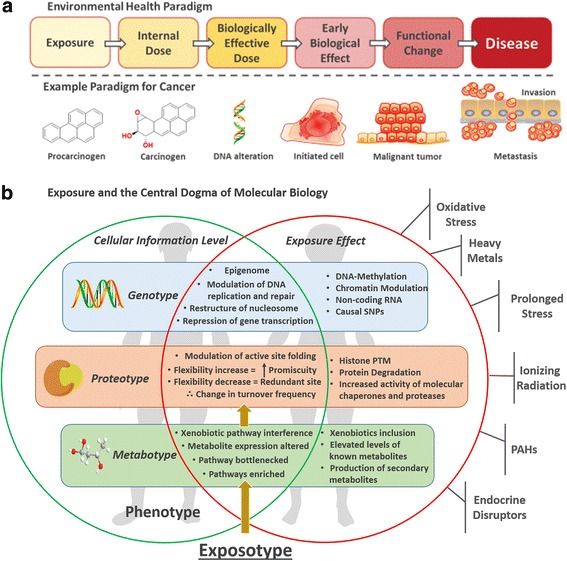
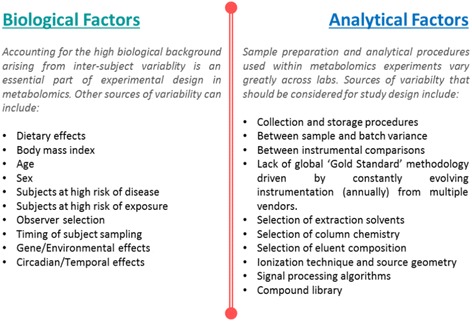
Metabolomics can be used to measure the complex global modulating effect that an exposure event has on an individual phenotype. Combining information derived from all levels of protein synthesis and subsequent enzymatic action on metabolite production can reveal the individual exposotype. We discuss some of the methodological and statistical challenges in dealing with this type of high-dimensional data, such as the impact of study design, analytical biases, and biological variance. We show examples of disease risk inference from metabolic traits using metabolome-wide association studies. We also evaluate how these studies may drive precision medicine approaches, and pharmacogenomics, which have up to now been inefficient. Finally, we discuss how to promote transparency and open science to improve reproducibility and credibility in metabolomics.
Comparison of exposotypes at the human population level may help understanding how environmental exposures affect biology at the systems level to determine cause, effect, and susceptibilities. Juxtaposition and integration of genomics and metabolomics information may offer additional insights. Clinical utility of this information for single individuals and populations has yet to be routinely demonstrated, but hopefully, recent advances to improve the robustness of large-scale metabolomics will facilitate clinical translation.
在过去的 20 年中,基因组技术的进步使人们能够以前所未有的方式获取人类基因组中包含的信息。然而,与各种疾病相关的多种遗传变异通常只占疾病风险的一小部分。这可能是由于疾病机制的多因素性质、环境的强烈影响以及基因-环境相互作用的复杂性。代谢组学是对生物样本中代谢过程产生的小分子进行定量的方法。代谢组学数据集包含丰富的信息,反映了疾病状态,并且受到遗传变异和环境的共同影响。因此,代谢组学被广泛应用于流行病学研究,以识别疾病风险特征。在这篇综述中,我们讨论了代谢组学在流行病学研究中的发展和挑战,特别是在评估环境暴露和提供对基因-环境相互作用和生物学影响机制的见解方面。
代谢组学可用于测量暴露事件对个体表型的复杂全局调节效应。结合来自所有蛋白质合成水平的信息以及随后对代谢物产生的酶促作用,可以揭示个体的暴露特征。我们讨论了处理这种高维数据类型时的一些方法学和统计学挑战,例如研究设计、分析偏差和生物变异性的影响。我们展示了使用代谢组关联研究从代谢特征推断疾病风险的示例。我们还评估了这些研究如何推动精准医学方法和药物基因组学的发展,迄今为止,这些方法和药物基因组学一直效率低下。最后,我们讨论了如何促进透明度和开放科学,以提高代谢组学的可重复性和可信度。
在人类群体水平上比较暴露特征可能有助于了解环境暴露如何影响系统水平的生物学,以确定病因、效应和易感性。基因组学和代谢组学信息的并列和整合可能会提供更多的见解。这种信息对个体和人群的临床应用尚未得到常规证明,但希望最近为提高大规模代谢组学的稳健性而进行的改进将促进临床转化。