Janowitz D, Schwahn C, Borchardt U, Wittfeld K, Schulz A, Barnow S, Biffar R, Hoffmann W, Habes M, Homuth G, Nauck M, Hegenscheid K, Lotze M, Völzke H, Freyberger H J, Debette S, Grabe H J
Department of Psychiatry and Psychotherapy, University Medicine Greifswald, Greifswald, Germany.
Department of Prosthetic Dentistry, Gerostomatology and Dental Materials, Center of Oral Health, University Medicine Greifswald, Greifswald, Germany.
Transl Psychiatry. 2014 Oct 14;4(10):e465. doi: 10.1038/tp.2014.102.
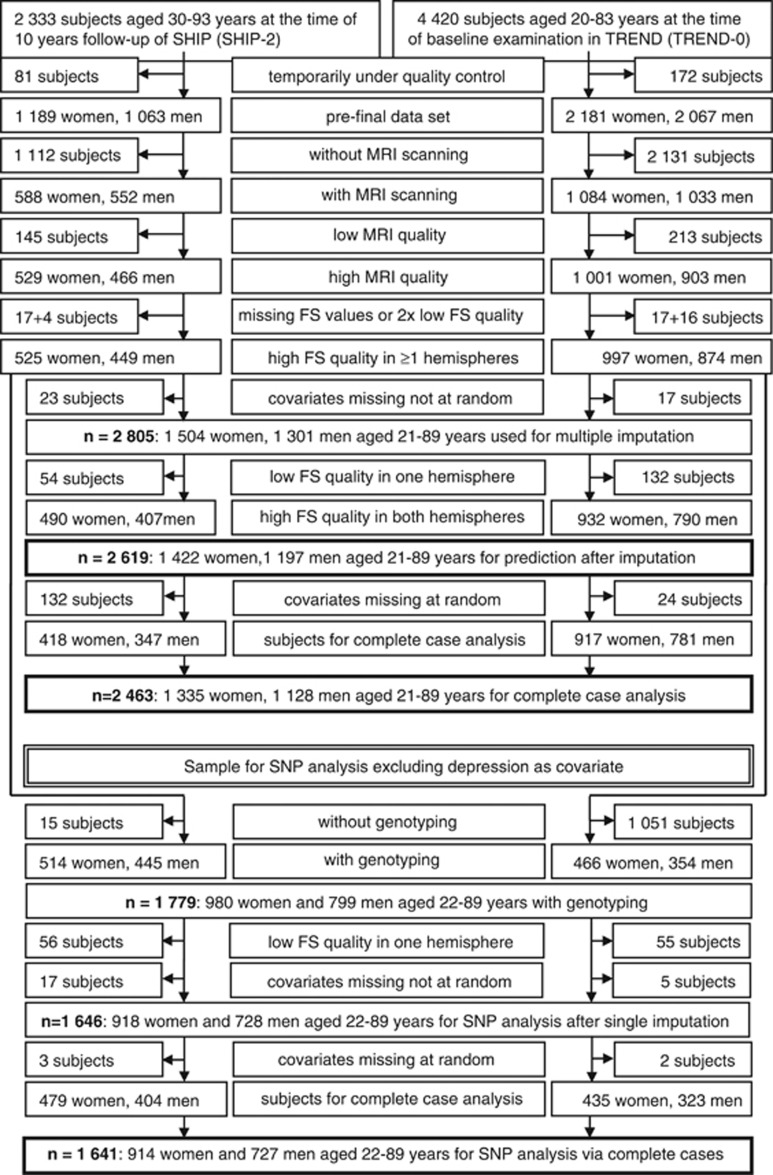
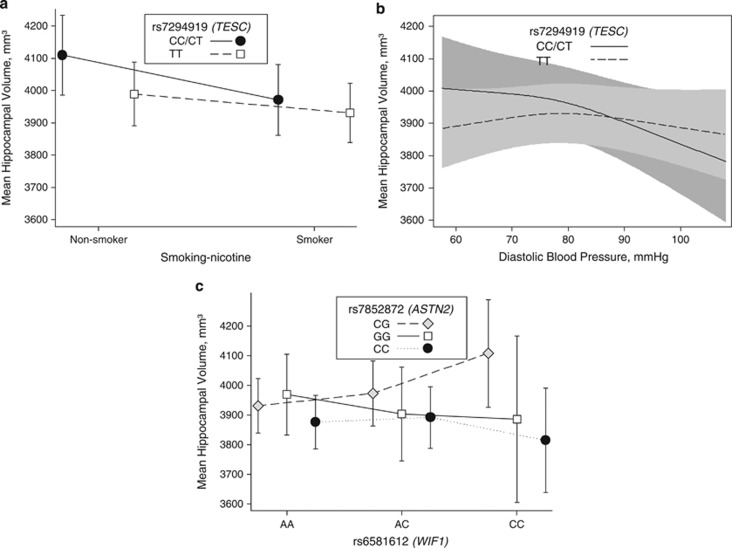
The hippocampus--crucial for memory formation, recall and mood regulation--is involved in the pathophysiology of dementia and depressive disorders. Recent genome-wide association studies (GWAS) have identified five genetic loci associated with hippocampal volume (HV). Previous studies have described psychosocial and clinical factors (for example, smoking, type 2 diabetes and hypertension) to have an impact on HV. However, the interplay between genetic, psychosocial and clinical factors on the HV remains unclear. Still, it is likely that genetic variants and clinical or psychosocial factors jointly act in modifying HV; it might be possible they even interact. Knowledge of these factors might help to quantify ones individual risk of or rather resilience against HV loss. We investigated subjects (N=2463; 55.7% women; mean age 53 years) from the Study of Health in Pomerania (SHIP-2; SHIP-TREND-0) who underwent whole-body magnetic resonance imaging (MRI) and genotyping. HVs were estimated with FreeSurfer. For optimal nonlinear model fitting, we used regression analyses with restricted cubic splines. Genetic variants and associated psychosocial or clinical factors were jointly assessed for potential two-way interactions. We observed associations between HV and gender (P<0.0001), age (P<0.0001), body height (P<0.0001), education (P=0.0053), smoking (P=0.0058), diastolic blood pressure (P=0.0211), rs7294919 (P=0.0065), rs17178006 (P=0.0002), rs6581612 (P=0.0036), rs6741949 (P=0.0112) and rs7852872 (P=0.0451). In addition, we found three significant interactions: between rs7294919 and smoking (P=0.0473), rs7294919 and diastolic blood pressure (P=0.0447) and between rs7852872 and rs6581612 (P=0.0114). We suggest that these factors might have a role in the individual susceptibility to hippocampus-associated disorders.
海马体——对记忆形成、回忆及情绪调节至关重要——参与了痴呆症和抑郁症的病理生理过程。近期的全基因组关联研究(GWAS)已确定了五个与海马体体积(HV)相关的基因位点。此前的研究表明,社会心理和临床因素(如吸烟、2型糖尿病和高血压)会对HV产生影响。然而,基因、社会心理和临床因素之间对HV的相互作用仍不清楚。尽管如此,基因变异与临床或社会心理因素可能共同作用于改变HV;它们甚至可能相互影响。了解这些因素可能有助于量化个体HV损失的风险或抵抗力。我们对来自波美拉尼亚健康研究(SHIP - 2;SHIP - TREND - 0)的受试者(N = 2463;55.7%为女性;平均年龄53岁)进行了研究,这些受试者接受了全身磁共振成像(MRI)和基因分型。使用FreeSurfer估算HV。为了进行最佳非线性模型拟合,我们使用了带有受限立方样条的回归分析。对基因变异以及相关的社会心理或临床因素进行联合评估,以确定潜在的双向相互作用。我们观察到HV与性别(P < 0.0001)、年龄(P < 0.0001)、身高(P < 0.0001)、教育程度(P = 0.0053)、吸烟(P = 0.0058)、舒张压(P = 0.0211)、rs7294919(P = 0.0065)、rs17178006(P = 0.0002)、rs6581612(P = 0.0036)、rs6741949(P = 0.0112)和rs7852872(P = 0.0451)之间存在关联。此外,我们发现了三个显著的相互作用:rs7294919与吸烟之间(P = 0.0473)、rs7294919与舒张压之间(P = 0.0447)以及rs7852872与rs6581612之间(P = 0.0114)。我们认为这些因素可能在个体对海马体相关疾病的易感性中起作用。