Saiepour M Hadi, Chakravarthy Sridhara, Min Rogier, Levelt Christiaan N
Department of Molecular Visual Plasticity, The Netherlands Institute for Neuroscience, Royal Netherlands Academy of Arts and Sciences (KNAW), Amsterdam 1105, The Netherlands.
Cereb Cortex. 2015 Oct;25(10):3713-22. doi: 10.1093/cercor/bhu245. Epub 2014 Oct 14.
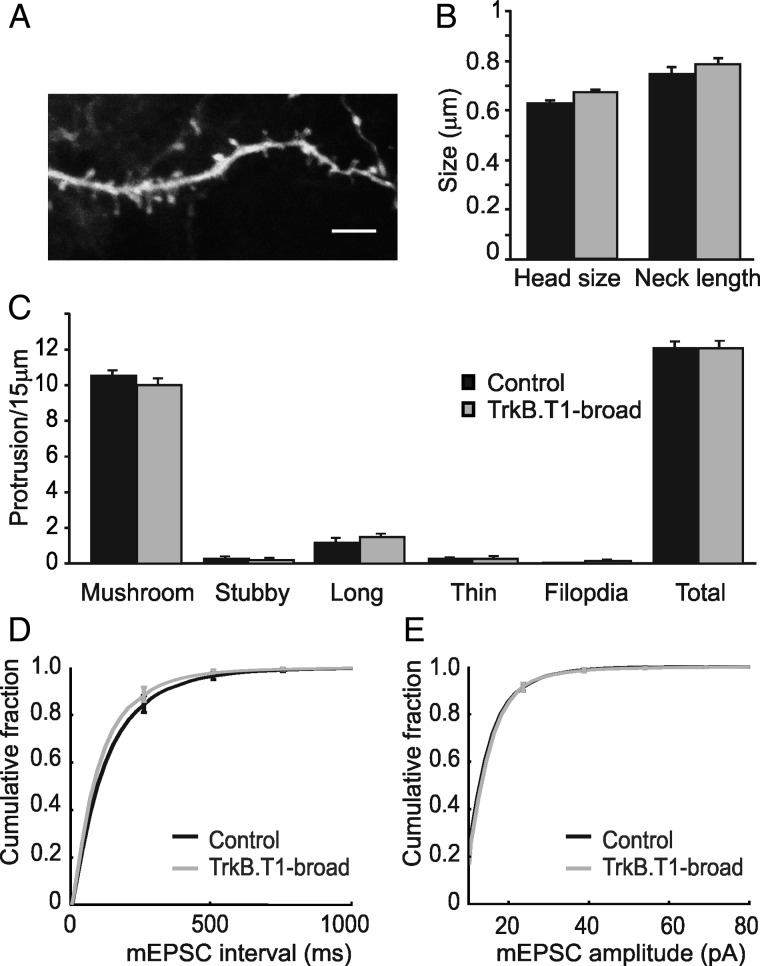
During cortical development, synaptic competition regulates the formation and adjustment of neuronal connectivity. It is unknown whether synaptic competition remains active in the adult brain and how inhibitory neurons participate in this process. Using morphological and electrophysiological measurements, we show that expressing a dominant-negative form of the TrkB receptor (TrkB.T1) in the majority of pyramidal neurons in the adult visual cortex does not affect excitatory synapse densities. This is in stark contrast to the previously reported loss of excitatory input which occurs if the exact same transgene is expressed in sparse neurons at the same age. This indicates that synaptic competition remains active in adulthood. Additionally, we show that interneurons not expressing the TrkB.T1 transgene may have a competitive advantage and obtain more excitatory synapses when most neighboring pyramidal neurons do express the transgene. Finally, we demonstrate that inhibitory synapses onto pyramidal neurons are reduced when TrkB signaling is interfered with in most pyramidal neurons but not when few pyramidal neurons have this deficit. This adjustment of inhibitory innervation is therefore not a cell-autonomous consequence of decreased TrkB signaling but more likely a homeostatic mechanism compensating for activity changes at the population level.
在皮层发育过程中,突触竞争调节神经元连接的形成和调整。目前尚不清楚突触竞争在成人大脑中是否仍然活跃,以及抑制性神经元如何参与这一过程。通过形态学和电生理学测量,我们发现,在成年视觉皮层的大多数锥体神经元中表达TrkB受体的显性负性形式(TrkB.T1)不会影响兴奋性突触密度。这与之前报道的情况形成鲜明对比,即在相同年龄的稀疏神经元中表达相同的转基因会导致兴奋性输入丧失。这表明突触竞争在成年期仍然活跃。此外,我们发现,当大多数相邻锥体神经元表达TrkB.T1转基因时,不表达该转基因的中间神经元可能具有竞争优势并获得更多兴奋性突触。最后,我们证明,当大多数锥体神经元的TrkB信号受到干扰时,锥体神经元上的抑制性突触会减少,但当少数锥体神经元有这种缺陷时则不会。因此,这种抑制性神经支配的调整不是TrkB信号减少的细胞自主结果,而更可能是一种在群体水平上补偿活动变化的稳态机制。