Texas Children's Cancer Center, 6701 Fannin Street #1400, Houston, TX 77030 USA ; Department of Pediatrics, Baylor College of Medicine, One Baylor Plaza, Houston, TX 77030 USA.
Dan L. Duncan Cancer Center, Baylor College of Medicine, One Baylor Plaza, Houston, TX 77030 USA.
Genome Med. 2014 Sep 17;6(9):69. doi: 10.1186/s13073-014-0069-3. eCollection 2014.
Effectively educating families about the risks and benefits of genomic tests such as whole exome sequencing (WES) offers numerous challenges, including the complexity of test results and potential loss of privacy. Research on best practices for obtaining informed consent (IC) in a variety of clinical settings is needed. The BASIC3 study of clinical tumor and germline WES in an ethnically diverse cohort of newly diagnosed pediatric cancer patients offers the opportunity to study the IC process in the setting of critical illness. We report on our experience for the first 100 families enrolled, including study participation rates, reasons for declining enrollment, assessment of clinical and demographic factors that might impact study enrollment, and preferences of parents for participation in optional genomics study procedures.
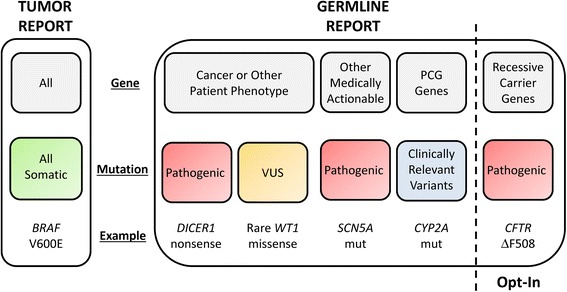
A specifically trained IC team offered study enrollment to parents of eligible children for procedures including clinical tumor and germline WES with results deposited in the medical record and disclosure of both diagnostic and incidental results to the family. Optional study procedures were also offered, such as receiving recessive carrier status and deposition of data into research databases. Stated reasons for declining participation were recorded. Clinical and demographic data were collected and comparisons made between enrolled and non-enrolled patients.
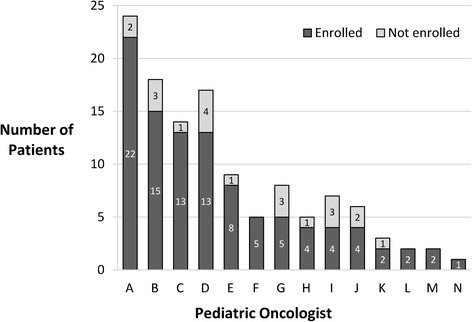
Over 15 months, 100 of 121 (83%) eligible families elected to enroll in the study. No significant differences in enrollment were detected based on factors such as race, ethnicity, use of Spanish interpreters and Spanish consent forms, and tumor features (central nervous system versus non-central nervous system, availability of tumor for WES). The most common reason provided for declining enrollment (10% of families) was being overwhelmed by the new cancer diagnosis. Risks specific to clinical genomics, such as privacy concerns, were less commonly reported (5.5%). More than 85% of parents consented to each of the optional study procedures.
An IC process was developed that utilizes a specialized IC team, active communication with the oncology team, and an emphasis on scheduling flexibility. Most parents were willing to participate in a clinical germline and tumor WES study as well as optional procedures such as genomic data sharing independent of race, ethnicity or language spoken.
有效地向家庭传授基因组测试(如全外显子组测序[WES])的风险和益处带来了诸多挑战,包括测试结果的复杂性和潜在的隐私泄露。需要在各种临床环境下研究获得知情同意(IC)的最佳实践。在一个新诊断的儿科癌症患者的种族多样化队列中进行临床肿瘤和种系 WES 的 BASIC3 研究为研究在重病情况下的 IC 过程提供了机会。我们报告了前 100 个入组家庭的经验,包括研究参与率、拒绝入组的原因、评估可能影响研究入组的临床和人口统计学因素,以及父母对参与可选基因组学研究程序的偏好。
一个专门培训的 IC 团队向符合条件的儿童的父母提供研究入组机会,包括临床肿瘤和种系 WES,结果存入病历,并向家庭披露诊断和偶然结果。还提供了可选的研究程序,例如接受隐性携带者状态并将数据存入研究数据库。记录了拒绝参与的理由。收集了临床和人口统计学数据,并比较了入组和未入组患者之间的差异。
在 15 个月的时间里,121 个符合条件的家庭中有 100 个(83%)选择入组研究。在入组方面没有发现种族、族裔、使用西班牙语口译员和西班牙语同意书以及肿瘤特征(中枢神经系统与非中枢神经系统、肿瘤是否可用于 WES)等因素的显著差异。拒绝入组的最常见原因(占家庭的 10%)是被新的癌症诊断所压垮。与临床基因组学相关的风险,如隐私问题,较少被报告(5.5%)。超过 85%的父母同意了每项可选的研究程序。
开发了一种 IC 流程,该流程利用专门的 IC 团队、与肿瘤团队的积极沟通以及强调日程安排的灵活性。大多数父母愿意参与临床种系和肿瘤 WES 研究以及可选程序,如独立于种族、族裔或语言的基因组数据共享。