Clinical Research Division, D3-100 Fred Hutchinson Cancer Research Center, 1100 Fairview Ave, Seattle, WA 98109 USA ; Department of Medicine, University of Washington, Seattle, WA USA.
Clinical Research Division, D3-100 Fred Hutchinson Cancer Research Center, 1100 Fairview Ave, Seattle, WA 98109 USA.
J Immunother Cancer. 2014 Oct 14;2(1):36. doi: 10.1186/s40425-014-0036-y. eCollection 2014.
Adoptive T cell therapy represents an attractive modality for the treatment of patients with cancer. Peripheral blood mononuclear cells have been used as a source of antigen specific T cells but the very low frequency of T cells recognizing commonly expressed antigens such as NY-ESO-1 limit the applicability of this approach to other solid tumors. To overcome this, we tested a strategy combining IL-21 modulation during in vitro stimulation with first-in-class use of tetramer-guided cell sorting to generate NY-ESO-1 specific cytotoxic T lymphocytes (CTL).
CTL generation was evaluated in 6 patients with NY-ESO-1 positive sarcomas, under clinical manufacturing conditions and characterized for phenotypic and functional properties.
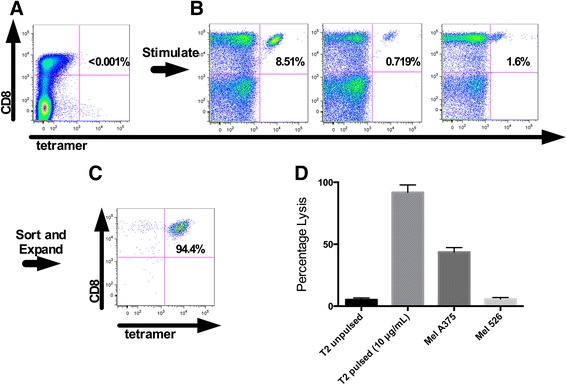
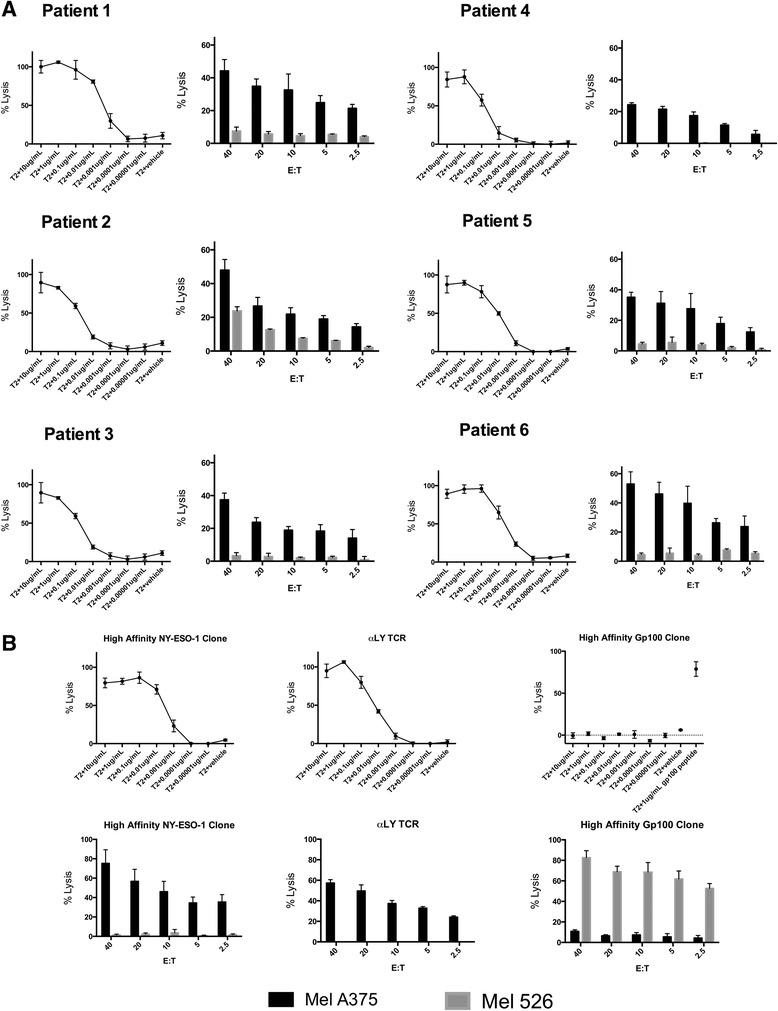
Following in vitro stimulation, T cells stained with NY-ESO-1 tetramer were enriched from frequencies as low as 0.4% to >90% after single pass through a clinical grade sorter. NY-ESO-1 specific T cells were generated from all 6 patients. The final products expanded on average 1200-fold to a total of 36 billion cells, were oligoclonal and contained 67-97% CD8(+), tetramer(+) T cells with a memory phenotype that recognized endogenous NY-ESO-1.
This study represents the first series using tetramer-guided cell sorting to generate T cells for adoptive therapy. This approach, when used to target more broadly expressed tumor antigens such as WT-1 and additional Cancer-Testis antigens will enhance the scope and feasibility of adoptive T cell therapy.
过继性 T 细胞疗法是治疗癌症患者的一种有吸引力的方法。外周血单核细胞已被用作抗原特异性 T 细胞的来源,但识别常见表达抗原(如 NY-ESO-1)的 T 细胞频率非常低,限制了这种方法在其他实体瘤中的应用。为了克服这一限制,我们测试了一种策略,即在体外刺激过程中结合 IL-21 调节,首次使用四聚体引导的细胞分选来产生 NY-ESO-1 特异性细胞毒性 T 淋巴细胞(CTL)。
在临床生产条件下,评估了 6 名 NY-ESO-1 阳性肉瘤患者的 CTL 生成情况,并对其表型和功能特性进行了表征。
在体外刺激后,通过单次通过临床级分选器,可从低至 0.4%的频率富集到 >90%NY-ESO-1 四聚体染色的 T 细胞。从所有 6 名患者中均可产生 NY-ESO-1 特异性 T 细胞。最终产品平均扩增 1200 倍,达到 360 亿个细胞,呈寡克隆状态,含有 67-97%的 CD8(+)、四聚体(+)T 细胞,具有记忆表型,可识别内源性 NY-ESO-1。
本研究代表了首次使用四聚体引导的细胞分选来产生用于过继性治疗的 T 细胞的系列研究。当用于靶向更广泛表达的肿瘤抗原(如 WT-1 和其他癌症-睾丸抗原)时,这种方法将增强过继性 T 细胞治疗的范围和可行性。