Santos Geanne K N, Dutra Kamilla A, Lira Camila S, Lima Bheatriz N, Napoleão Thiago H, Paiva Patrícia M G, Maranhão Claudia A, Brandão Sofia S F, Navarro Daniela M A F
Laboratório de Ecologia Química, Departamento de Química Fundamental, Universidade Federal de Pernambuco, 50670-901 Recife, PE, Brazil.
Laboratório de Glicoproteínas, Departamento de Bioquímica, Universidade Federal de Pernambuco, 50670-420 Recife, PE, Brazil.
Molecules. 2014 Oct 14;19(10):16573-87. doi: 10.3390/molecules191016573.
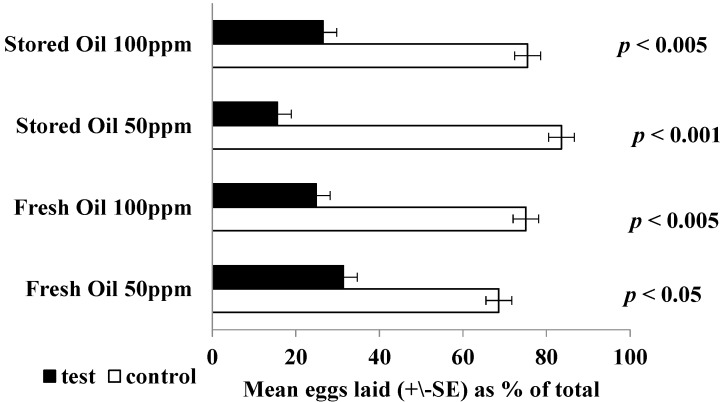
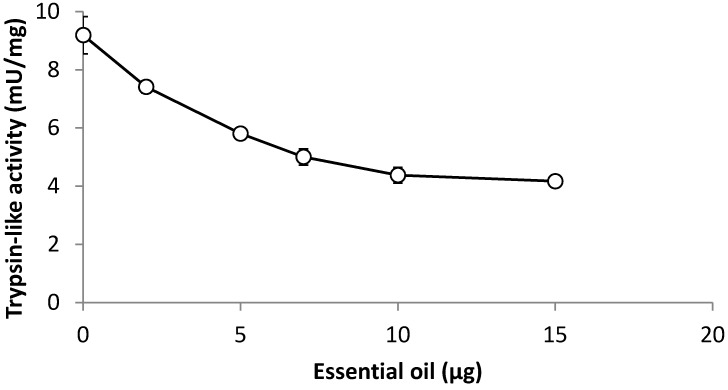
Although numerous reports are available concerning the larvicidal potential of essential oils, very few investigations have focused on their mechanisms of action. In the present study, we have investigated the chemical composition of the leaf oil of Croton rhamnifolioides during storage and its effects on oviposition and survival of larvae of the dengue fever mosquito Aedes aegypti. In addition, we have established a possible mechanism of action for the larvicidal activity of the essential oil. GC-MS analyses revealed marked differences in the composition of oil that had been freshly isolated and that of a sample that had been stored in a sealed amber-glass vial under refrigeration for three years. However, both fresh and stored oil exhibited substantial larvicidal activities with LC50 values of 122.35 and 89.03 ppm, respectively, and oviposition deterrent effects against gravid females at concentrations of 50 and 100 µg·mL-1. These results demonstrate that the larvicidal effect of the essential oil was unchanged during three years of storage even though its chemical composition altered. Hence, the essential oil could be used in the preparation of commercial products. In addition, we observed that the trypsin-like activity of mosquito larvae was inhibited in vitro by the essential oil of C. rhamnifolioides, suggesting that the larvicidal effect may be associated with inhibition of this enzyme.
尽管已有大量关于香精油杀幼虫潜力的报告,但很少有研究关注其作用机制。在本研究中,我们调查了鼠李叶巴豆叶油在储存期间的化学成分及其对登革热媒介埃及伊蚊幼虫产卵和存活的影响。此外,我们还确定了该香精油杀幼虫活性的一种可能作用机制。气相色谱-质谱分析显示,新鲜分离的油和在密封琥珀色玻璃瓶中冷藏三年的样品在成分上存在显著差异。然而,新鲜油和储存油均表现出显著的杀幼虫活性,其半数致死浓度(LC50)分别为122.35 ppm和89.03 ppm,并且在浓度为50和100 µg·mL-1时对妊娠雌蚊具有产卵驱避作用。这些结果表明,尽管香精油的化学成分发生了变化,但其杀幼虫效果在三年储存期间并未改变。因此,该香精油可用于制备商业产品。此外,我们观察到,鼠李叶巴豆香精油在体外抑制了蚊虫幼虫的类胰蛋白酶活性,这表明杀幼虫作用可能与该酶的抑制有关。