Chou I-Jun, Tench Christopher R, Gowland Penny, Jaspan Tim, Dineen Rob A, Evangelou Nikos, Abdel-Fahim Rasha, Whitehouse William P, Constantinescu Cris S
Division of Clinical Neuroscience, School of Medicine, University of Nottingham, Nottingham, UK.
Division of Child Health, Obstetrics and Gynaecology, School of Medicine, University of Nottingham, Nottingham, UK.
BMJ Open. 2014 Oct 15;4(10):e006094. doi: 10.1136/bmjopen-2014-006094.
To explore the possible discomfort perceived by children participating in 7 T MRI research, and the age range in which children are most likely to tolerate it well.
A cross-sectional survey using age-appropriate questionnaires containing six measures of subjective discomfort (general discomfort, dizziness, noisiness, claustrophobia and feeling of cold or warm).
For children, 3 T clinical scanner in a tertiary referral teaching hospital; for adults, 3 and 7 T scanner in a university research building.
Non-sedated children and young people under 18 years of age who underwent 3 T clinical MRI for brain or musculoskeletal scans and adult volunteers attending 7 T with or without 3 T for brain scans.
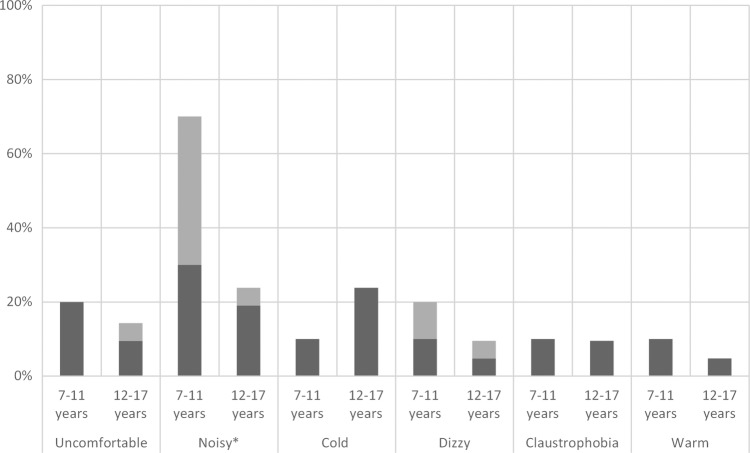
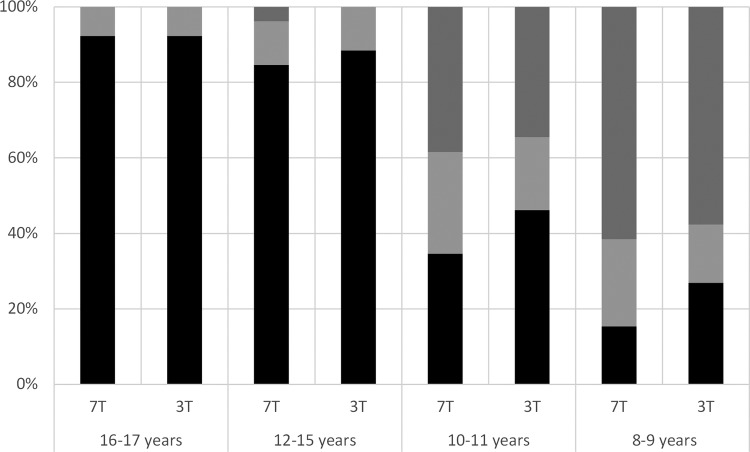
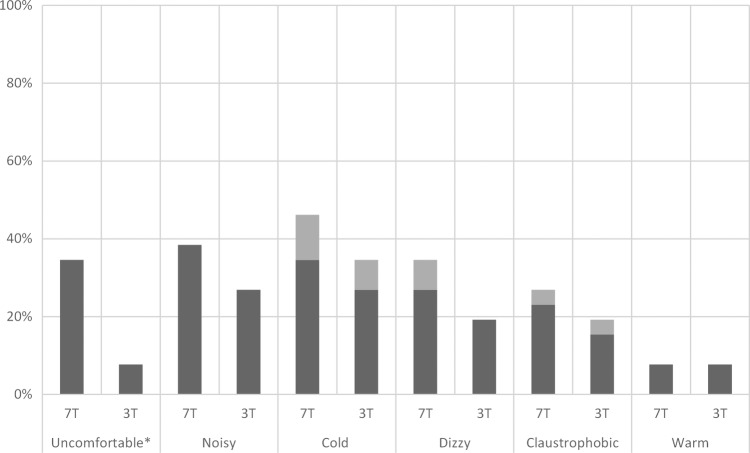
83% (89/107) of involved individuals returned questionnaires. The most common discomfort among 31 children receiving 3 T MRI was noisiness (39%), followed by cold (19%), general discomfort (16%), dizziness (13%) and claustrophobia (10%). The noise was reported more frequently in children younger than 12 years than those older (p=0.021). The most common discomfort for 58 adults receiving 7 T MRI was noisiness (43%). In adults, there was a higher frequency of general discomfort during 7 than 3 T scans (p=0.031). More than 85% of adult respondents thought children aged 12-17 years would tolerate 7 T scans well, but only 35% and 15% thought children aged 10-11 and 8-9 years, respectively, would.
Noisiness was the most common discomfort across all ages in 3 and 7 T scanners. Although general discomfort was more common during 7 than 3 T scans in adults, most adults thought children aged 12 years or more would tolerate 7 T MRI well. Cautious enrolment of children in 7 T MRI study is warranted, but until there is more evidence of how well those aged 12 years or more tolerate 7 T MRI, we would caution against enrolling younger children.
探讨参与7T磁共振成像(MRI)研究的儿童可能感受到的不适,以及儿童最有可能耐受良好的年龄范围。
采用适合不同年龄段的问卷进行横断面调查,问卷包含六项主观不适指标(总体不适、头晕、噪音、幽闭恐惧症以及冷热感觉)。
儿童在一家三级转诊教学医院的3T临床扫描仪上进行检查;成人在一所大学研究楼的3T和7T扫描仪上进行检查。
18岁以下未使用镇静剂的儿童和青少年,他们因脑部或肌肉骨骼扫描接受3T临床MRI检查,以及接受7T(有或没有接受过3T)脑部扫描的成人志愿者。
83%(89/107)的参与个体返回了问卷。在接受3T MRI检查的31名儿童中,最常见的不适是噪音(39%),其次是寒冷(19%)、总体不适(16%)、头晕(13%)和幽闭恐惧症(10%)。12岁以下儿童报告噪音的频率高于12岁及以上儿童(p=0.021)。在接受7T MRI检查的58名成人中,最常见的不适是噪音(43%)。在成人中,7T扫描时总体不适的频率高于3T扫描(p=0.031)。超过85%的成年受访者认为12至17岁的儿童能够很好地耐受7T扫描,但只有35%和15%的受访者分别认为10至11岁和8至9岁的儿童能够耐受。
在3T和7T扫描仪中,噪音是各年龄段最常见的不适。虽然成人中7T扫描时总体不适比3T扫描更常见,但大多数成人认为12岁及以上的儿童能够很好地耐受7T MRI检查。在7T MRI研究中谨慎招募儿童是有必要的,但在有更多证据表明12岁及以上儿童耐受7T MRI的情况如何之前,我们建议谨慎招募年龄较小的儿童。