Department of Infectious Diseases, Sainte Musse, General Hospital, 54 rue Henri Sainte Claire Deville, 83100 Toulon, France.
Department of Virology, General Hospital, Toulon, France.
AIDS Res Ther. 2014 Oct 7;11(1):33. doi: 10.1186/1742-6405-11-33. eCollection 2014.
Ongoing HIV-1 replication in lymphoid cells is one explanation of the persistence of HIV-1 reservoirs despite highly active antiretroviral therapy (cART). We tested the potential of cART intensification by Maraviroc plus Raltegravir to decrease proviral HIV-1 DNA levels in lymphoid cells during a randomized trial.
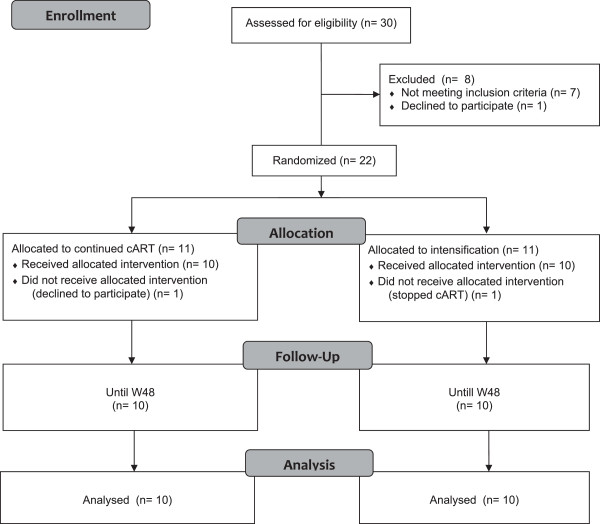
We randomly assigned for 48 weeks 22 patients to continue their current first line regimen of Truvada® plus Kaletra® or intensify it with Maraviroc and Raltegravir. The primary objective was to obtain a 50% decrease in proviral HIV-1 DNA levels in lymphoid cells with intensification. Blood samples were drawn at W-2, W0, W2, W4, W12, W24 and W48. Plasma viremia, cellular proviral DNA and cellular RNA, 2-LTR circles and lymphocytes subsets were assayed using validated methods. Patients in the intensified group underwent a gut biopsy at baseline and W48 to measure proviral DNA levels. Statistical analysis used parametric and non-parametric tests.
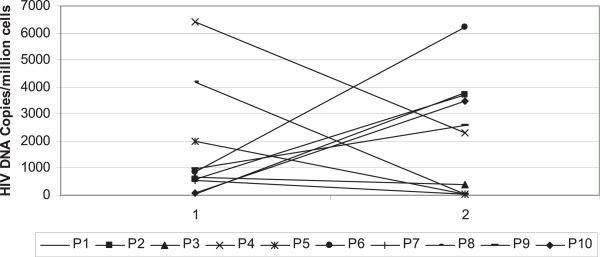
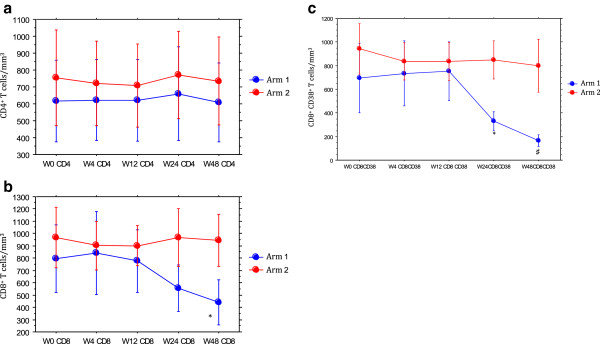
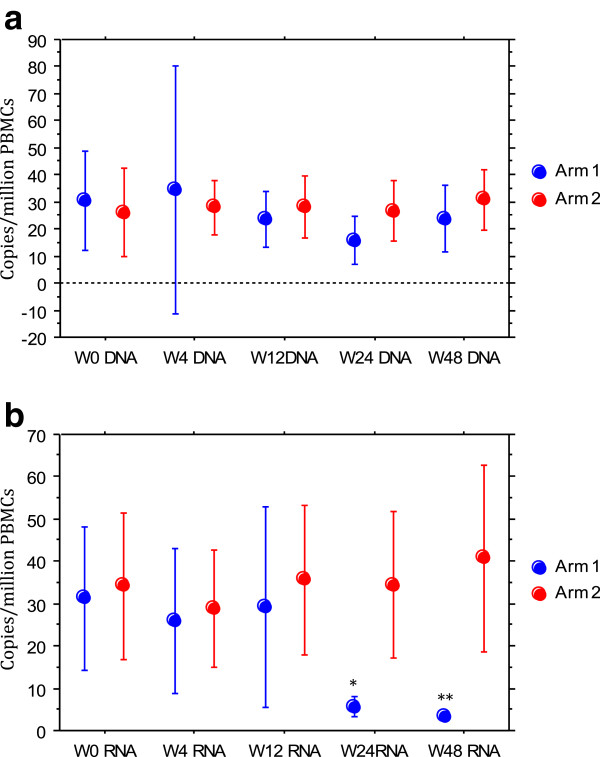
Ten patients in each arm completed the trial. The 2 populations were comparable at baseline. No change in the reservoir size was observed in the intensified arm compared to the control arm measured in peripheral blood mononuclear cells (PBMCs). No change in the reservoir size was observed in gut proviral DNA in the intensified arm. In this group, no increase in 2-LTR circles was observed as early as 2 weeks after intensification and no change was found in residual plasma RNA levels measured by the single copy assay. However, a decrease in CD8(+) T cells activation was observed at 24 and 48 weeks, as well as in PBMCs HIV-1 RNA levels.
We conclude that the intensification of a Protease Inhibitor regimen with Maraviroc and Raltegravir does not impact the blood proviral DNA reservoir of HIV but can decrease the cell-associated HIV RNA, the CD8 activation and has a possible impact on rectal proviral HIV DNA in some patients.
ClinicalTrials.gov identifier number NCT00935480.
尽管高效抗逆转录病毒疗法(cART)的应用,HIV-1 仍在淋巴样细胞中持续复制,这可以解释 HIV-1 储存库的持续存在。我们通过一项随机试验检测了 Maraviroc 联合 Raltegravir 强化 cART 以降低淋巴样细胞中前病毒 HIV-1 DNA 水平的潜力。
我们将 22 例患者随机分为 48 周组,继续使用替诺福韦/恩曲他滨加洛福韦或强化 Maraviroc 和 Raltegravir。主要目的是通过强化治疗使淋巴样细胞中的前病毒 HIV-1 DNA 水平降低 50%。在 W-2、W0、W2、W4、W12、W24 和 W48 时采血。采用经证实的方法检测血浆病毒载量、细胞前病毒 DNA 和 RNA、2-LTR 环和淋巴细胞亚群。基线和 W48 时对强化组的患者进行肠道活检,以测量前病毒 DNA 水平。统计分析采用参数和非参数检验。
每组各有 10 例患者完成了试验。两组患者在基线时具有可比性。强化组与对照组相比,外周血单核细胞(PBMC)中的储存库大小无变化。强化组肠道前病毒 DNA 无变化。在此组中,强化后 2 周即可观察到 2-LTR 环无增加,且用单拷贝法测量的残留血浆 RNA 水平无变化。然而,在 24 和 48 周时观察到 CD8+T 细胞活化降低,以及 PBMCs 中的 HIV-1 RNA 水平降低。
我们得出结论,Maraviroc 和 Raltegravir 强化蛋白酶抑制剂方案不会影响 HIV 的血液前病毒 DNA 储存库,但可以降低细胞相关 HIV RNA、CD8 激活,并可能对某些患者的直肠前病毒 HIV DNA 产生影响。
ClinicalTrials.gov 标识符:NCT00935480。