Neurocomputation and Neuroimaging Unit, Department of Education and Psychology, Freie Universität Berlin Berlin, Germany.
Front Psychol. 2014 Sep 29;5:1102. doi: 10.3389/fpsyg.2014.01102. eCollection 2014.
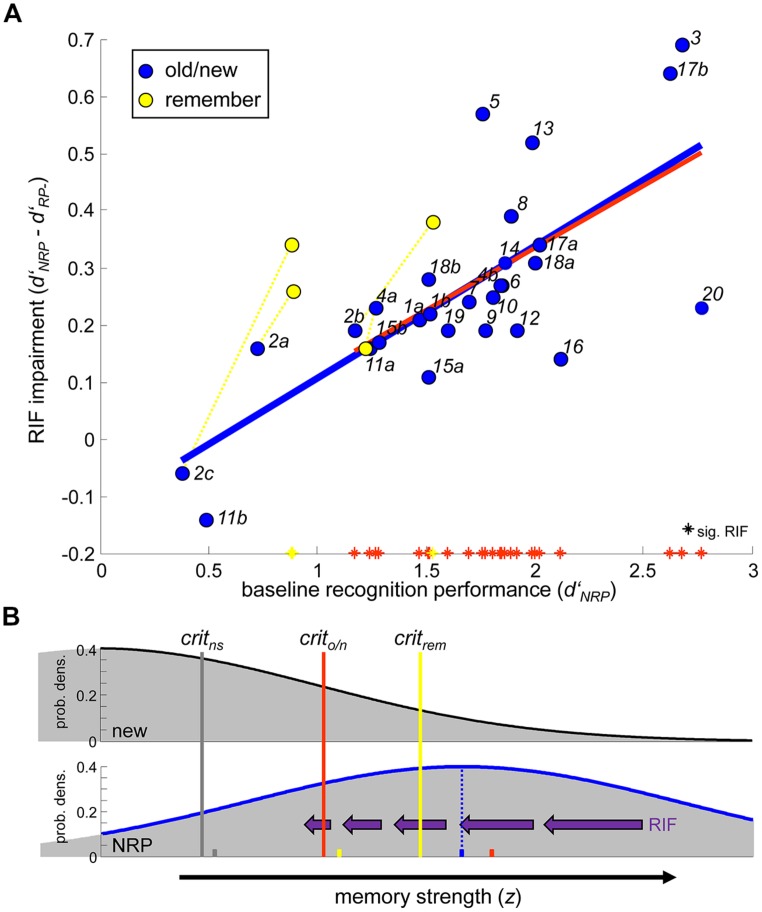
Retrieval practice of previously studied material can impair subsequent memory for related unpracticed material. An emerging view holds that such retrieval-induced forgetting (RIF) may affect episodic recollection, but not the context-free familiarity of the affected items. Here, a survey of accruing recent findings of RIF in recognition tests shows that the impairment of unpracticed material depends vitally on baseline memory strength. Therein, the absence of RIF under specific conditions, previously taken as evidence for the immunity of familiarity, can be predicted on grounds of exceedingly low baseline levels. Similarly, differential RIF effects on the parameters of dual-process recognition models can be explained by baseline differences, suggesting that RIF might impair any sub-process that substantially contributes to overall recognition accuracy. By contrast, the strengthening of practiced material appears independent of baseline levels and does not predict the magnitude of RIF, in accordance with an inhibitory causation of the forgetting. In summary, the inventory presents RIF in recognition as a subtle proportional impairment, future illumination of which may demand increased attention to baseline memory levels.
检索先前学习过的材料会损害随后对未练习过的相关材料的记忆。一种新出现的观点认为,这种检索诱发的遗忘(RIF)可能会影响情节回忆,但不会影响受影响项目的无上下文熟悉度。在这里,对最近在识别测试中 RIF 积累的发现进行的调查表明,未练习材料的损害在很大程度上取决于基线记忆强度。在某些特定条件下,以前被认为是熟悉度免疫的情况下没有 RIF,可以根据极低的基线水平来预测。同样,双加工识别模型参数的差异 RIF 效应可以用基线差异来解释,这表明 RIF 可能会损害对整体识别准确性有重大贡献的任何子过程。相比之下,练习材料的强化似乎独立于基线水平,并且不会预测 RIF 的幅度,这与遗忘的抑制性因果关系一致。总之,该清单将识别中的 RIF 呈现为一种微妙的比例损伤,未来的研究可能需要更加关注基线记忆水平。