Seong Youngmo, Lim Do-Hwan, Kim Augustine, Seo Jae Hong, Lee Young Sik, Song Hoseok, Kwon Young-Soo
Department of Bioscience & Biotechnology, Sejong University, Seoul 143-747, Korea.
College of Life Sciences and Biotechnology, Korea University, Seoul 136-713, Korea.
Nucleic Acids Res. 2014 Nov 10;42(20):12806-21. doi: 10.1093/nar/gku957. Epub 2014 Oct 17.
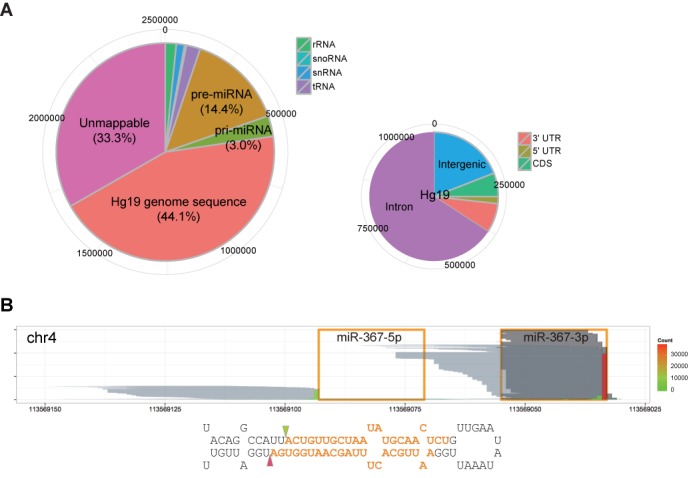
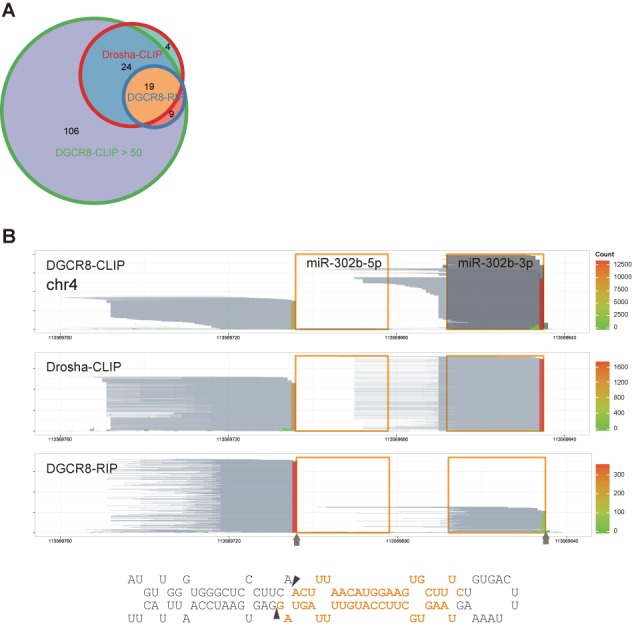
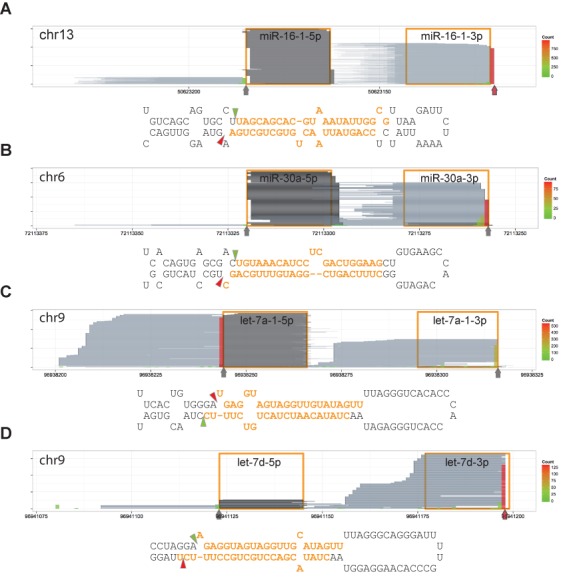
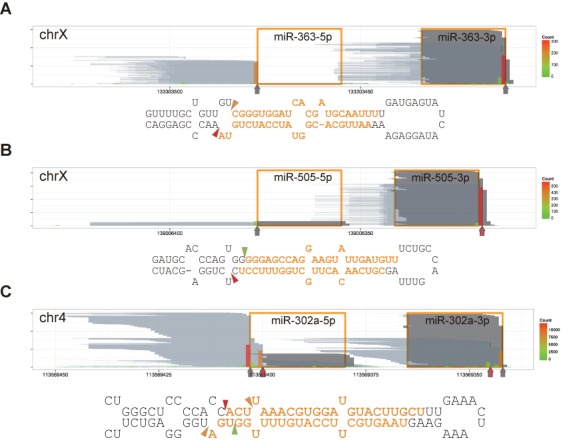
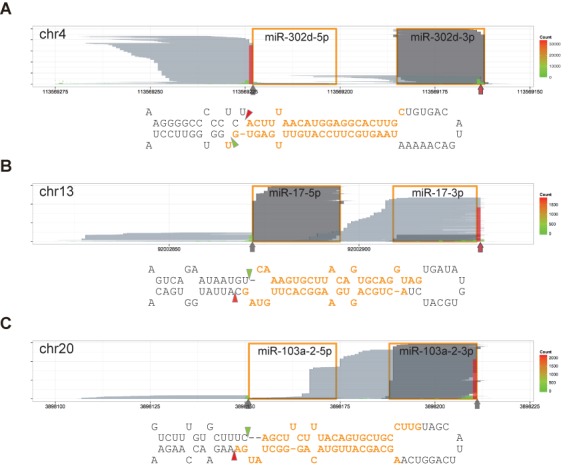
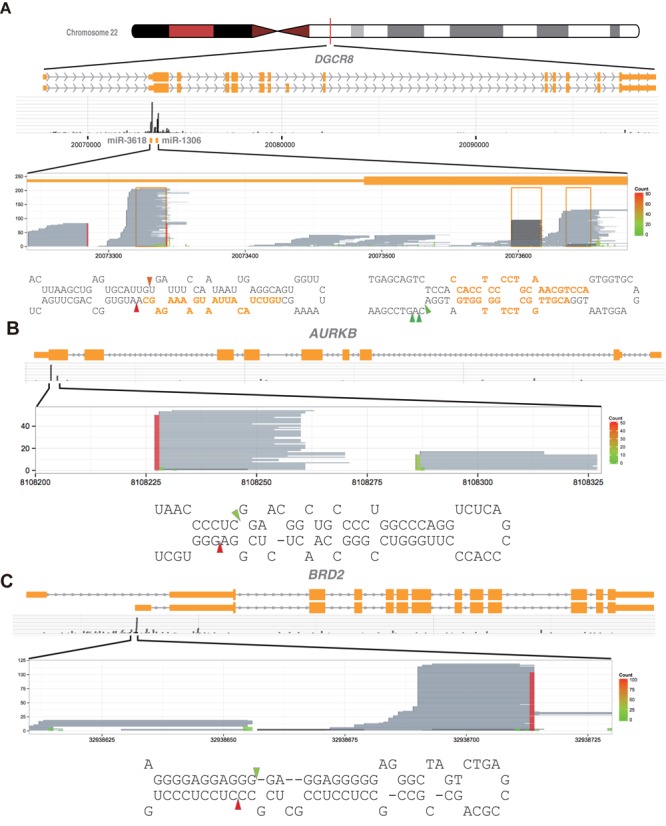
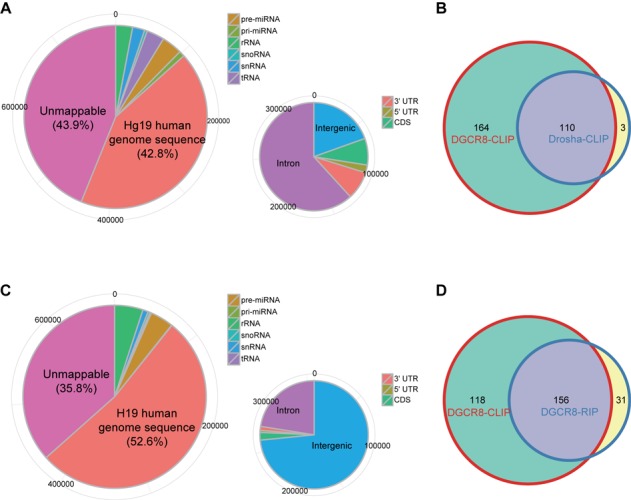
The Microprocessor plays an essential role in canonical miRNA biogenesis by facilitating cleavage of stem-loop structures in primary transcripts to yield pre-miRNAs. Although miRNA biogenesis has been extensively studied through biochemical and molecular genetic approaches, it has yet to be addressed to what extent the current miRNA biogenesis models hold true in intact cells. To address the issues of in vivo recognition and cleavage by the Microprocessor, we investigate RNAs that are associated with DGCR8 and Drosha by using immunoprecipitation coupled with next-generation sequencing. Here, we present global protein-RNA interactions with unprecedented sensitivity and specificity. Our data indicate that precursors of canonical miRNAs and miRNA-like hairpins are the major substrates of the Microprocessor. As a result of specific enrichment of nascent cleavage products, we are able to pinpoint the Microprocessor-mediated cleavage sites per se at single-nucleotide resolution. Unexpectedly, a 2-nt 3' overhang invariably exists at the ends of cleaved bases instead of nascent pre-miRNAs. Besides canonical miRNA precursors, we find that two novel miRNA-like structures embedded in mRNAs are cleaved to yield pre-miRNA-like hairpins, uncoupled from miRNA maturation. Our data provide a framework for in vivo Microprocessor-mediated cleavage and a foundation for experimental and computational studies on miRNA biogenesis in living cells.
微处理器通过促进初级转录本中茎环结构的切割以产生前体miRNA,在经典miRNA生物合成中发挥着至关重要的作用。尽管通过生化和分子遗传学方法对miRNA生物合成进行了广泛研究,但目前的miRNA生物合成模型在完整细胞中在多大程度上成立尚未得到解决。为了解决微处理器在体内的识别和切割问题,我们通过使用免疫沉淀结合下一代测序来研究与DGCR8和Drosha相关的RNA。在此,我们以前所未有的灵敏度和特异性展示了全局蛋白质-RNA相互作用。我们的数据表明,经典miRNA和miRNA样发夹的前体是微处理器的主要底物。由于新生切割产物的特异性富集,我们能够以单核苷酸分辨率精确确定微处理器介导的切割位点本身。出乎意料的是,切割碱基的末端总是存在一个2个核苷酸的3'突出端,而不是新生的前体miRNA。除了经典miRNA前体,我们发现嵌入mRNA中的两个新型miRNA样结构被切割以产生类似前体miRNA的发夹,与miRNA成熟无关。我们的数据为体内微处理器介导的切割提供了一个框架,并为活细胞中miRNA生物合成的实验和计算研究奠定了基础。