Institute for Cellular and Molecular Biology, Department of Molecular Biosciences, The University of Texas at Austin, Austin, Texas 78712-0162, USA.
RNA. 2014 Jul;20(7):1068-77. doi: 10.1261/rna.044537.114. Epub 2014 May 22.
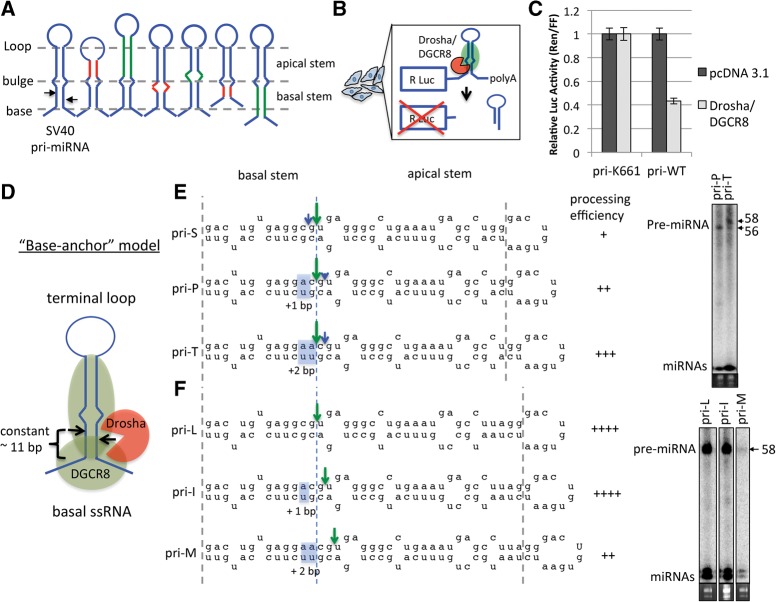
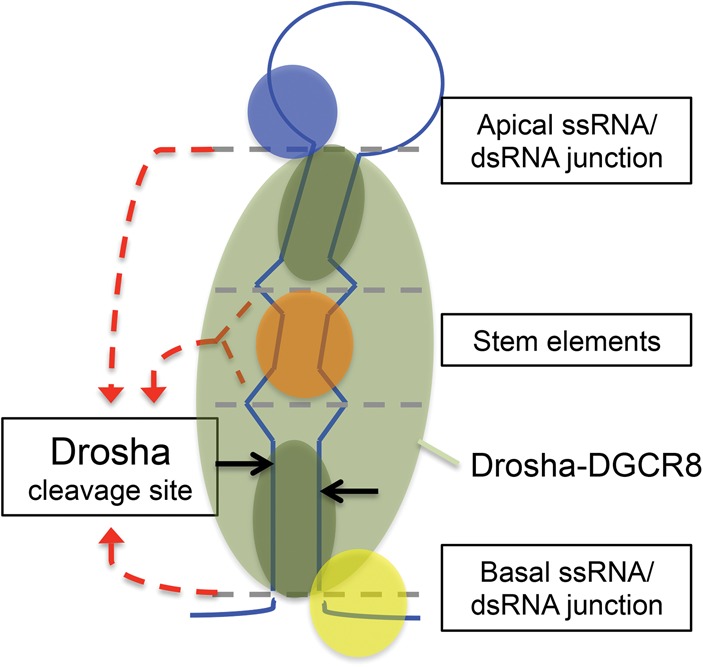
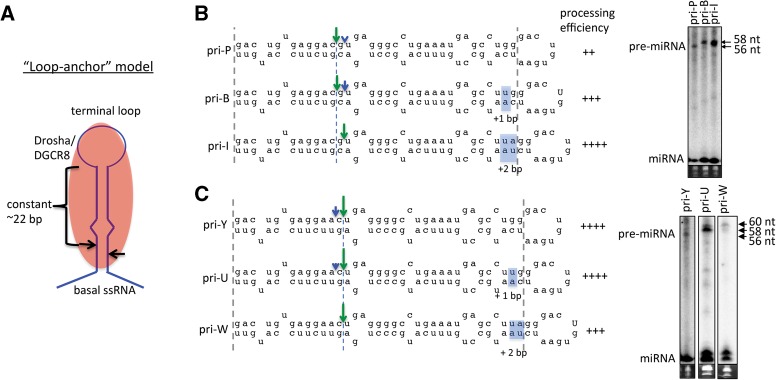
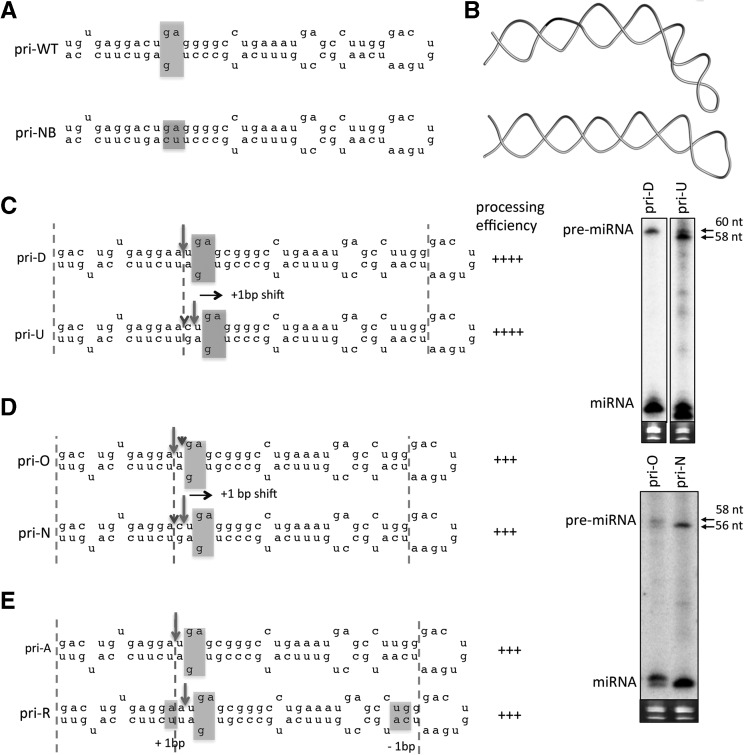
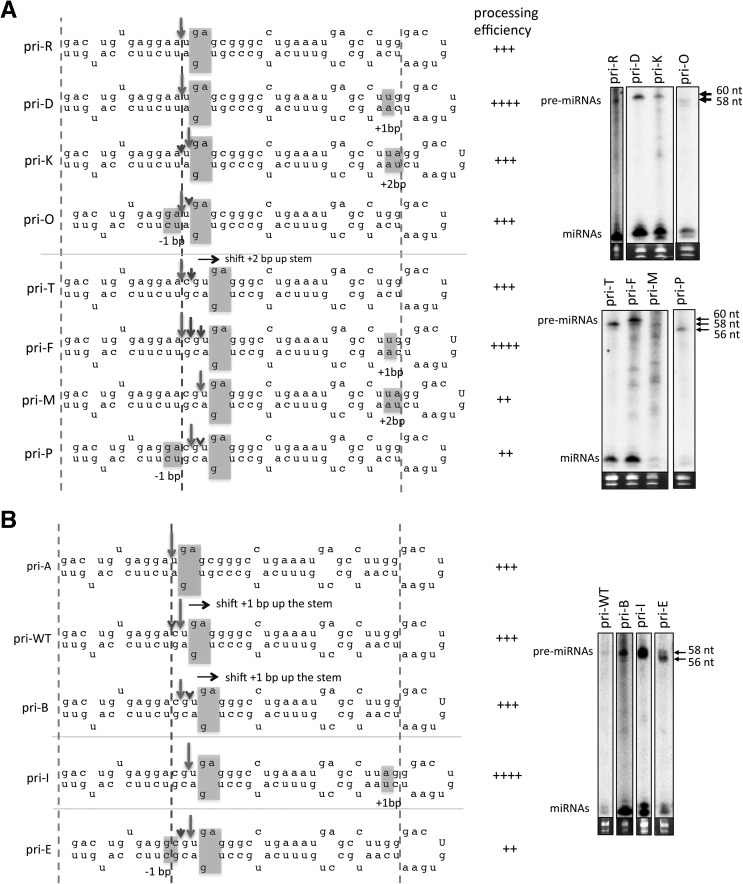
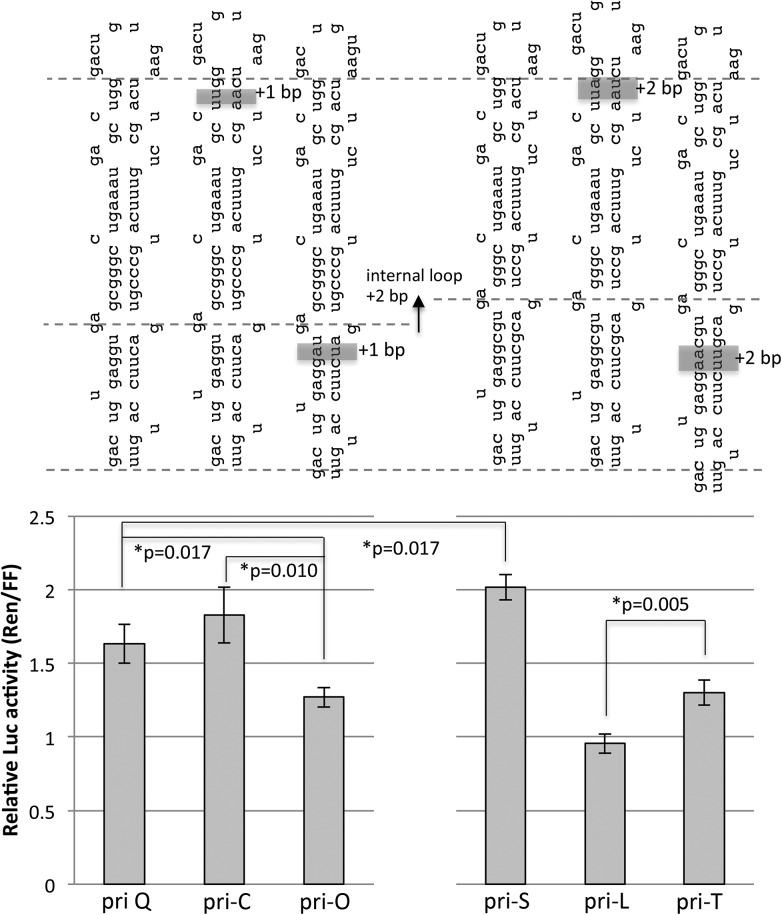
Processing of primary microRNA (pri-miRNA) stem-loops by the Drosha-DGCR8 complex is the initial step in miRNA maturation and crucial for miRNA function. Nonetheless, the underlying mechanism that determines the Drosha cleavage site of pri-miRNAs has remained unclear. Two prevalent but seemingly conflicting models propose that Drosha-DGCR8 anchors to and directs cleavage a fixed distance from either the basal single-stranded (ssRNA) or the terminal loop. However, recent studies suggest that the basal ssRNA and/or the terminal loop may influence the Drosha cleavage site dependent upon the sequence/structure of individual pri-miRNAs. Here, using a panel of closely related pri-miRNA variants, we further examine the role of pri-miRNA structures on Drosha cleavage site selection in cells. Our data reveal that both the basal ssRNA and terminal loop influence the Drosha cleavage site within three pri-miRNAs, the Simian Virus 40 (SV40) pri-miRNA, pri-miR-30a, and pri-miR-16. In addition to the flanking ssRNA regions, we show that an internal loop within the SV40 pri-miRNA stem strongly influences Drosha cleavage position and efficiency. We further demonstrate that the positions of the internal loop, basal ssRNA, and the terminal loop of the SV40 pri-miRNA cooperatively coordinate Drosha cleavage position and efficiency. Based on these observations, we propose that the pri-miRNA stem, defined by internal and flanking structural elements, guides the binding position of Drosha-DGCR8, which consequently determines the cleavage site. This study provides mechanistic insight into pri-miRNA processing in cells that has numerous biological implications and will assist in refining Drosha-dependent shRNA design.
初级 microRNA(pri-miRNA)茎环结构由 Drosha-DGCR8 复合物加工,这是 miRNA 成熟的初始步骤,对 miRNA 功能至关重要。尽管如此,决定 pri-miRNA 的 Drosha 切割位点的潜在机制仍不清楚。两种流行但似乎相互矛盾的模型表明,Drosha-DGCR8 锚定并指导从基底层单链(ssRNA)或末端环固定距离处切割。然而,最近的研究表明,基底层 ssRNA 和/或末端环可能会根据单个 pri-miRNA 的序列/结构影响 Drosha 切割位点。在这里,我们使用一组密切相关的 pri-miRNA 变体,进一步研究 pri-miRNA 结构在细胞中对 Drosha 切割位点选择的作用。我们的数据表明,基底层 ssRNA 和末端环都影响了三种 pri-miRNA 中的 Drosha 切割位点,即猿猴病毒 40(SV40)pri-miRNA、pri-miR-30a 和 pri-miR-16。除了侧翼 ssRNA 区域外,我们还表明,SV40 pri-miRNA 茎内的内部环强烈影响 Drosha 切割位置和效率。我们进一步证明,SV40 pri-miRNA 的内部环、基底层 ssRNA 和末端环的位置协同协调 Drosha 切割位置和效率。基于这些观察结果,我们提出 pri-miRNA 茎由内部和侧翼结构元件定义,指导 Drosha-DGCR8 的结合位置,从而决定切割位点。这项研究为细胞中 pri-miRNA 加工提供了机制上的见解,具有许多生物学意义,并将有助于改进依赖 Drosha 的 shRNA 设计。