Korkes Henri Augusto, Sass Nelson, Moron Antonio F, Câmara Niels Olsen S, Bonetti Tatiana, Cerdeira Ana Sofia, Da Silva Ismael Dale Cotrim Guerreiro, De Oliveira Leandro
Department of Obstetrics - Federal University of Sao Paulo, Sao Paulo, Sao Paulo, Brazil; Laboratory of Clinical and Experimental Investigation - School Maternity Vila Nova Cachoeirinha, Sao Paulo, Sao Paulo, Brazil.
Department of Obstetrics - Federal University of Sao Paulo, Sao Paulo, Sao Paulo, Brazil.
PLoS One. 2014 Oct 17;9(10):e110747. doi: 10.1371/journal.pone.0110747. eCollection 2014.
Adipose tissue is responsible for triggering chronic systemic inflammatory response and these changes may be involved in the pathophysiology of preeclampsia.
To characterize the lipid profile in the placenta and plasma of patients with preeclampsia.
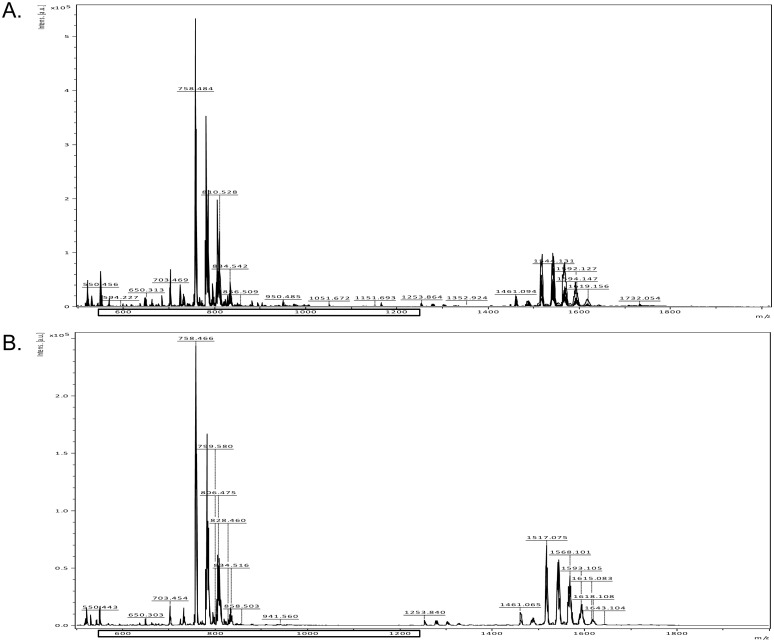
Samples were collected from placenta and plasma of 10 pregnant women with preeclampsia and 10 controls. Lipids were extracted using the Bligh-Dyer protocol and were analysed by MALDI TOF-TOF mass spectrometry.
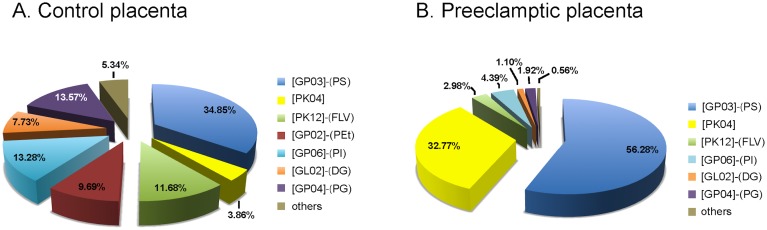
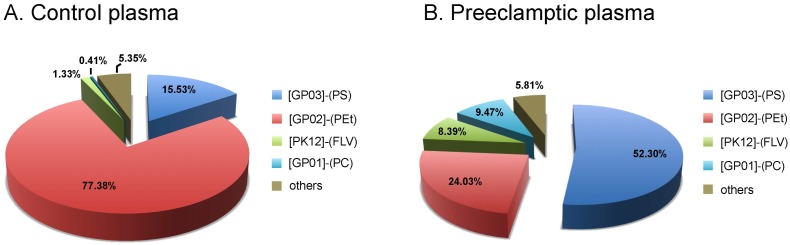
Approximately 200 lipid signals were quantified. The most prevalent lipid present in plasma of patients with preeclampsia was the main class Glycerophosphoserines-GP03 (PS) representing 52.30% of the total lipid composition, followed by the main classes Glycerophosphoethanolamines-GP02 (PEt), Glycerophosphocholines-GP01 (PC) and Flavanoids-PK12 (FLV), with 24.03%, 9.47% and 8.39% respectively. When compared to the control group, plasma samples of patients with preeclampsia showed an increase of PS (p<0.0001), PC (p<0.0001) and FLV (p<0.0001). Placental analysis of patients with preeclampsia, revealed the PS as the most prevalent lipid representing 56.28%, followed by the main class Macrolides/polyketides-PK04 with 32.77%, both with increased levels when compared with patients control group, PS (p<0.0001) and PK04 (p<0.0001).
Lipids found in placenta and plasma from patients with preeclampsia differ from those of pregnant women in the control group. Further studies are needed to clarify if these changes are specific and a cause or consequence of preeclampsia.
脂肪组织会引发慢性全身炎症反应,这些变化可能参与了先兆子痫的病理生理过程。
对先兆子痫患者胎盘和血浆中的脂质谱进行特征分析。
收集了10例先兆子痫孕妇和10例对照组孕妇的胎盘及血浆样本。采用布利-戴尔法提取脂质,并用基质辅助激光解吸电离飞行时间串联质谱进行分析。
共定量了约200个脂质信号。先兆子痫患者血浆中最主要的脂质是甘油磷酸丝氨酸-GP03(PS),占总脂质成分的52.30%,其次是甘油磷酸乙醇胺-GP02(PEt)、甘油磷酸胆碱-GP01(PC)和类黄酮-PK12(FLV),分别占24.03%、9.47%和8.39%。与对照组相比,先兆子痫患者的血浆样本中PS(p<0.0001)、PC(p<0.0001)和FLV(p<0.0001)均有所增加。对先兆子痫患者胎盘的分析显示,PS是最主要的脂质,占56.28%,其次是大环内酯类/聚酮类-PK04,占32.77%,与对照组患者相比,这两类脂质水平均升高,PS(p<0.0001)和PK04(p<0.0001)。
先兆子痫患者胎盘和血浆中的脂质与对照组孕妇不同。需要进一步研究以阐明这些变化是否具有特异性,以及是否为先兆子痫的原因或结果。