Garrouste-Orgeas Maité, Périer Antoine, Mouricou Philippe, Grégoire Charles, Bruel Cédric, Brochon Sandie, Philippart François, Max Adeline, Misset Benoit
Medical-Surgical ICU, Saint Joseph Hospital Network, Paris, France; IAME, UMR 1137, Paris Diderot University, Sorbonne Paris Cité, Paris, France.
Maison des Adolescents, University Hospital Cochin, Paris, France; INSERM U-669, University Paris Sud and University Paris Descartes, UMR-S0669, Paris, France.
PLoS One. 2014 Oct 16;9(10):e110146. doi: 10.1371/journal.pone.0110146. eCollection 2014.
Keeping an ICU patient diary has been reported to benefit the patient's recovery. Here, we investigated the families' experience with reading and writing in patient ICU diaries kept by both the family and the staff.
We conducted a qualitative study involving 32 semi-structured in-depth interviews of relatives of 26 patients (34% of all family members who visited patients) who met our ICU-diary criterion, i.e., ventilation for longer than 48 hours. Grounded theory was used to conceptualise the interview data via a three-step coding process (open coding, axial coding, and selective coding).
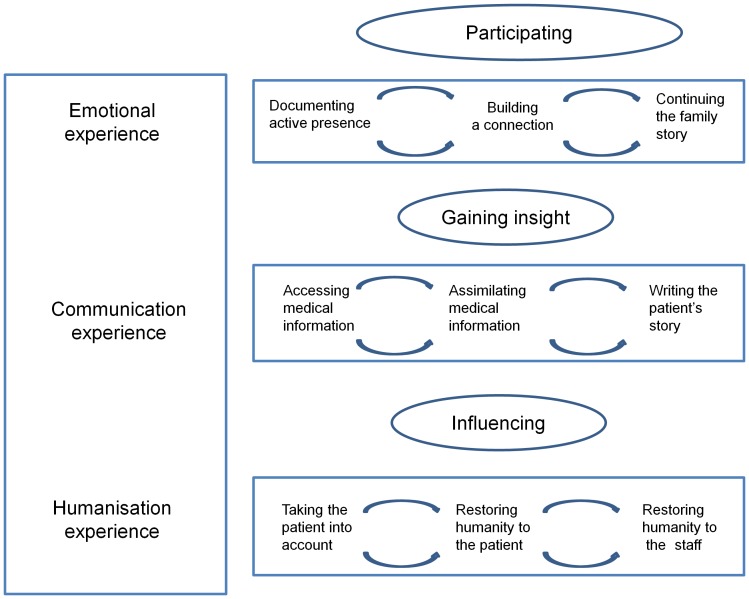
Communicative, emotional, and humanising experiences emerged from our data. First, family members used the diaries to access, understand, and assimilate the medical information written in the diaries by staff members, and then to share this information with other family members. Second, the diaries enabled family members to maintain a connection with the patient by documenting their presence and expressing their love and affection. Additionally, families confided in the diaries to maintain hope. Finally, family members felt the diaries humanized the medical staff and patient.
Our findings indicate positive effects of diaries on family members. The diaries served as a powerful tool to deliver holistic patient- and family-centered care despite the potentially dehumanising ICU environment. The diaries made the family members aware of their valuable role in caring for the patient and enhanced their access to and comprehension of medical information. Diaries may play a major role in improving the well-being of ICU-patient families.
据报道,记录重症监护病房(ICU)患者日记有助于患者康复。在此,我们调查了家属阅读和撰写由家属及医护人员共同记录的患者ICU日记的体验。
我们开展了一项定性研究,对26名患者的亲属进行了32次半结构化深度访谈(占所有探视患者家属的34%),这些患者符合我们的ICU日记标准,即通气时间超过48小时。采用扎根理论,通过三步编码过程(开放编码、主轴编码和选择性编码)对访谈数据进行概念化。
我们的数据中出现了沟通、情感和人性化体验。首先,家庭成员利用日记获取、理解并吸收医护人员在日记中记录的医疗信息,然后与其他家庭成员分享这些信息。其次,日记使家庭成员能够通过记录他们的陪伴以及表达他们的爱和情感,与患者保持联系。此外,家属向日记倾诉以维持希望。最后,家庭成员认为日记使医护人员和患者更有人情味。
我们的研究结果表明日记对家庭成员有积极影响。尽管ICU环境可能缺乏人情味,但日记是提供以患者和家庭为中心的整体护理的有力工具。日记使家庭成员意识到他们在照顾患者方面的重要作用,并增强了他们获取和理解医疗信息的能力。日记可能在改善ICU患者家属的福祉方面发挥重要作用。