Zhang Zhen-yu, Dai Zhen-ling, Yin Xiao-wei, Li Shu-heng, Li Shu-ping, Ge Hai-yan
Department of Gastrointestinal Surgery, Shanghai East Hospital, Tongji University School of Medicine, Pudong New District, No, 150, Jimo Road, Shanghai 200120, China.
BMC Cancer. 2014 Oct 21;14:773. doi: 10.1186/1471-2407-14-773.
Circulating tumor cells (CTCs) are metastatic cells disseminated into the bloodstreams. They have been proposed to monitor disease progression for decades. However, the prognostic value of CTCs in gastric cancer (GC) remains controversial. We performed a meta-analysis to investigate the topic.
A systematic search was made for relevant studies in academic data bases, involving the Medline, Embase, and Science Citation Index. Data on prognosis of GC patients, such as recurrence-free survival (RFS) and overall survival (OS), were extracted when possible. The meta-analysis was performed with the random effects model and the pooled hazard ratios (HRs) and their associated 95% confident intervals (95%CIs) were computed as effect measures.
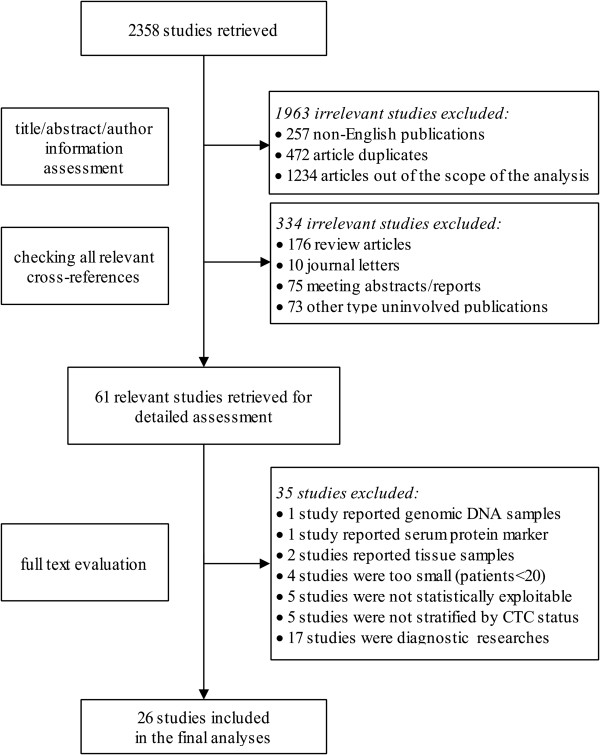
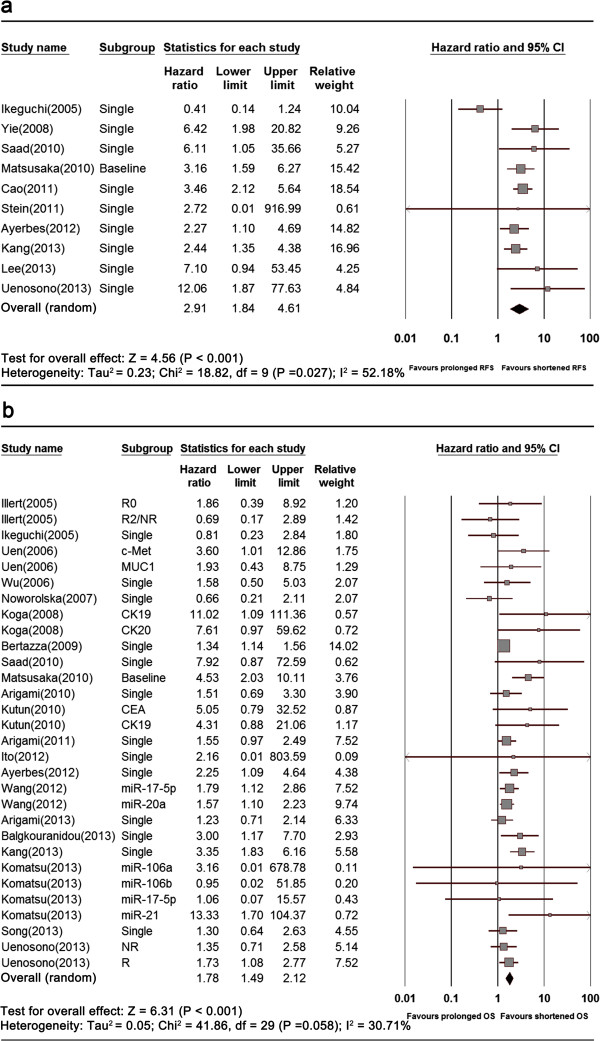
Twenty six studies (including 40 subgroups) with peripheral blood samples of 1950 cases from 10 countries were included in the final analysis. The pooled results showed that GC patients with detectable CTCs (including circulating miRNAs) had a tendency to experience shortened RFS (HR=2.91, 95% CI [1.84-4.61], I2=52.18%, n=10). As for patient deaths, we found a similar association of CTC (including circulating miRNAs) presence with worse OS (HR=1.78, 95% CI [1.49-2.12], I2=30.71%, n=30). Additionally, subgroup analyses indicated strong prognostic powers of CTCs, irrespective of geographical, methodological, detection time and sample size differences of the studies.
Our meta-analysis shows that CTCs (including circulating miRNAs) can predict the survival of GC patients. Large prospective studies are warranted to determine the best sampling time points, detection methods in homogeneous patients with GC in the future.
循环肿瘤细胞(CTCs)是播散进入血流的转移细胞。数十年来,人们一直提议利用它们来监测疾病进展。然而,CTCs在胃癌(GC)中的预后价值仍存在争议。我们进行了一项荟萃分析来研究该课题。
在学术数据库(包括Medline、Embase和科学引文索引)中系统检索相关研究。尽可能提取GC患者的预后数据,如无复发生存期(RFS)和总生存期(OS)。采用随机效应模型进行荟萃分析,并计算合并风险比(HRs)及其相关的95%置信区间(95%CIs)作为效应量。
最终分析纳入了来自10个国家的26项研究(包括40个亚组),共1950例患者的外周血样本。汇总结果显示,可检测到CTCs(包括循环miRNAs)的GC患者有RFS缩短的趋势(HR = 2.91,95%CI [1.84 - 4.61],I2 = 52.18%,n = 10)。对于患者死亡情况,我们发现CTCs(包括循环miRNAs)的存在与较差的OS也有类似关联(HR = 1.78,95%CI [1.49 - 2.12],I2 = 30.71%,n = 30)。此外,亚组分析表明,无论研究的地理、方法、检测时间和样本量差异如何,CTCs都具有很强的预后预测能力。
我们的荟萃分析表明,CTCs(包括循环miRNAs)可以预测GC患者的生存情况。未来有必要开展大型前瞻性研究,以确定GC患者最佳的采样时间点和检测方法。