Gao Yunhe, Xi Hongqing, Wei Bo, Cui Jianxin, Zhang Kecheng, Li Hua, Cai Aizhen, Shen Weishen, Li Jiyang, Rosell Rafael, Chao Joseph, Chen Tianhui, Klempner Samuel, Qiao Zhi, Chen Lin
Department of General Surgery, Chinese PLA General Hospital, Beijing, China.
General Surgery Institute, Chinese PLA General Hospital, Beijing, China.
Front Oncol. 2019 Nov 26;9:1222. doi: 10.3389/fonc.2019.01222. eCollection 2019.
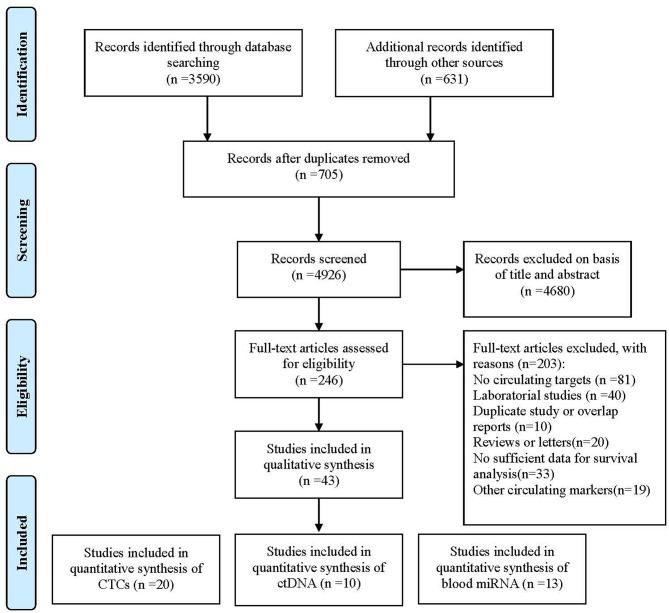
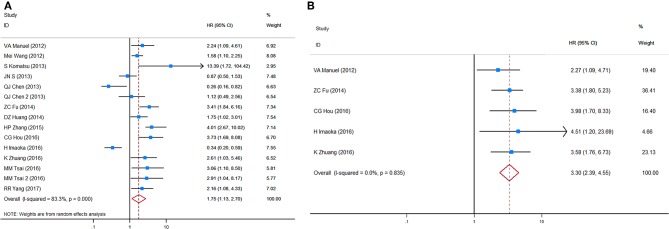
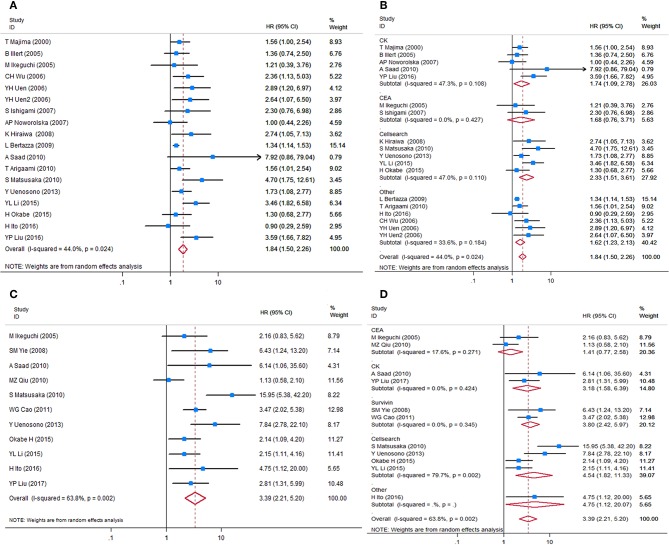
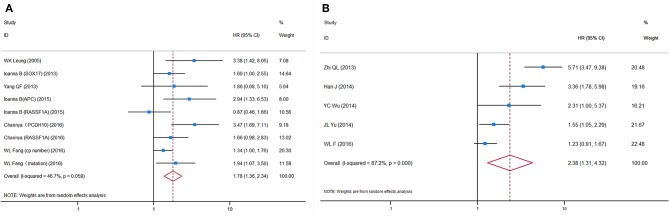
Reports regarding liquid biopsy and gastric cancer (GC) have emerged rapidly in recent decades, yet their prognostic value still remains controversial. This study was aimed to assess the impact of liquid biopsy, including circulating tumor cells (CTCs) and cell-free nucleic acids, on GC patients' prognosis. PubMed, Medline, EMBASE, and ClinicalTrial.gov databases were searched for studies that report GC patient survival data stratified by CTC/circulating tumor DNA (ctDNA)/circulating miRNAs' status. The hazard ratios (HRs) and their 95% confidence intervals (CIs) for patients' overall survival (OS) and disease-free survival (DFS)/progression-free survival (PFS) were recorded or calculated depending on circulating target status. We initially identified 4,221 studies, from which 43 were eligible for further analysis, comprising 3,814 GC patients. Pooled analyses showed that detection of certain CTCs, ctDNA, and circulating miRNA was associated with poorer OS (CTCs: HR = 1.84, 95%CI 1.50-2.26, < 0.001; ctDNA: HR = 1.78, 95%CI 1.36-2.34, < 0.001; circulating miRNA: HR = 1.74, 95%CI 1.13-2.69, < 0.001) and DFS/PFS (CTCs: HR = 3.39, 95%CI 2.21-5.20, < 0.001; ctDNA: HR = 2.38, 95%CI 1.31-4.32, = 0.004; circulating miRNA: HR = 3.30, 95%CI 2.39-4.55, < 0.001) of GC patients, regardless of disease stage and time point at which sample is taken (at baseline or post-treatment). The presence of CTCs and/or cellular components identifies a group of GC with poorer prognosis. Among circulating markers, CTCs demonstrated a stronger and more stable predictive value for late-stage disease and among Mongolian populations with GC. Less data are available for ctDNA and miRNA; however, their presence may also reflect aggressive biology and warrants further prospective study.
近几十年来,有关液体活检与胃癌(GC)的报道迅速涌现,但其预后价值仍存在争议。本研究旨在评估液体活检,包括循环肿瘤细胞(CTC)和游离核酸,对GC患者预后的影响。在PubMed、Medline、EMBASE和ClinicalTrial.gov数据库中检索报告了按CTC/循环肿瘤DNA(ctDNA)/循环miRNA状态分层的GC患者生存数据的研究。根据循环靶标状态记录或计算患者总生存期(OS)和无病生存期(DFS)/无进展生存期(PFS)的风险比(HRs)及其95%置信区间(CIs)。我们最初确定了4221项研究,其中43项符合进一步分析的条件,包括3814例GC患者。汇总分析表明,检测到某些CTC、ctDNA和循环miRNA与GC患者较差的OS(CTC:HR = 1.84,95%CI 1.50 - 2.26,< 0.001;ctDNA:HR = 1.78,95%CI 1.36 - 2.34,< 0.001;循环miRNA:HR = 1.74,95%CI 1.13 - 2.69,< 0.001)和DFS/PFS(CTC:HR = 3.39,95%CI 2.21 - 5.20,< 0.001;ctDNA:HR = 2.38,95%CI 1.31 - 4.32,= 0.004;循环miRNA:HR = 3.30,95%CI 2.39 - 4.55,< 0.001)相关,无论疾病阶段和取样时间点(基线或治疗后)如何。CTC和/或细胞成分的存在确定了一组预后较差的GC患者。在循环标志物中,CTC对晚期疾病和蒙古族GC人群显示出更强、更稳定的预测价值。关于ctDNA和miRNA的数据较少;然而,它们的存在也可能反映侵袭性生物学行为,值得进一步进行前瞻性研究。