LaBelle Edward V, Marshall Christopher W, Gilbert Jack A, May Harold D
Department of Microbiology & Immunology, Marine Biomedicine & Environmental Science Center, Hollings Marine Laboratory, Medical University of South Carolina, Charleston, South Carolina, United States of America.
Institute for Genomic and Systems Biology, Argonne National Laboratory, Argonne, Illinois, United States of America.
PLoS One. 2014 Oct 15;9(10):e109935. doi: 10.1371/journal.pone.0109935. eCollection 2014.
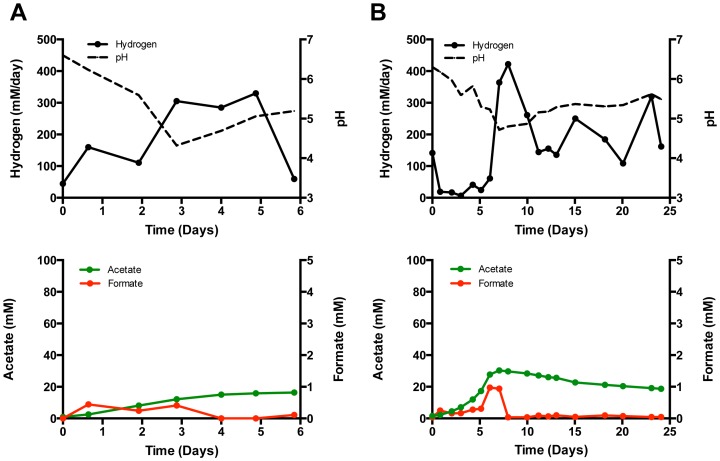
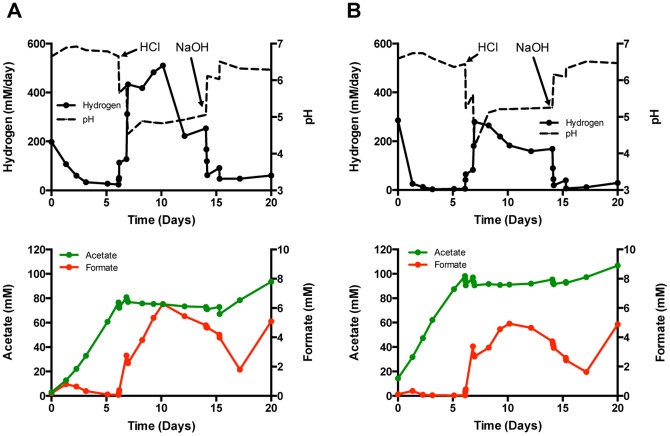
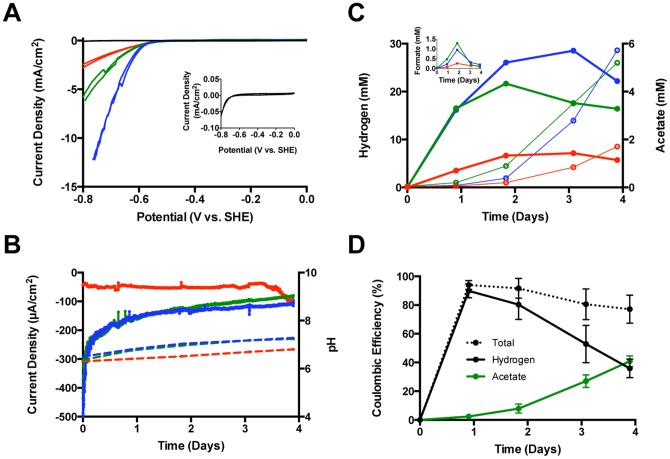
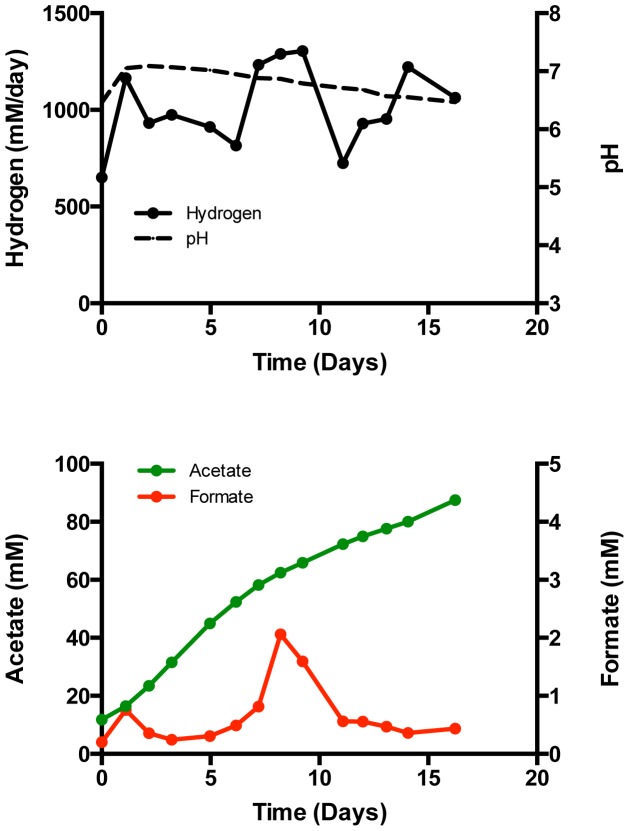
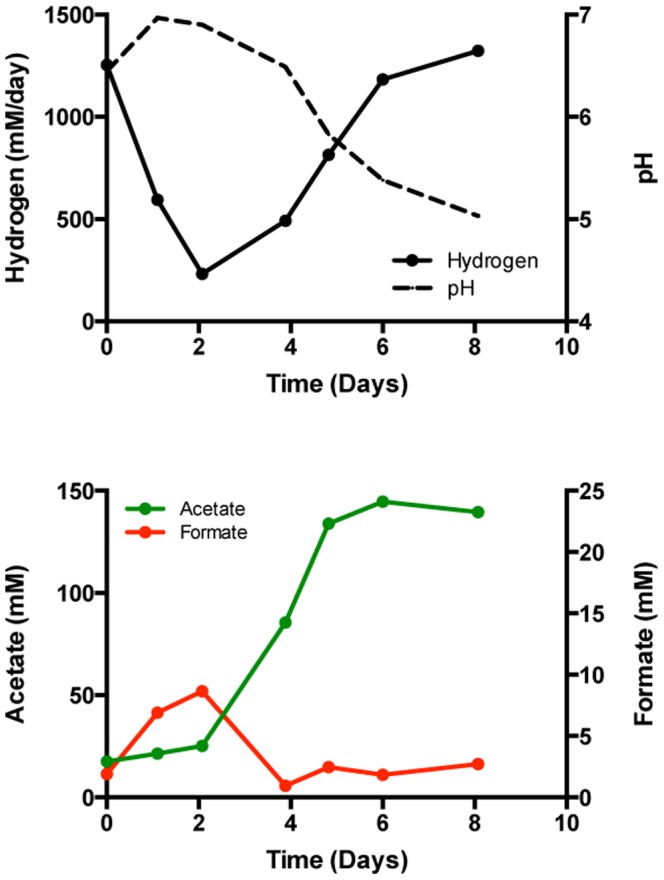
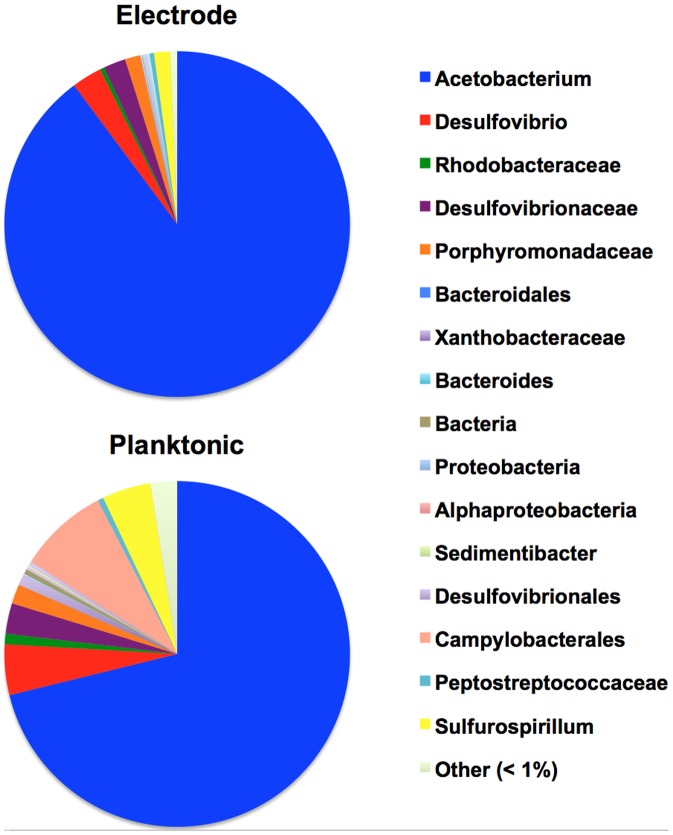
Production of hydrogen and organic compounds by an electrosynthetic microbiome using electrodes and carbon dioxide as sole electron donor and carbon source, respectively, was examined after exposure to acidic pH (∼ 5). Hydrogen production by biocathodes poised at -600 mV vs. SHE increased >100-fold and acetate production ceased at acidic pH, but ∼ 5-15 mM (catholyte volume)/day acetate and >1,000 mM/day hydrogen were attained at pH ∼ 6.5 following repeated exposure to acidic pH. Cyclic voltammetry revealed a 250 mV decrease in hydrogen overpotential and a maximum current density of 12.2 mA/cm2 at -765 mV (0.065 mA/cm2 sterile control at -800 mV) by the Acetobacterium-dominated community. Supplying -800 mV to the microbiome after repeated exposure to acidic pH resulted in up to 2.6 kg/m3/day hydrogen (≈ 2.6 gallons gasoline equivalent), 0.7 kg/m3/day formate, and 3.1 kg/m3/day acetate ( = 4.7 kg CO2 captured).
在暴露于酸性pH值(约为5)后,研究了使用电极且分别以二氧化碳作为唯一电子供体和碳源的电合成微生物群落产生氢气和有机化合物的情况。相对于标准氢电极(SHE),处于-600 mV的生物阴极产生氢气的量增加了100倍以上,并且在酸性pH值下醋酸盐的产生停止,但在反复暴露于酸性pH值后,在pH约为6.5时可获得约5-15 mM(阴极电解液体积)/天的醋酸盐和约1000 mM/天的氢气。循环伏安法显示,以醋杆菌为主的群落使析氢过电位降低了250 mV,在-765 mV时的最大电流密度为12.2 mA/cm²(在-800 mV时无菌对照为0.065 mA/cm²)。在反复暴露于酸性pH值后,向微生物群落提供-800 mV的电压,可产生高达2.6 kg/m³/天的氢气(约等于2.6加仑汽油当量)、0.7 kg/m³/天的甲酸盐和3.1 kg/m³/天的醋酸盐(相当于捕获了4.7 kg二氧化碳)。