Qi Xiao-Guang, Garber Paul A, Ji Weihong, Huang Zhi-Pang, Huang Kang, Zhang Peng, Guo Song-Tao, Wang Xiao-Wei, He Gang, Zhang Pei, Li Bao-Guo
1] College of Life Sciences, Northwest University, Xi'an 710069, China [2] Anthropology Department, University of Illinois, Urbana, Illinois 61801, USA.
Anthropology Department, University of Illinois, Urbana, Illinois 61801, USA.
Nat Commun. 2014 Oct 22;5:5296. doi: 10.1038/ncomms6296.
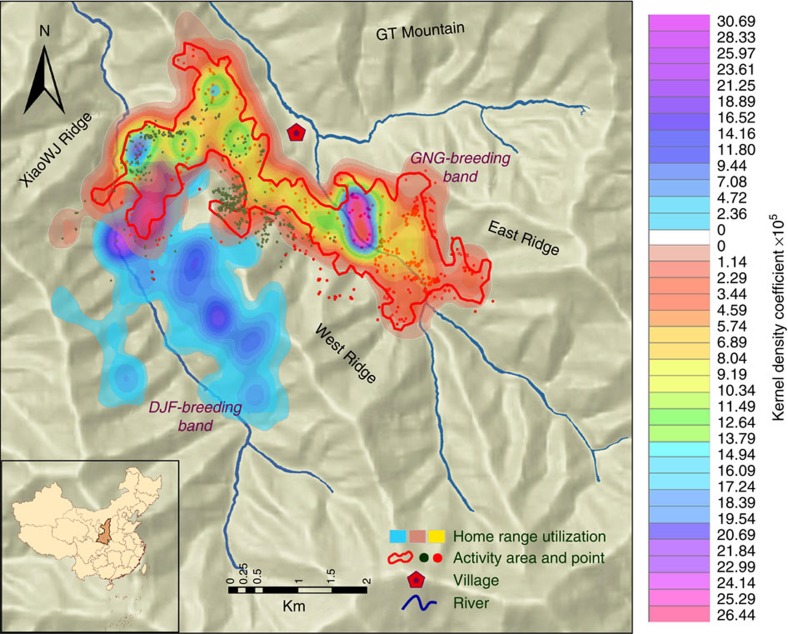
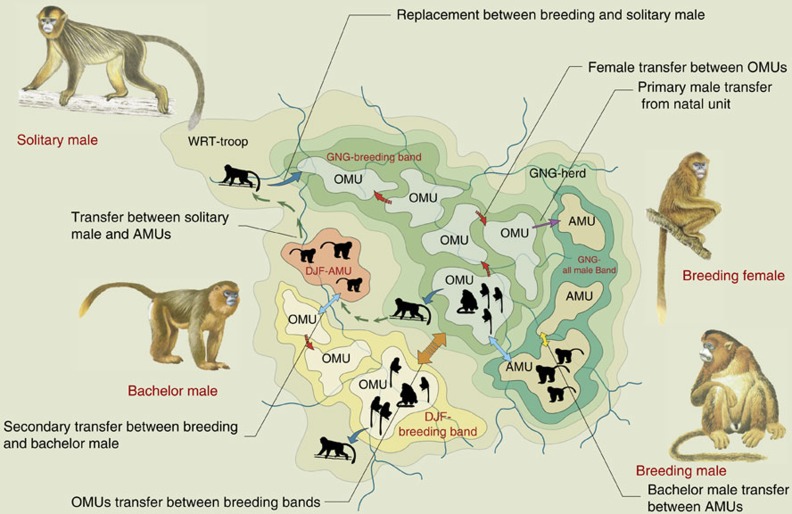
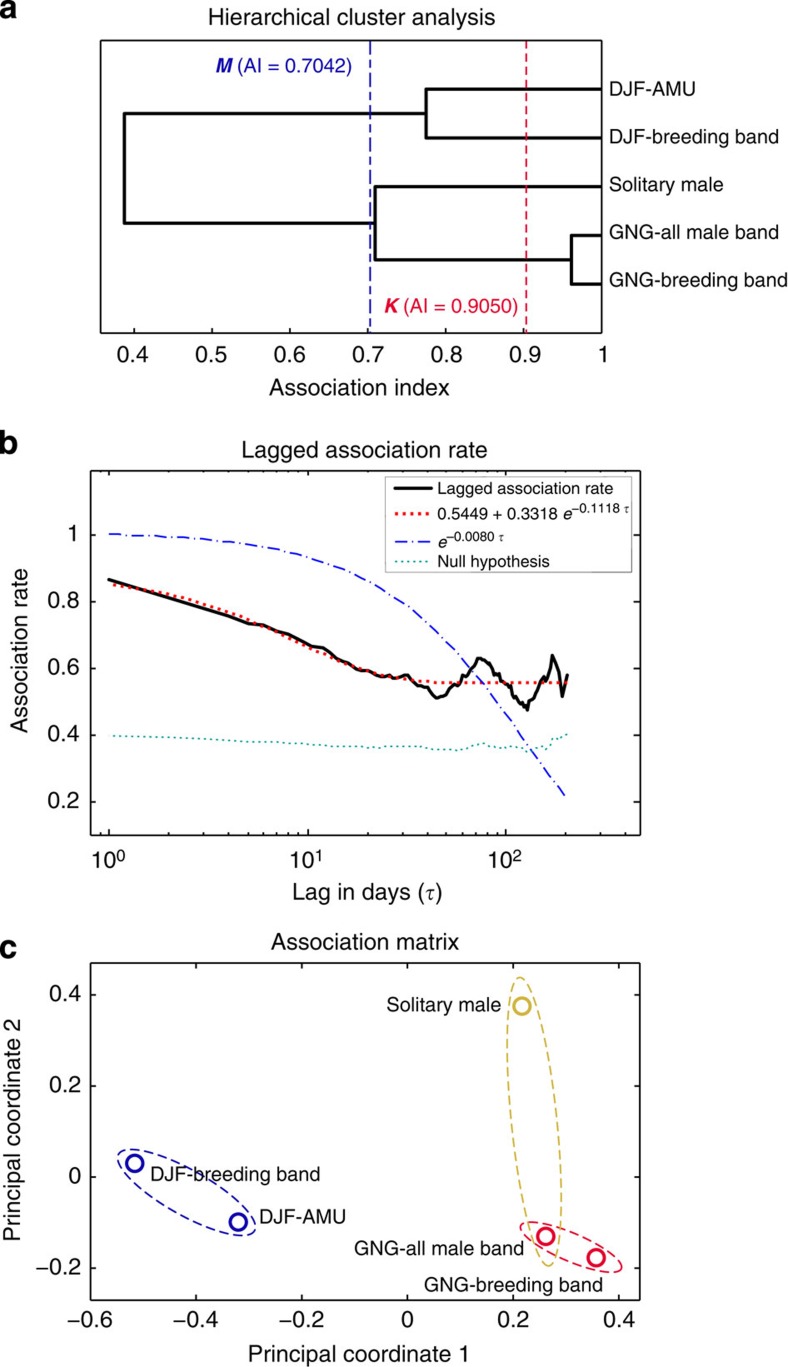
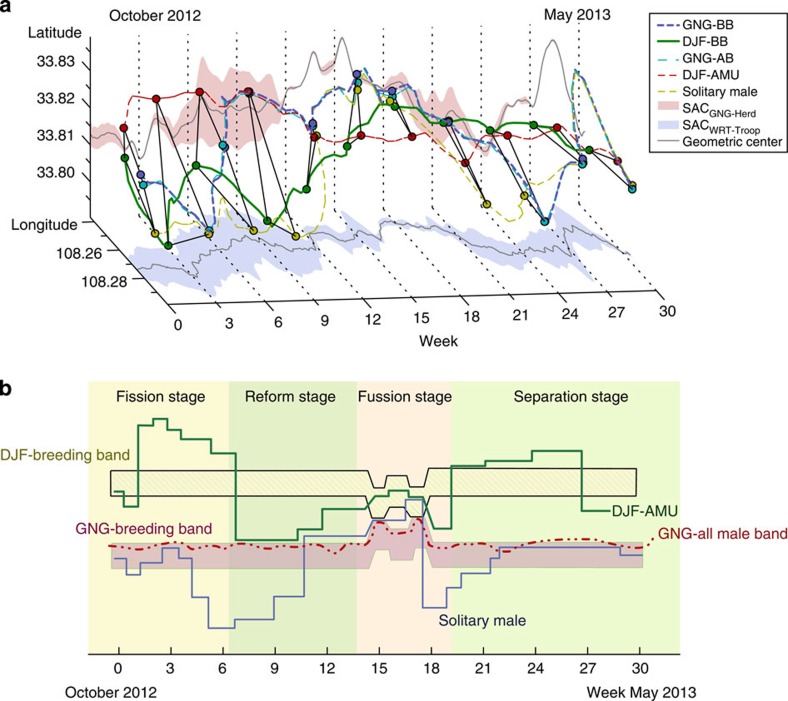
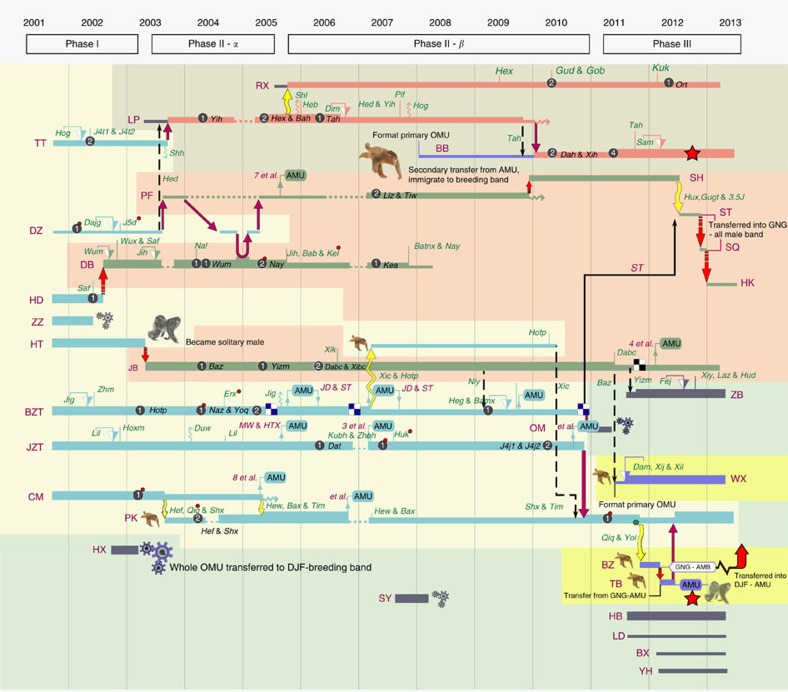
Multilevel societies (MLS), in which polygynous reproductive units are nested in a larger social matrix, represent a highly complex social system documented only in a small number of mammalian species. Using long-term behavioural data, satellite telemetry and social network analysis, we present a new framework for understanding the function and social dynamics of the golden snub-nosed monkey MLS. Here we show that several one-male units form a cohesive breeding band that associates with one or more all-male units to form a herd. Herds seasonally aggregate and exchange members, thus facilitating gene flow and inbreeding avoidance. This MLS evolved from the aggregation of independent one-male, multifemale units that characterize ancestral Asian colobines; the evolutionary pathway leading to this MLS contrasts with that proposed for African papionins, which appear to have undergone internal fissioning of multimale-multifemale groups. The results suggest that both environmental and phylogenetic factors are important in the evolution of a primate MLS.
多阶层社会(MLS)中,一夫多妻的繁殖单元嵌套在一个更大的社会矩阵中,代表了一种仅在少数哺乳动物物种中被记录的高度复杂的社会系统。利用长期行为数据、卫星遥测和社会网络分析,我们提出了一个新的框架来理解川金丝猴多阶层社会的功能和社会动态。在这里我们表明,几个单雄单元形成一个有凝聚力的繁殖带,该繁殖带与一个或多个全雄单元关联形成一个群体。群体季节性聚集并交换成员,从而促进基因流动和避免近亲繁殖。这种多阶层社会是从独立的单雄多雌单元聚集演化而来的,这些单元是亚洲叶猴祖先的特征;导致这种多阶层社会的进化途径与非洲狒狒的不同,非洲狒狒似乎经历了多雄多雌群体的内部裂变。结果表明,环境和系统发育因素在灵长类多阶层社会的进化中都很重要。