Taherian Fatemeh, Vafaei Abbas Ali, Vaezi Gholam Hassan, Eskandarian Sharaf, Kashef Adel, Rashidy-Pour Ali
Islamic Azad University, Damghan Branch, Damghan, Iran.
Laboratory of Learning and Memory, Research Center and Department of Physiology, School of Medicine, Semnan University of Medical Sciences, Semnan, Iran.
Basic Clin Neurosci. 2014 Summer;5(3):231-9.
Previous studies have demonstrated that the β-adrenergic receptor antagonist propranolol impairs fear memory reconsolidation in experimental animals. There are experimental parameters such as the age and the strength of memory that can interact with pharmacological manipulations of memory reconsolidation. In this study, we investigated the ability of the age and the strength of memory to influence the disrupting effects of propranolol on fear memory reconsolidation in rats.
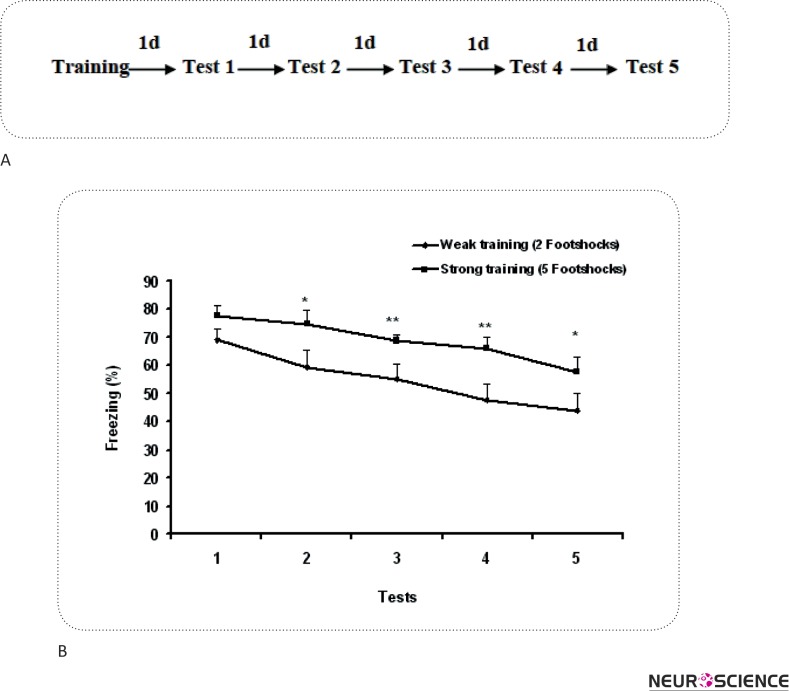
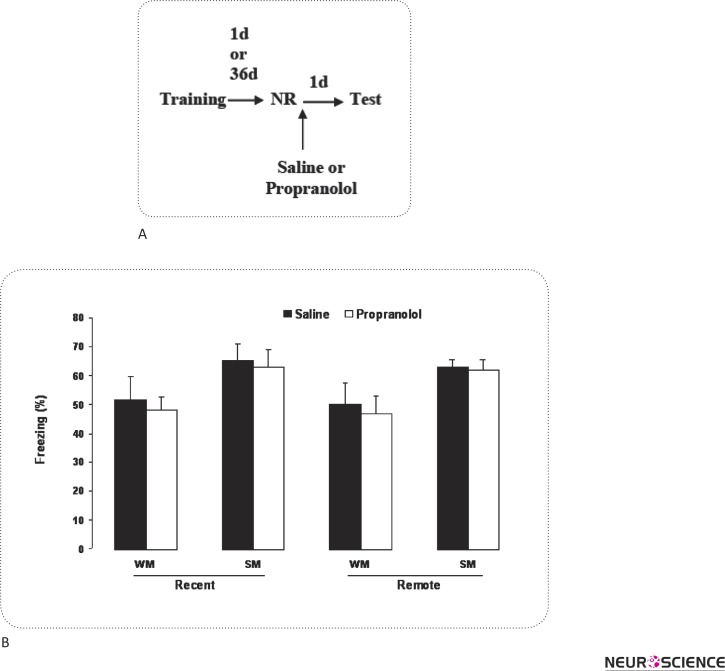
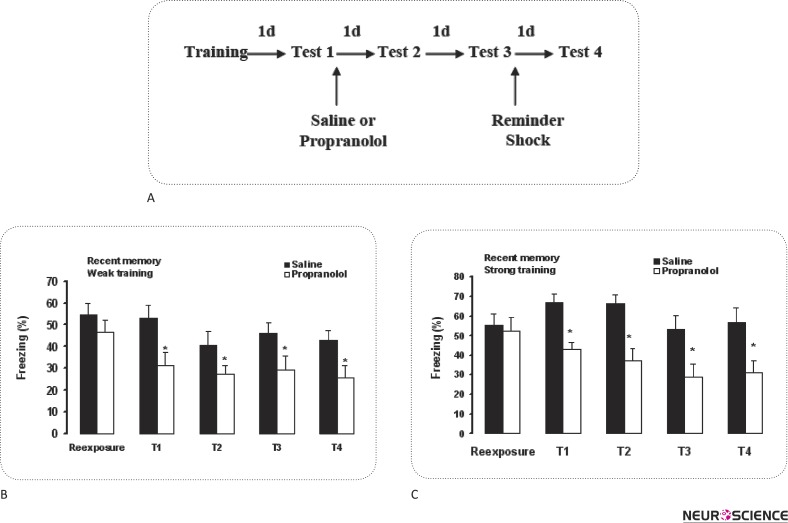
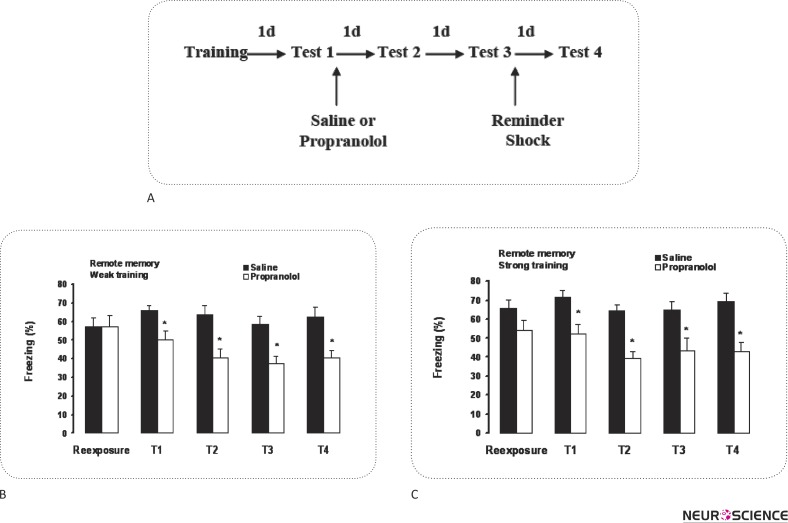
The rats were trained in a contextual fear conditioning using two (weak training) or five (strong training) footshocks (1mA). Propranolol (10mg/kg) injection was immediately followed retrieval of either a one-day recent (weak or strong) or 36-day remote (weak or strong) contextual fear memories.
We found that propranolol induced a long-lasting impairment of subsequent expression of recent and remote memories with either weak or strong strength. We also found no memory recovery after a weak reminder shock. Furthermore, no significant differences were found on the amount of memory deficit induced by propranolol among memories with different age and strength.
Our data suggest that the efficacy of propranolol in impairing fear memory reconsolidation is not limited to the age or strength of the memory.
先前的研究表明,β-肾上腺素能受体拮抗剂普萘洛尔会损害实验动物的恐惧记忆再巩固。存在一些实验参数,如年龄和记忆强度,它们可能会与记忆再巩固的药理学操作相互作用。在本研究中,我们调查了年龄和记忆强度对普萘洛尔破坏大鼠恐惧记忆再巩固作用的影响。
使用两次(弱训练)或五次(强训练)足部电击(1毫安)对大鼠进行情境恐惧条件训练。在检索一天前的近期(弱或强)或36天前的远期(弱或强)情境恐惧记忆后,立即注射普萘洛尔(10毫克/千克)。
我们发现,普萘洛尔会对近期和远期记忆的后续表达产生持久损害,无论,无论记忆强度是弱还是强。我们还发现,在进行一次弱的提示电击后,记忆没有恢复。此外,在不同年龄和强度的记忆中,普萘洛尔引起的记忆缺陷量没有显著差异。
我们的数据表明,普萘洛尔损害恐惧记忆再巩固的效果并不局限于记忆的年龄或强度。