Zheng Yunfei, Hou Jianxia, Peng Lei, Zhang Xin, Jia Lingfei, Wang Xian'e, Wei Shicheng, Meng Huanxin
Department of Oral and Maxillofacial Surgery, Peking University School and Hospital of Stomatology, Beijing, P.R. China; Department of Periodontology, Peking University School and Hospital of Stomatology, Beijing, P.R. China.
Department of Periodontology, Peking University School and Hospital of Stomatology, Beijing, P.R. China.
PLoS One. 2014 Oct 22;9(10):e110421. doi: 10.1371/journal.pone.0110421. eCollection 2014.
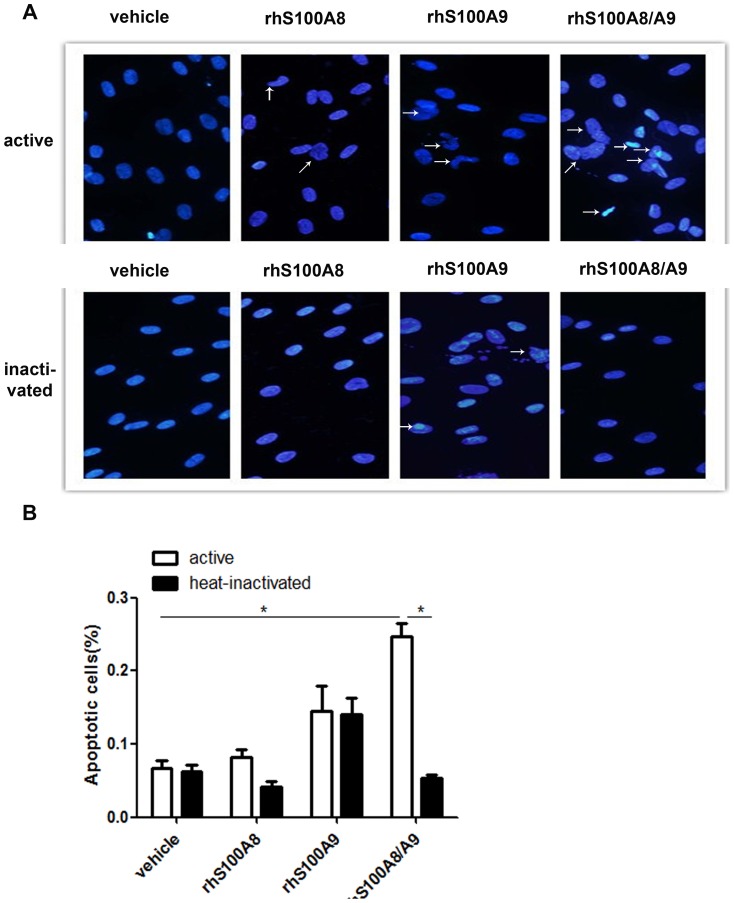
Calprotectin, a heterodimer of S100A8 and S100A9 subunits, is associated with inflammatory disorders such as rheumatoid arthritis and cystic fibrosis. Although calprotectin levels are increased significantly in the gingival crevicular fluid (GCF) of periodontitis patients, its effects on periodontal ligament cells (PDLCs) remain largely unknown. The aim of this study was to evaluate calprotectin levels in the GCF of generalized aggressive periodontitis (AgP) patients and to investigate the effects of recombinant human calprotectin (rhS100A8/A9) and its subunits (rhS100A8 and rhS100A9) in PDLCs. Both the concentration and amount of crevicular calprotectin were significantly higher in the AgP group compared with healthy controls. In addition, the GCF calprotectin levels were correlated positively with clinical periodontal parameters including bleeding index, probing depth, and clinical attachment loss. rhS100A8/A9 promoted cell apoptosis, whereas rhS100A8 and rhS100A9 individually exerted little effect on apoptosis in PDLCs. rhS100A9 and rhS100A8/A9 increased the activation of nuclear factor-κB (NF-κB) by promoting the nuclear translocation of p65 in PDLCs, subsequently inducing expression of the pro-inflammatory cytokines IL-6, IL-8, TNFα, and COX2. Treatment with an NF-κB inhibitor partially reversed the rhS100A9- and rhS100A8/A9-induced upregulation of the pro-inflammatory cytokines. rhS100A9, and not rhS100A8, was mainly responsible for the pro-inflammatory role of calprotectin. Collectively, our results suggest that calprotectin promotes apoptosis and the inflammatory response in PDLCs via rhS100A9. These findings might help identify novel treatments for periodontitis.
钙卫蛋白是由S100A8和S100A9亚基组成的异二聚体,与类风湿性关节炎和囊性纤维化等炎症性疾病有关。尽管牙周炎患者龈沟液(GCF)中的钙卫蛋白水平显著升高,但其对牙周膜细胞(PDLCs)的影响仍 largely未知。本研究的目的是评估广泛侵袭性牙周炎(AgP)患者GCF中的钙卫蛋白水平,并研究重组人钙卫蛋白(rhS100A8/A9)及其亚基(rhS100A8和rhS100A9)对PDLCs的影响。与健康对照组相比,AgP组龈沟钙卫蛋白的浓度和含量均显著更高。此外,GCF钙卫蛋白水平与包括出血指数、探诊深度和临床附着丧失在内的临床牙周参数呈正相关。rhS100A8/A9促进细胞凋亡,而rhS100A8和rhS100A9单独对PDLCs的凋亡影响很小。rhS100A9和rhS100A8/A9通过促进PDLCs中p65的核转位增加核因子-κB(NF-κB)的活化,随后诱导促炎细胞因子IL-6、IL-8、TNFα和COX2的表达。用NF-κB抑制剂处理可部分逆转rhS100A9和rhS100A8/A9诱导的促炎细胞因子上调作用。主要是rhS100A9而非rhS100A8负责钙卫蛋白的促炎作用。总的来说,我们的结果表明钙卫蛋白通过rhS100A9促进PDLCs的凋亡和炎症反应。这些发现可能有助于确定牙周炎的新治疗方法。