
通过复杂脂质双层的分子模拟表明,脂质聚集与膜曲率相关。
Lipid clustering correlates with membrane curvature as revealed by molecular simulations of complex lipid bilayers.
作者信息
Koldsø Heidi, Shorthouse David, Hélie Jean, Sansom Mark S P
机构信息
Department of Biochemistry, University of Oxford, Oxford, United Kingdom.
出版信息
PLoS Comput Biol. 2014 Oct 23;10(10):e1003911. doi: 10.1371/journal.pcbi.1003911. eCollection 2014 Oct.
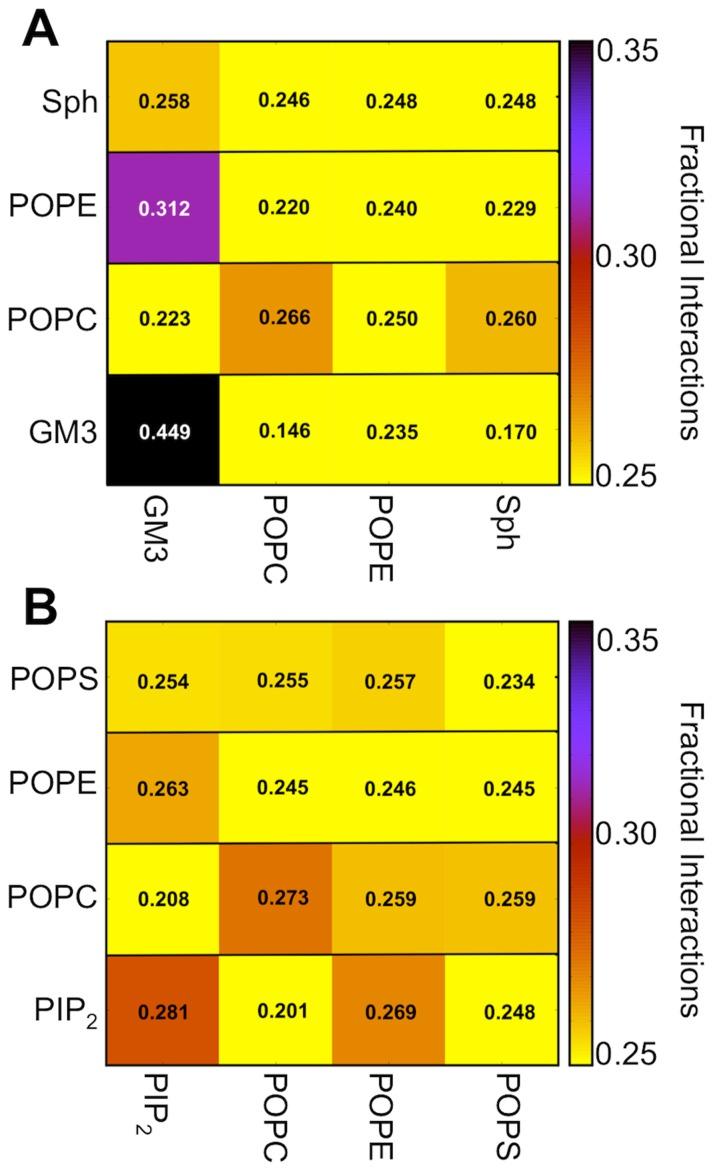
Cell membranes are complex multicomponent systems, which are highly heterogeneous in the lipid distribution and composition. To date, most molecular simulations have focussed on relatively simple lipid compositions, helping to inform our understanding of in vitro experimental studies. Here we describe on simulations of complex asymmetric plasma membrane model, which contains seven different lipids species including the glycolipid GM3 in the outer leaflet and the anionic lipid, phosphatidylinositol 4,5-bisphophate (PIP2), in the inner leaflet. Plasma membrane models consisting of 1500 lipids and resembling the in vivo composition were constructed and simulations were run for 5 µs. In these simulations the most striking feature was the formation of nano-clusters of GM3 within the outer leaflet. In simulations of protein interactions within a plasma membrane model, GM3, PIP2, and cholesterol all formed favorable interactions with the model α-helical protein. A larger scale simulation of a model plasma membrane containing 6000 lipid molecules revealed correlations between curvature of the bilayer surface and clustering of lipid molecules. In particular, the concave (when viewed from the extracellular side) regions of the bilayer surface were locally enriched in GM3. In summary, these simulations explore the nanoscale dynamics of model bilayers which mimic the in vivo lipid composition of mammalian plasma membranes, revealing emergent nanoscale membrane organization which may be coupled both to fluctuations in local membrane geometry and to interactions with proteins.
细胞膜是复杂的多组分系统,其脂质分布和组成高度不均一。迄今为止,大多数分子模拟都集中在相对简单的脂质组成上,有助于增进我们对体外实验研究的理解。在此,我们描述了对复杂不对称质膜模型的模拟,该模型在外层小叶中包含七种不同的脂质种类,包括糖脂GM3,在内层小叶中包含阴离子脂质磷脂酰肌醇4,5-二磷酸(PIP2)。构建了由1500种脂质组成且类似于体内组成的质膜模型,并进行了5微秒的模拟。在这些模拟中,最显著的特征是外层小叶中形成了GM3纳米簇。在质膜模型内蛋白质相互作用的模拟中,GM3、PIP2和胆固醇都与模型α-螺旋蛋白形成了有利的相互作用。对包含6000个脂质分子的模型质膜进行的更大规模模拟揭示了双层表面曲率与脂质分子聚集之间的相关性。特别是,双层表面的凹面(从细胞外侧看)区域局部富含GM3。总之,这些模拟探索了模拟哺乳动物质膜体内脂质组成的模型双层的纳米级动力学,揭示了可能与局部膜几何形状的波动以及与蛋白质的相互作用相关联的新兴纳米级膜组织。




 Zotero 插件