Matthies-Baraibar Carmen, Arcelay-Salazar Andoni, Cantero-González David, Colina-Alonso Alberto, García-Urbaneja Marbella, González-Llinares Rosa María, Letona-Aranburu Jon, Martínez-Carazo Catalina, Mateos-Del Pino Maider, Nuño-Solinís Roberto, Olaetxea-Urizar Esther, de la Rica-Giménez José Antonio, Rodríguez-González María Angeles, Dabouza-Acebal Silvia
Basque Institute for Healthcare Innovation (O+berri), Torre del BEC, Ronda de Azkue 1, 48902 Barakaldo, Spain.
BMC Health Serv Res. 2014 Oct 24;14:468. doi: 10.1186/1472-6963-14-468.
To determine whether there is greater employee satisfaction in organisations that have made more progress in implementation of the European Foundation for Quality Management (EFQM) model.
A series of cross-sectional studies (one for each assessment cycle) comparing staff satisfaction survey results between groups of healthcare organisations by degree of implementation of the EFQM model (assessed in terms of external recognition of management quality in each organisation).
30 healthcare organisations including hospitals, primary care and mental health providers in Osakidetza, the Basque public health service.
Employees of 30 Osakidetza organisations.
Progress in implementation of EFQM model.
Scores in 9 dimensions of employee satisfaction from questionnaires administered in healthcare organisations in 4 assessment cycles between 2001 and 2010.
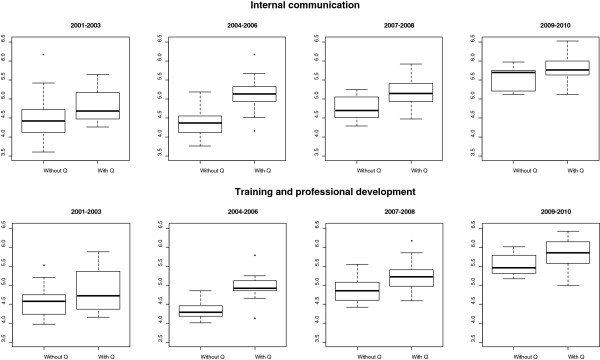
Comparing satisfaction results in organisations granted Gold or Silver Q Awards and those without this type of external recognition, we found statistically significant differences in the dimensions of training and internal communication. Then, comparing recipients of Gold Q Awards with those with no Q Certification, differences in leadership style and in policy and strategy also emerged as significant.
Progress of healthcare organisations in the implementation of the EFQM Excellence Model is associated with increases in their employee satisfaction in dimensions that can be managed at the level of each organisation, while dimensions in which no statistically significant differences were found represent common organisational elements with little scope for self-management.
确定在欧洲质量管理基金会(EFQM)模型实施方面取得更大进展的组织中员工满意度是否更高。
进行一系列横断面研究(每个评估周期一项),根据EFQM模型的实施程度(根据各组织管理质量的外部认可情况评估)比较医疗保健组织组之间的员工满意度调查结果。
30个医疗保健组织,包括巴斯克公共卫生服务机构Osakidetza的医院、初级保健机构和心理健康服务机构。
30个Osakidetza组织的员工。
EFQM模型的实施进展。
2001年至2010年期间4个评估周期内在医疗保健组织中进行问卷调查得出的员工满意度9个维度的得分。
比较获得金质或银质Q奖的组织与未获得此类外部认可的组织的满意度结果,我们发现培训和内部沟通维度存在统计学上的显著差异。然后,将金质Q奖获得者与无Q认证者进行比较,领导风格以及政策和战略方面的差异也很显著。
医疗保健组织在实施EFQM卓越模型方面的进展与各组织层面可管理维度上员工满意度的提高相关,而未发现统计学显著差异的维度代表了几乎没有自我管理空间的常见组织要素。