School of Nutrition and Health Sciences, College of Public Health and Nutrition, Taipei Medical University, Taipei 110, Taiwan.
BMC Complement Altern Med. 2014 Oct 25;14:415. doi: 10.1186/1472-6882-14-415.
Ginsenosides, the major bioactive compounds in ginseng root, have been found to have antioxidant, immunomodulatory and anti-inflammatory activities. This study investigated the effects of ginsenosides on carbon tetrachloride (CCl4)-induced hepatitis and liver fibrosis in rats.
Male Sprague-Dawley rats were randomly divided into four groups: control, CCl4, CCl4 + 0.5 g/kg Panax ginseng extract and CCl4 + 0.05 g/kg ginsenoside Rb1 groups. The treated groups were orally given Panax ginseng extract or ginsenoside Rb1 two weeks before the induction of liver injury for successive 9 weeks. Liver injury was induced by intraperitoneally injected with 400 ml/l CCl4 at a dose of 0.75 ml/kg body weight weekly for 7 weeks. The control group was intraperitoneally injected with olive oil.
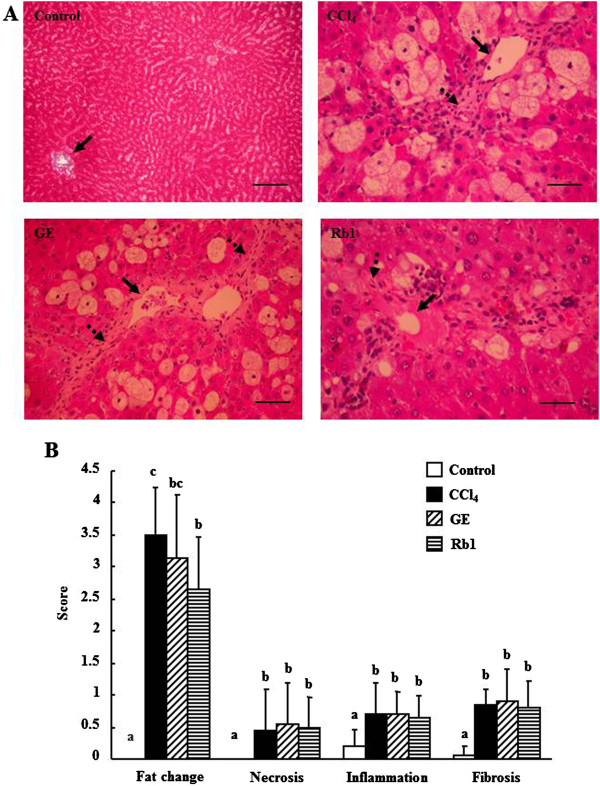
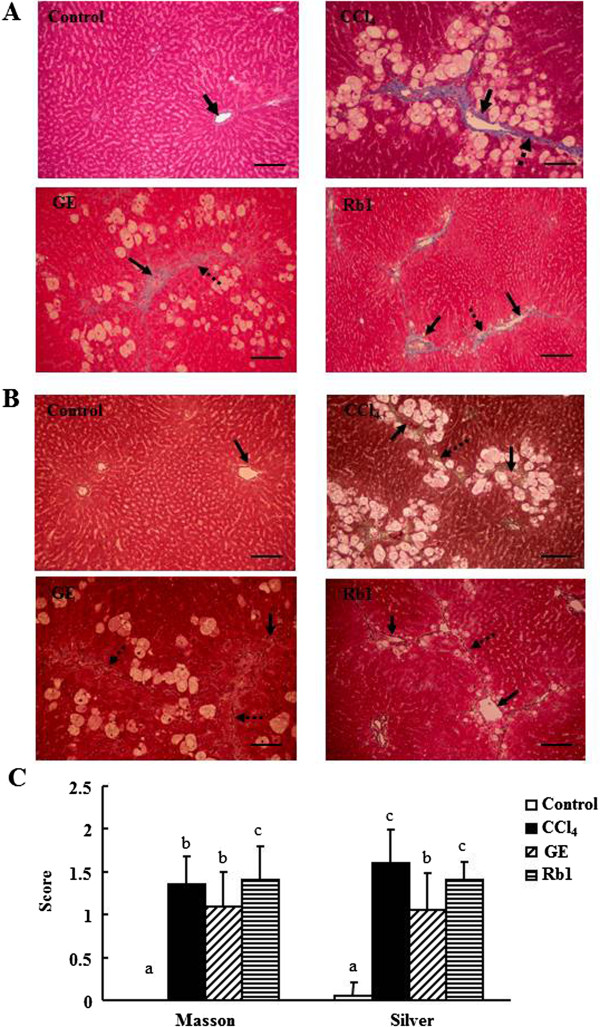
The pathological results showed that ginsenoside Rb1 decreased hepatic fat deposition (2.65 ± 0.82 vs 3.50 ± 0.75, p <0.05) and Panax ginseng extract lowered hepatic reticular fiber accumulation (1.05 ± 0.44 vs 1.60 ± 0.39, p <0.01) increased by CCl4. Plasma alanine aminotransferase and aspartate aminotransferase activities were increased by CCl4 (p <0.01), and aspartate aminotransferase activity was decreased by Panax ginseng extract at week 9 (p <0.05). Exposure to CCl4 for 7 weeks, the levels of plasma and hepatic triglycerides (p <0.01), hepatic cholesterol (p <0.01), interleukin-1β (p <0.01), prostaglandin E2 (p <0.05), soluble intercellular adhesion molecule-1 (p <0.05), hydroxyproline (p <0.05), matrix metalloproteinase-2 (p <0.05) and tissue inhibitor of metalloproteinase-1 (TIMP-1) (p <0.01) were elevated, however, hepatic interleukin-10 level was lowered (p <0.05). Both Panax ginseng extract and ginsenoside Rb1 decreased plasma and hepatic triglyceride, hepatic prostaglandin E2, hydroxyproline and TIMP-1 levels, and Panax ginseng extract further inhibited interleukin-1β concentrations (p <0.05).
Panax ginseng extract and ginsenoside Rb1 attenuate plasma aminotransferase activities and liver inflammation to inhibit CCl4-induced liver fibrosis through down-regulation of hepatic prostaglandin E2 and TIMP-1.
人参根中的主要生物活性化合物人参皂苷具有抗氧化、免疫调节和抗炎作用。本研究探讨了人参皂苷对四氯化碳(CCl4)诱导的大鼠肝炎和肝纤维化的影响。
雄性 Sprague-Dawley 大鼠随机分为四组:对照组、CCl4 组、CCl4+0.5g/kg 人参提取物组和 CCl4+0.05g/kg 人参皂苷 Rb1 组。治疗组在肝损伤诱导前连续 9 周每周口服给予人参提取物或人参皂苷 Rb1。每周一次通过腹腔注射 400ml/l CCl4 0.75ml/kg 体重,连续 7 周诱导肝损伤。对照组腹腔注射橄榄油。
病理结果显示,人参皂苷 Rb1 减少肝脂肪沉积(2.65±0.82 对 3.50±0.75,p<0.05),人参提取物降低肝网状纤维堆积(1.05±0.44 对 1.60±0.39,p<0.01),CCl4 所致升高。CCl4 使血浆丙氨酸氨基转移酶和天冬氨酸氨基转移酶活性升高(p<0.01),人参提取物在第 9 周使天冬氨酸氨基转移酶活性降低(p<0.05)。暴露于 CCl4 7 周后,血浆和肝组织甘油三酯(p<0.01)、胆固醇(p<0.01)、白细胞介素-1β(p<0.01)、前列腺素 E2(p<0.05)、可溶性细胞间黏附分子-1(p<0.05)、羟脯氨酸(p<0.05)、基质金属蛋白酶-2(p<0.05)和组织金属蛋白酶抑制剂-1(TIMP-1)(p<0.01)水平升高,而肝组织白细胞介素-10 水平降低(p<0.05)。人参提取物和人参皂苷 Rb1 均降低了血浆和肝组织甘油三酯、肝组织前列腺素 E2、羟脯氨酸和 TIMP-1 水平,且人参提取物进一步抑制了白细胞介素-1β浓度(p<0.05)。
人参提取物和人参皂苷 Rb1 通过下调肝组织前列腺素 E2 和 TIMP-1,减轻血浆氨基转移酶活性和肝脏炎症,抑制 CCl4 诱导的肝纤维化。