Chen Mei-Yen, Lai Li-Ju, Chen Hsiu-Chih, Gaete Jorge
College of Nursing, Chang Gung University of Science and Technology, No, 2, Chiapu Rd, West Sec,, Putz City, Chiayi County 61363, Taiwan.
BMC Public Health. 2014 Oct 26;14:1106. doi: 10.1186/1471-2458-14-1106.
Health-promoting lifestyle choices of adolescents are closely related to current and subsequent health status. However, parsimonious yet reliable and valid screening tools are scarce. The original 40-item adolescent health promotion (AHP) scale was developed by our research team and has been applied to measure adolescent health-promoting behaviors worldwide. The aim of our study was to examine the psychometric properties of a newly developed short-form version of the AHP (AHP-SF) including tests of its reliability and validity.
The study was conducted in nine middle and high schools in southern Taiwan. Participants were 814 adolescents randomly divided into two subgroups with equal size and homogeneity of baseline characteristics. The first subsample (calibration sample) was used to modify and shorten the factorial model while the second subsample (validation sample) was utilized to validate the result obtained from the first one. The psychometric testing of the AHP-SF included internal reliability of McDonald's omega and Cronbach's alpha, convergent validity, discriminant validity, and construct validity with confirmatory factor analysis (CFA).
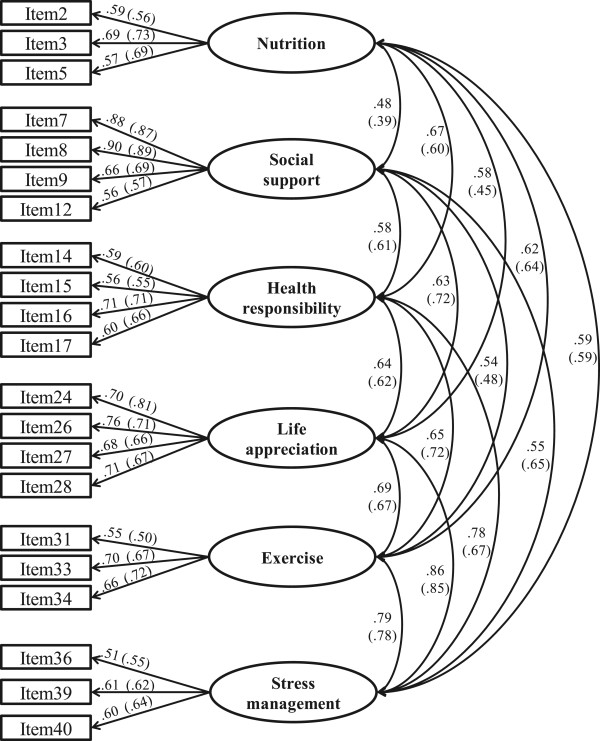
The results of the CFA supported a six-factor model and 21 items were retained in the AHP-SF with acceptable model fit. For the discriminant validity test, results indicated that adolescents with lower AHP-SF scores were more likely to be overweight or obese, skip breakfast, and spend more time watching TV and playing computer games. The AHP-SF also showed excellent internal consistency with a McDonald's omega of 0.904 (Cronbach's alpha 0.905) in the calibration group.
The current findings suggest that the AHP-SF is a valid and reliable instrument for the evaluation of adolescent health-promoting behaviors. Primary health care providers and clinicians can use the AHP-SF to assess these behaviors and evaluate the outcome of health promotion programs in the adolescent population.
青少年促进健康的生活方式选择与当前及后续的健康状况密切相关。然而,简洁且可靠有效的筛查工具却很稀缺。我们的研究团队开发了最初包含40个条目的青少年健康促进(AHP)量表,并已在全球范围内用于测量青少年促进健康的行为。我们研究的目的是检验新开发的AHP简版(AHP-SF)的心理测量特性,包括对其信度和效度的测试。
该研究在台湾南部的9所初中和高中进行。参与者为814名青少年,他们被随机分为两个规模相等且基线特征同质的亚组。第一个子样本(校准样本)用于修改和缩短因子模型,而第二个子样本(验证样本)用于验证从第一个样本获得的结果。AHP-SF的心理测量测试包括麦克唐纳ω系数和克朗巴赫α系数的内部信度、收敛效度、区分效度以及采用验证性因子分析(CFA)的结构效度。
CFA的结果支持一个六因子模型,AHP-SF保留了21个条目,模型拟合度可接受。对于区分效度测试,结果表明AHP-SF得分较低的青少年更有可能超重或肥胖、不吃早餐以及花更多时间看电视和玩电脑游戏。在校准组中,AHP-SF还显示出极好的内部一致性,麦克唐纳ω系数为0.904(克朗巴赫α系数为0.905)。
目前的研究结果表明,AHP-SF是评估青少年促进健康行为的有效且可靠的工具。初级卫生保健提供者和临床医生可以使用AHP-SF来评估这些行为,并评估青少年人群健康促进项目的效果。