Biochemistry Department, Science College, King Saud University, P,O box 22452, Zip code 11495 Riyadh, Saudi Arabia.
BMC Complement Altern Med. 2014 Oct 25;14:416. doi: 10.1186/1472-6882-14-416.
Reducing exposure to toxic environmental agents is a critical area of intervention. Prenatal or postnatal exposure to certain chemicals has been documented to increase the risk of autism spectrum disorder. Propionic acid (PA) found in some foods and formed as a metabolic product of gut microbiota has been reported to mediate the effects of autism. Results from animal studies may help to identify environmental contaminants and drugs that produce or prevent neurotoxicity, and may thereby aid in the treatment of neurodevelopmental disorders such as autism. The present study investigated the protective and/or therapeutic effects of vitamin D against brain intoxication induced by propionic acid (PPA) in rats.
Twenty-eight young male Western Albino rats were enrolled in the present study. They were grouped into four equal groups of 7. The control group received only phosphate buffered saline; the oral buffered PPA-treated group received a neurotoxic dose of 250 mg/kg body weight/day for 3 days; and the Vitamin D-protected group received 1000 IU/kg/day of alpha, 25-dihydroxyvitamin D (3) (1, 25-VD) for two weeks, after which the rats were injected with PPA 250 mg/Kg body weight/day for 3 days. The fourth group received PPA 250 mg/Kg body weight/day for 3 days followed by alpha, 25-dihydroxyvitamin D (3) (1, 25-VD) for two weeks (Vitamin D therapeutic effect). Vitamin D and calcium were measured in the plasma of the four studied groups. Serotonin, interferon gamma (IFN-γ), glutathione-s-transferase activity and DNA double helix breaks were assayed in the brain tissue of the rats for all groups.
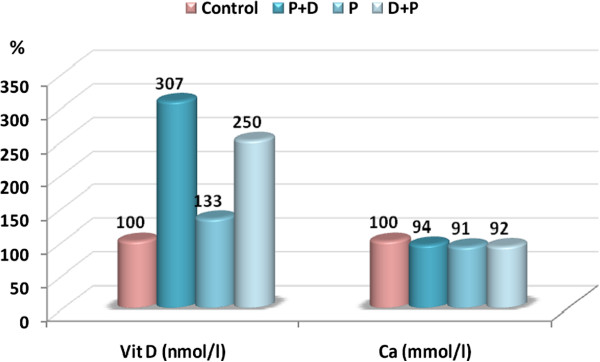
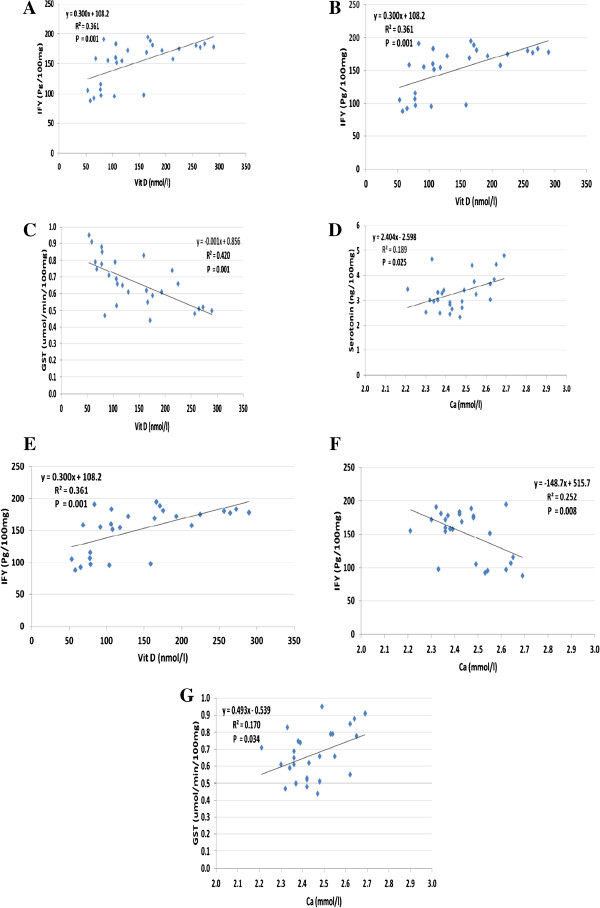
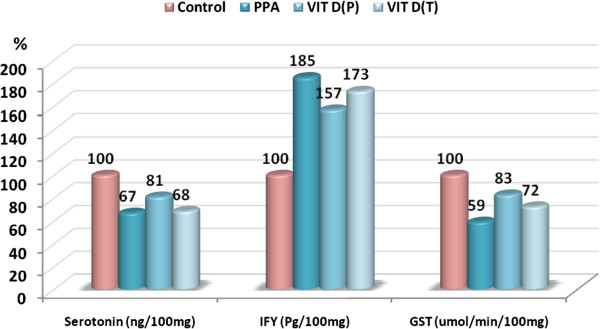
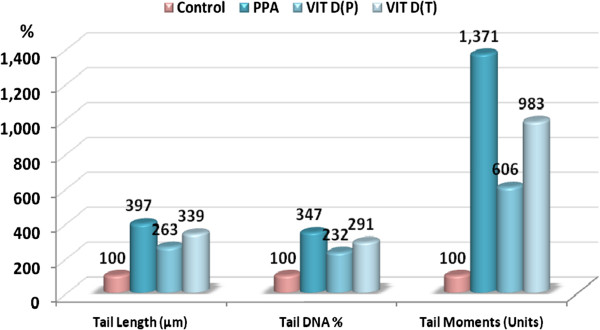
The obtained data showed that the PPA-treated group demonstrated higher plasma vitamin D levels compared to the control rats, together with multiple signs of brain toxicity, as indicated by a depletion of serotonin (5HT), an increase in IFN-γ and inhibition of glutathione-s-transferase activity as three biomarkers of brain dysfunction. Additionally, Comet DNA assays showed remarkably higher tail length, tail DNA % damage and tail moment as a neurotoxic effect of PPA.
Vitamin D showed a greater protective than therapeutic effect on PPA-induced neurotoxicity in rats, as there was a remarkable amelioration of the impaired biochemically measured parameters representing neurochemical, inflammation, and detoxification processes.
减少接触有毒环境因素是一个关键的干预领域。已经有文献记录表明,产前或产后接触某些化学物质会增加自闭症谱系障碍的风险。丙酸(PA)存在于某些食物中,并作为肠道微生物群的代谢产物形成,据报道会介导自闭症的发生。动物研究的结果可能有助于识别产生或预防神经毒性的环境污染物和药物,从而有助于治疗自闭症等神经发育障碍。本研究旨在探讨维生素 D 对丙酸(PPA)诱导的大鼠脑中毒的保护和/或治疗作用。
本研究纳入 28 只雄性 Western Albino 大鼠,随机分为 4 组,每组 7 只。对照组仅给予磷酸盐缓冲液;口服缓冲 PPA 处理组给予 250mg/kg 体重/天的神经毒性剂量,连续 3 天;维生素 D 保护组给予 1000IU/kg/天的α,25-二羟基维生素 D(3)(1,25-VD),连续 2 周,然后给予 250mg/kg 体重/天的 PPA 连续 3 天。第 4 组给予 250mg/kg 体重/天的 PPA 连续 3 天,然后给予α,25-二羟基维生素 D(3)(1,25-VD)连续 2 周(维生素 D 治疗效果)。检测 4 组大鼠血浆中的维生素 D 和钙。检测各组大鼠脑组织中的 5-羟色胺、干扰素 γ(IFN-γ)、谷胱甘肽-S-转移酶活性和 DNA 双螺旋断裂。
与对照组大鼠相比,PPA 处理组大鼠的血浆维生素 D 水平升高,同时出现多种脑毒性迹象,表现为 5-羟色胺(5HT)耗竭、IFN-γ 增加和谷胱甘肽-S-转移酶活性抑制,作为脑功能障碍的三个生物标志物。此外,彗星 DNA 检测显示,PPA 引起的尾长、尾 DNA%损伤和尾矩显著增加,表明其具有神经毒性作用。
与治疗作用相比,维生素 D 对 PPA 诱导的大鼠神经毒性具有更强的保护作用,因为神经化学、炎症和解毒过程中受损的生化测量参数有明显改善。