Islam Mohammad R, Ellis Ian R, Macluskey Michaelina, Cochrane Lynda, Jones Sarah J
Division of Oral and Maxillofacial Clinical Sciences, The Dental School, University of Dundee, Dundee, DD1 4HR UK.
Division of Population Health Science, Medical Research Institute, University of Dundee, Dundee, DD2 4BF UK.
Exp Hematol Oncol. 2014 Oct 17;3(1):25. doi: 10.1186/2162-3619-3-25. eCollection 2014.
Tobacco, alcohol and HPV infection are associated with increased risk of HNSCC. However, little is known about the underlying signaling events influencing risk. We aimed to investigate the relationship between these risk factors and Akt phosphorylation, to determine prognostic value.
VEGF-positive HNSCC biopsies, with known HPV status, were analyzed by immunohistochemistry (IHC) for Akt, phosphorylated at residues S473 and T308. Comparisons between the tissues were carried out using a Mann-Whitney U test. Associations between the variables and continuous immunohistochemical parameters were evaluated with general linear models. Patient characteristics and pAkt IHC score were analyzed for possible association with overall survival by Cox proportional hazard models.
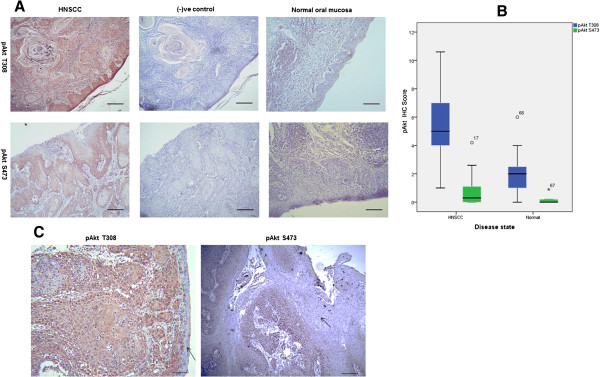
Immunohistochemistry revealed that cancer patients had significantly higher levels of pAkt T308 than S473 (P < 0.001). Smoking and alcohol were found to be independent risk factors for Akt phosphorylation at T308 (P = 0.022 and 0.027, respectively). Patients with tumors positive for HPV or pAkt S473 had a poorer prognosis (P = 0.005, and 0.004, respectively). Patients who were heavy drinkers were 49 times more likely to die than non-drinkers (P = 0.003). Patients with low pAkt T308 were more likely to be HPV positive (P = 0.028). Non-drinkers were also found to have lower levels of pAkt T308 and were more likely to have tumors positive for HPV than heavy drinkers (P = 0.044 and 0.007, respectively).
This study suggests different mechanisms of carcinogenesis are initiated by smoking, alcohol and HPV. Our data propose higher phosphorylation of Akt at T308 as a reliable biomarker for smoking and alcohol induced HNSCC progression and higher phosphorylation of Akt at S473 as a prognostic factor for HNSCC.
烟草、酒精和人乳头瘤病毒(HPV)感染与头颈部鳞状细胞癌(HNSCC)风险增加相关。然而,对于影响风险的潜在信号事件知之甚少。我们旨在研究这些风险因素与Akt磷酸化之间的关系,以确定其预后价值。
对已知HPV状态的VEGF阳性HNSCC活检组织进行免疫组织化学(IHC)分析,检测Akt在S473和T308位点的磷酸化情况。使用Mann-Whitney U检验对组织进行比较。通过一般线性模型评估变量与连续免疫组织化学参数之间的关联。采用Cox比例风险模型分析患者特征和pAkt IHC评分与总生存期的可能关联。
免疫组织化学显示,癌症患者中pAkt T308水平显著高于S473(P<0.001)。吸烟和酒精被发现是Akt在T308位点磷酸化的独立风险因素(分别为P = 0.022和0.027)。HPV或pAkt S473呈阳性的肿瘤患者预后较差(分别为P = 0.005和0.004)。重度饮酒者死亡的可能性是非饮酒者的49倍(P = 0.003)。pAkt T308水平低的患者更可能HPV呈阳性(P = 0.028)。还发现非饮酒者的pAkt T308水平较低,且比重度饮酒者更可能有HPV阳性肿瘤(分别为P = 0.044和0.007)。
本研究表明,吸烟、酒精和HPV引发了不同的致癌机制。我们的数据表明,Akt在T308位点的较高磷酸化是吸烟和酒精诱导的HNSCC进展的可靠生物标志物,而Akt在S473位点的较高磷酸化是HNSCC的预后因素。