Ilie Marius, Hofman Véronique, Long-Mira Elodie, Selva Eric, Vignaud Jean-Michel, Padovani Bernard, Mouroux Jérôme, Marquette Charles-Hugo, Hofman Paul
Laboratory of Clinical and Experimental Pathology, Pasteur Hospital, Nice, France; Human Biobank BB-0033-00025, Pasteur Hospital, Nice, France; IRCAN Team 3, INSERM U1081/UMR CNRS 7284, Faculty of Medicine of Nice, University of Nice Sophia Antipolis, Nice, France.
Laboratory of Clinical and Experimental Pathology, Pasteur Hospital, Nice, France; IRCAN Team 3, INSERM U1081/UMR CNRS 7284, Faculty of Medicine of Nice, University of Nice Sophia Antipolis, Nice, France.
PLoS One. 2014 Oct 31;9(10):e111597. doi: 10.1371/journal.pone.0111597. eCollection 2014.
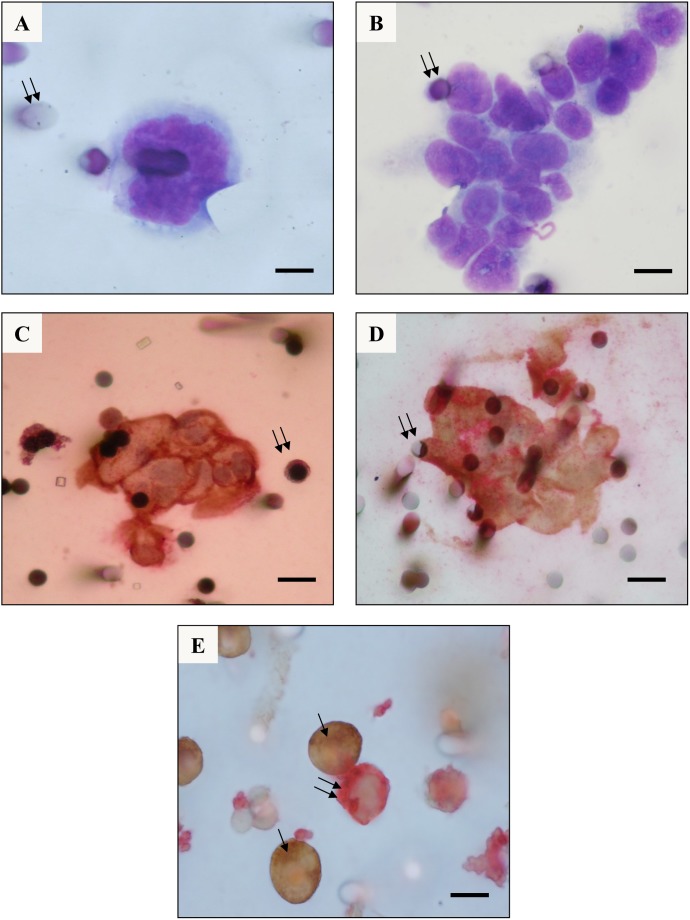
Chronic obstructive pulmonary disease (COPD) is a risk factor for lung cancer. Migration of circulating tumor cells (CTCs) into the blood stream is an early event that occurs during carcinogenesis. We aimed to examine the presence of CTCs in complement to CT-scan in COPD patients without clinically detectable lung cancer as a first step to identify a new marker for early lung cancer diagnosis. The presence of CTCs was examined by an ISET filtration-enrichment technique, for 245 subjects without cancer, including 168 (68.6%) COPD patients, and 77 subjects without COPD (31.4%), including 42 control smokers and 35 non-smoking healthy individuals. CTCs were identified by cytomorphological analysis and characterized by studying their expression of epithelial and mesenchymal markers. COPD patients were monitored annually by low-dose spiral CT. CTCs were detected in 3% of COPD patients (5 out of 168 patients). The annual surveillance of the CTC-positive COPD patients by CT-scan screening detected lung nodules 1 to 4 years after CTC detection, leading to prompt surgical resection and histopathological diagnosis of early-stage lung cancer. Follow-up of the 5 patients by CT-scan and ISET 12 month after surgery showed no tumor recurrence. CTCs detected in COPD patients had a heterogeneous expression of epithelial and mesenchymal markers, which was similar to the corresponding lung tumor phenotype. No CTCs were detected in control smoking and non-smoking healthy individuals. CTCs can be detected in patients with COPD without clinically detectable lung cancer. Monitoring "sentinel" CTC-positive COPD patients may allow early diagnosis of lung cancer.
慢性阻塞性肺疾病(COPD)是肺癌的一个危险因素。循环肿瘤细胞(CTC)向血流中的迁移是癌症发生过程中出现的早期事件。我们旨在检测无临床可检测到肺癌的COPD患者中CTC的存在情况,作为识别早期肺癌诊断新标志物的第一步,以补充CT扫描。通过ISET过滤富集技术检测245名无癌症受试者中CTC的存在情况,其中包括168名(68.6%)COPD患者和77名无COPD受试者(31.4%),后者包括42名对照吸烟者和35名非吸烟健康个体。通过细胞形态学分析鉴定CTC,并通过研究其上皮和间充质标志物的表达对其进行表征。每年用低剂量螺旋CT对COPD患者进行监测。在3%的COPD患者(168名患者中的5名)中检测到了CTC。对CTC阳性的COPD患者进行CT扫描筛查的年度监测发现,在检测到CTC后1至4年发现了肺结节,从而促使对早期肺癌进行手术切除和组织病理学诊断。术后12个月通过CT扫描和ISET对这5名患者进行随访,未发现肿瘤复发。在COPD患者中检测到的CTC具有上皮和间充质标志物的异质性表达,这与相应的肺肿瘤表型相似。在对照吸烟者和非吸烟健康个体中未检测到CTC。在无临床可检测到肺癌的COPD患者中可以检测到CTC。监测“哨兵”CTC阳性的COPD患者可能有助于早期诊断肺癌。