Pineda-Tenor Daniel, Berenguer Juan, Jiménez-Sousa María A, García-Alvarez Mónica, Aldámiz-Echevarria Teresa, Carrero Ana, Vázquez-Morón Sonia, García-Broncano Pilar, Diez Cristina, Tejerina Francisco, Guzmán-Fulgencio María, Resino Salvador
BMC Med. 2014 Nov 3;12:198. doi: 10.1186/s12916-014-0198-y.
The Fat Mass and Obesity-Associated Protein (FTO) gene rs9939609 single nucleotide polymorphism (SNP) has been associated with obesity, metabolic syndrome, insulin resistance (IR), and type 2 diabetes mellitus in the general population. The aim of our study was to examine for the first time the association of the rs9939609 polymorphism with metabolic disturbances, liver disease and virologic response to hepatitis C virus (HCV) therapy with pegylated-interferon-alpha plus ribavirin (pegIFNα/RBV) in human immunodeficiency virus (HIV)/HCV coinfected patients.
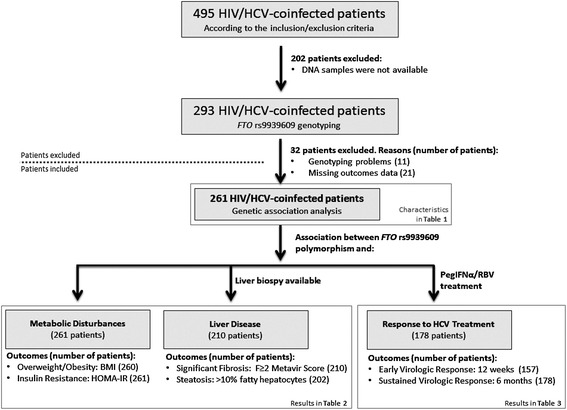
We carried out a cross-sectional study in 261 patients, of whom 178 were subsequently treated with pegIFNα/RBV therapy. FTO rs9939609 and IFNL3 rs12980275 polymorphisms were genotyped by GoldenGate®. The main outcomes were: 1) metabolic disturbances: insulin resistance (homeostatic model assessment (HOMA-IR)) and overweight (body mass index (BMI)); 2) liver disease (Metavir score): significant fibrosis (F ≥2) and steatosis (>10% fatty hepatocytes); and 3) virologic response to HCV treatment: sustained virologic response (SVR).
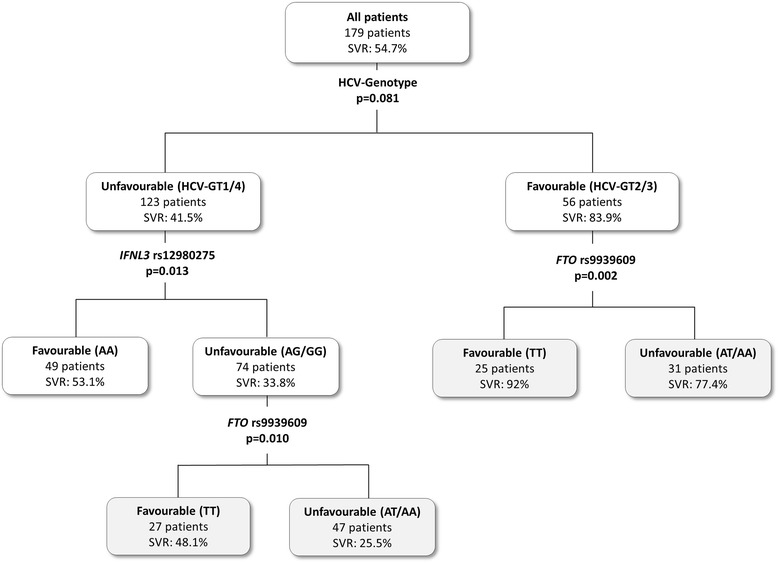
The rs9939609 AA genotype was associated with higher values of BMI (adjusted arithmetic mean ratio (aAMR) = 1.08; 95% confidence interval (95%CI) = 1.03 to 1.14; P = 0.002) and HOMA-IR (aAMR = 1.32; 95%CI = 1.03 to 1.69; P = 0.027). Patients with an rs9939609 AA genotype had higher likelihoods of achieving values of BMI ≥27.5 kg/m2 (adjusted odds ratio (aOR) = 3.46; 95%CI =1.17 to 10.21; P = 0.024), HOMA-IR ≥2.5 (aOR = 2.09; 95%CI = 1.02 to 4.32; P = 0.045), significant fibrosis (aOR = 2.34; 95%CI =1.02 to 5.36; P = 0.045) and steatosis (aOR = 3.65; 95%CI = 1.29 to 10.36; P = 0.015). The rs9939609 AT/AA genotype decreased the likelihood of achieving SVR (aOR = 0.58; 95%CI = 0.34 to 0.99; P = 0.044). A decision tree was performed with the genotypes of HCV, IFNL3 and FTO. The incorporation of rs9939609 significantly improves the prediction of SVR (P <0.05). The overall accuracy was 68.2%.
Patients carrying the unfavourable AT/AA genotype of rs9939609 polymorphism had higher odds of metabolic disturbances and a lower likelihood of achieving successful virologic response to HCV therapy.
脂肪量与肥胖相关蛋白(FTO)基因rs9939609单核苷酸多态性(SNP)与普通人群的肥胖、代谢综合征、胰岛素抵抗(IR)及2型糖尿病相关。我们研究的目的是首次检测rs9939609多态性与人类免疫缺陷病毒(HIV)/丙型肝炎病毒(HCV)合并感染患者的代谢紊乱、肝脏疾病以及聚乙二醇化干扰素α加利巴韦林(pegIFNα/RBV)治疗HCV的病毒学应答之间的关联。
我们对261例患者进行了一项横断面研究,其中178例随后接受了pegIFNα/RBV治疗。采用基因分型技术对FTO rs9939609和IFNL3 rs12980275多态性进行基因分型。主要观察指标为:1)代谢紊乱:胰岛素抵抗(稳态模型评估(HOMA-IR))和超重(体重指数(BMI));2)肝脏疾病(梅塔维评分):显著纤维化(F≥2)和脂肪变性(>10%脂肪性肝细胞);3)HCV治疗的病毒学应答:持续病毒学应答(SVR)。
rs9939609 AA基因型与较高的BMI值(校正算术平均比(aAMR)= = 1.08;95%置信区间(95%CI)= 1.03至1.14;P = 0.002)和HOMA-IR(aAMR = 1.32;95%CI = 1.03至1.69;P = 0.027)相关。rs9939609 AA基因型的患者达到BMI≥27.5 kg/m2值的可能性更高(校正比值比(aOR)= 3.46;95%CI =1.17至10.21;P = 0.024),HOMA-IR≥2.5(aOR = 2.09;95%CI = 1.02至4.32;P = 0.045),显著纤维化(aOR = 2.34;95%CI =1.02至5.36;P = 0.045)和脂肪变性(aOR = 3.65;95%CI = 1.2至10.36;P = 0.015)。rs9939609 AT/AA基因型降低了达到SVR的可能性(aOR = 0.58;95%CI = 0.34至0.99;P = 0.044)。利用HCV、IFNL3和FTO的基因型构建了决策树。纳入rs9939609显著提高了SVR的预测能力(P <0.05)。总体准确率为68.2%。
携带rs9939609多态性不利的AT/AA基因型的患者发生代谢紊乱的几率更高,且HCV治疗获得成功病毒学应答的可能性更低。