Abuzeid M I, Bolonduro O, La Chance J, Abozaid T, Urich M, Ullah K, Ali T, Ashraf M, Khan I
Division of Reproductive Endocrinology and Infertility, Department of Obstetrics and Gynecology, Hurley Medical Center, Flint, Michigan, United States, 48503. ; IVF Michigan, PC, Rochester Hills, Michigan, United States, 48307.
Division of Reproductive Endocrinology and Infertility, Department of Obstetrics and Gynecology, Hurley Medical Center, Flint, Michigan, United States, 48503.
Facts Views Vis Obgyn. 2014;6(3):145-9.
Many studies on assisted reproductive technology examine live birth rate per cycle. However, after a cycle fails, couples often want to know what their chances are of having a live birth if they continue treatment. From a patients' perspective, the cumulative probability of live birth is more informative.
This study includes patients who underwent fresh, frozen and non-donor ICSI cycles at our IVF unit between 2006-2012. Patients were divided into two groups; Group 1 represented those who underwent only Day 5 transfers, Group 2 represented only Day 3 transfers. Patients who underwent both were excluded. -Cycles were analyzed until the first live birth or the end of the 3rd cycle. Using Kaplan-Meier analysis, we estimated the cumulative live birth rates for each group and according to female age.
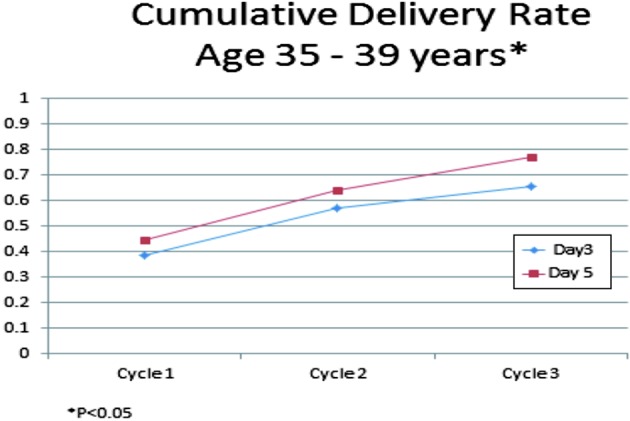
The mean age for Group 1 was significantly lower than for Group 2. After 3 cycles, Group 1's CLBR was 79% versus 66% in Group 2. When analyzing the live births by age and group, there was a significant difference in the CLBR after 3 cycles with the women less than 35 years having the highest CLBR and the women 40 years or older having the lowest CLBR.
In women less than 35 years, excellent CLBR can be achieved irrespective of the transfer day. For women 40 years and above, better results of CLBR are observed with Day 5 transfers. Our findings may impact the counseling of couples considering IVF treatment.
许多关于辅助生殖技术的研究都考察每个周期的活产率。然而,在一个周期失败后,夫妇们通常想知道如果继续治疗,他们活产的几率有多大。从患者的角度来看,活产的累积概率更具参考价值。
本研究纳入了2006年至2012年间在我们体外受精中心接受新鲜、冷冻及非供体卵胞浆内单精子注射周期治疗的患者。患者被分为两组;第1组为仅接受第5天胚胎移植的患者,第2组为仅接受第3天胚胎移植的患者。接受过两种移植方式的患者被排除。对周期进行分析,直至首次活产或第3个周期结束。使用Kaplan-Meier分析方法,我们估计了每组以及根据女性年龄的累积活产率。
第1组的平均年龄显著低于第2组。3个周期后,第1组的累积活产率为79%,而第2组为66%。按年龄和组分析活产情况时,3个周期后的累积活产率存在显著差异,年龄小于35岁的女性累积活产率最高,40岁及以上的女性累积活产率最低。
对于年龄小于35岁的女性,无论移植日如何,均可获得优异的累积活产率。对于40岁及以上的女性,第5天胚胎移植的累积活产率结果更佳。我们的研究结果可能会影响考虑体外受精治疗的夫妇的咨询。