Krens Lisanne L, Simkens Lieke H J, Baas Jara M, Koomen Els R, Gelderblom Hans, Punt Cornelis J A, Guchelaar Henk-Jan
Dept. of Clinical Pharmacy and Toxicology, Leiden University Medical Center, Leiden, The Netherlands.
Dept. of Medical Oncology, Academic Medical Center, University of Amsterdam, Amsterdam, The Netherlands.
PLoS One. 2014 Nov 6;9(11):e112201. doi: 10.1371/journal.pone.0112201. eCollection 2014.
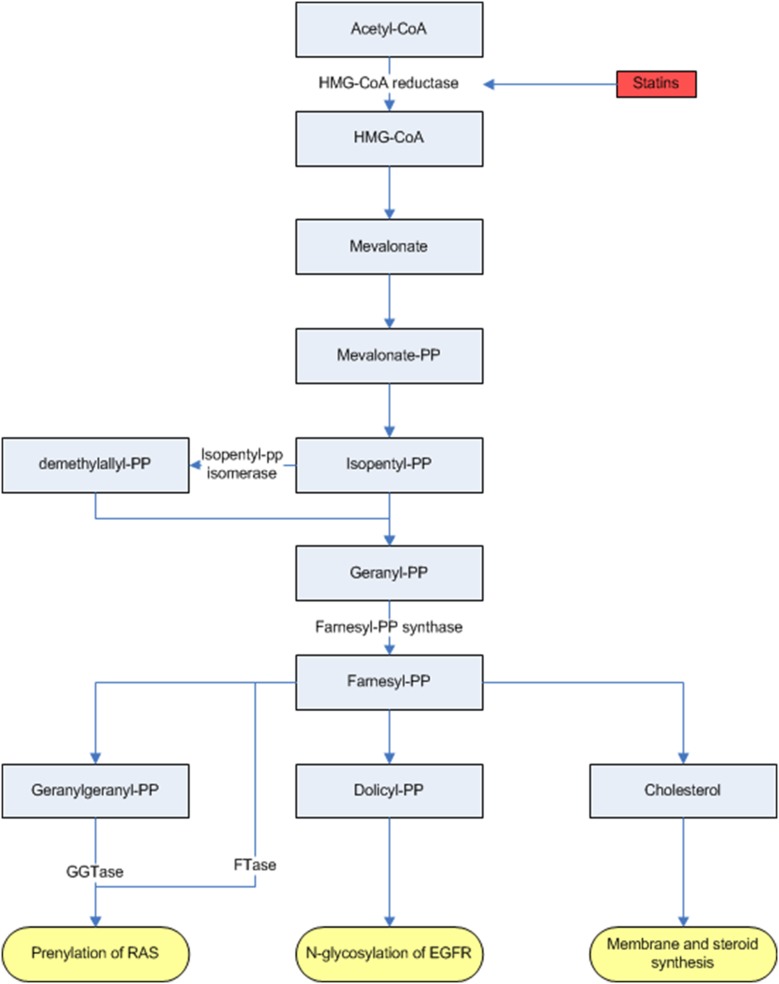
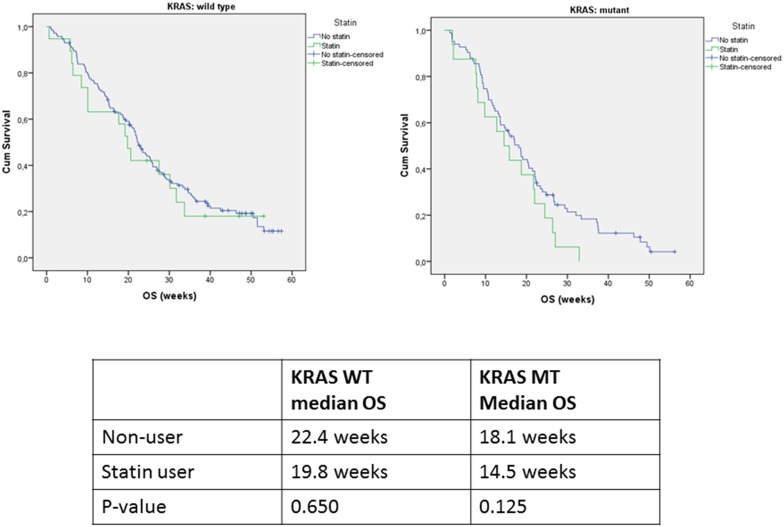
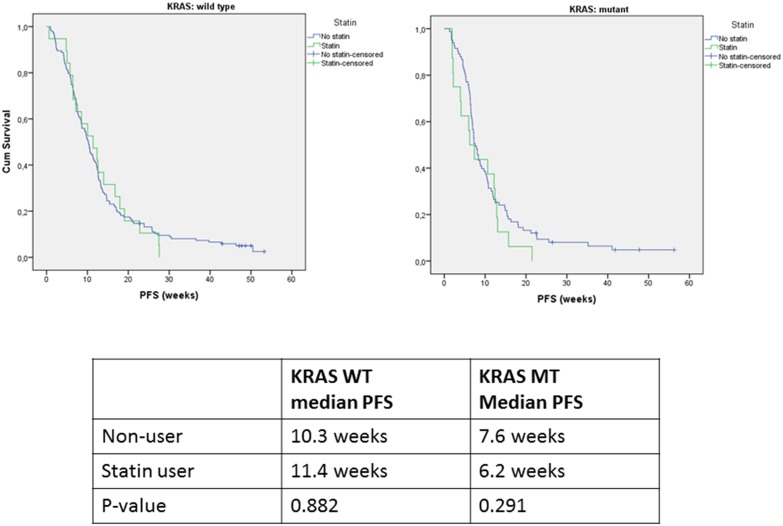
Statins may inhibit the expression of the mutant KRAS phenotype by preventing the prenylation and thus the activation of the KRAS protein. This study was aimed at retrospectively evaluating the effect of statin use on outcome in KRAS mutant metastatic colorectal cancer patients (mCRC) treated with cetuximab. Treatment data were obtained from patients who were treated with capecitabine, oxaliplatin bevacizumab ± cetuximab in the phase III CAIRO2 study. A total of 529 patients were included in this study, of whom 78 patients were on statin therapy. In patients with a KRAS wild type tumor (n = 321) the median PFS was 10.3 vs. 11.4 months for non-users compared to statin users and in patients with a KRAS mutant tumor (n = 208) this was 7.6 vs. 6.2 months, respectively. The hazard ratio (HR) for PFS for statin users was 1.12 (95% confidence interval 0.78-1.61) and was not influenced by treatment arm, KRAS mutation status or the KRAS*statin interaction. Statin use adjusted for covariates was not associated with increased PFS (HR = 1.01, 95% confidence interval 0.71-1.54). In patients with a KRAS wild type tumor the median OS for non-users compared to statin users was 22.4 vs. 19.8 months and in the KRAS mutant tumor group the OS was 18.1 vs. 14.5 months. OS was significantly shorter in statin users versus non-users (HR = 1.54; 95% confidence interval 1.06-2.22). However, statin use, adjusted for covariates was not associated with increased OS (HR = 1.41, 95% confidence interval 0.95-2.10). In conclusion, the use of statins at time of diagnosis was not associated with an improved PFS in KRAS mutant mCRC patients treated with chemotherapy and bevacizumab plus cetuximab.
他汀类药物可能通过阻止异戊二烯化从而抑制KRAS蛋白的激活,进而抑制突变型KRAS表型的表达。本研究旨在回顾性评估使用他汀类药物对接受西妥昔单抗治疗的KRAS突变型转移性结直肠癌患者(mCRC)预后的影响。治疗数据来自在III期CAIRO2研究中接受卡培他滨、奥沙利铂、贝伐单抗±西妥昔单抗治疗的患者。本研究共纳入529例患者,其中78例接受他汀类药物治疗。在KRAS野生型肿瘤患者(n = 321)中,未使用他汀类药物的患者中位无进展生存期(PFS)为10.3个月,而使用他汀类药物的患者为11.4个月;在KRAS突变型肿瘤患者(n = 208)中,这一数值分别为7.6个月和6.2个月。使用他汀类药物患者的PFS风险比(HR)为1.12(95%置信区间0.78 - 1.61),且不受治疗组、KRAS突变状态或KRAS*他汀类药物相互作用的影响。经协变量调整后,使用他汀类药物与PFS增加无关(HR = 1.01,95%置信区间0.71 - 1.54)。在KRAS野生型肿瘤患者中,未使用他汀类药物的患者与使用他汀类药物的患者相比,中位总生存期(OS)分别为22.4个月和19.8个月;在KRAS突变型肿瘤组中,OS分别为18.1个月和14.5个月。使用他汀类药物的患者OS明显短于未使用者(HR = 1.54;95%置信区间1.06 - 2.22)。然而,经协变量调整后,使用他汀类药物与OS增加无关(HR = 1.41,95%置信区间0.95 - 2.10)。总之,在接受化疗、贝伐单抗加西妥昔单抗治疗的KRAS突变型mCRC患者中,诊断时使用他汀类药物与PFS改善无关。