Fleming Aoife, Bradley Colin, Cullinan Shane, Byrne Stephen
Pharmaceutical Care Research Group, School of Pharmacy, University College Cork, Ireland.
Department of General Practice, University College Cork, Ireland.
BMJ Open. 2014 Nov 5;4(11):e006442. doi: 10.1136/bmjopen-2014-006442.
To explore healthcare professionals' views of antibiotic prescribing in long-term care facilities (LTCFs). To use the findings to recommend intervention strategies for antimicrobial stewardship in LTCFs.
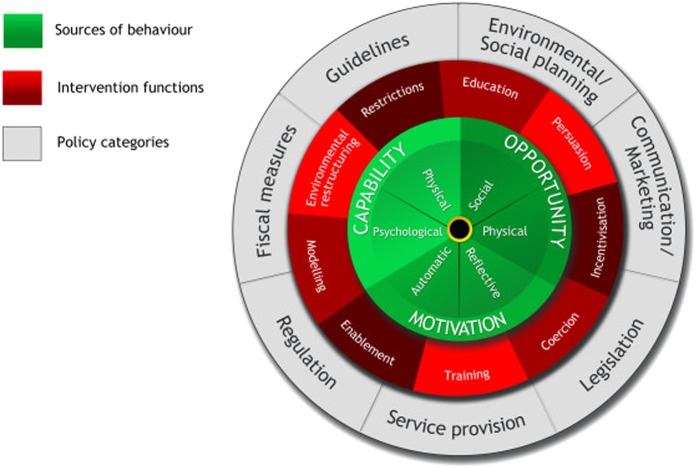
Qualitative semistructured interviews were conducted. The data were analysed by thematic content analysis. After the interviews, the emerging findings were mapped to the theoretical domains framework (TDF), and the behaviour change wheel and behaviour change technique (BCT) taxonomy were used to recommend future intervention strategies.
Interviews were conducted with 37 healthcare professionals who work in LTCFs (10 general practitioners, 4 consultants, 14 nurses, 9 pharmacists) between December 2012 and March 2013.
Interviews were conducted in the greater Cork region.
The main domains from the TDF which emerged were: 'Knowledge', 'Environmental context and resources', 'Social influences', 'Beliefs about consequences', 'Memory, attention and decision making', with the findings identifying a need for 'Behavioural regulation'. Many participants believed that antibiotic prescribing was satisfactory at their LTCF, despite the lack of surveillance activities.
This study, using the TDF and BCT taxonomy, has found that antibiotic prescribing in LTCFs is influenced by many social and contextual factors. The challenges of the setting and patient population, the belief about consequences to the patient, and the lack of implementation of guidelines and knowledge regarding antibiotic prescribing patterns are significant challenges to address. On the basis of the study findings and the application of the TDF and BCT taxonomy, we suggest some practical intervention functions for antimicrobial stewardship in LTCFs.
探讨医疗保健专业人员对长期护理机构(LTCFs)抗生素处方的看法。利用研究结果为长期护理机构的抗菌药物管理推荐干预策略。
进行了定性半结构化访谈。通过主题内容分析对数据进行分析。访谈后,将新出现的研究结果映射到理论领域框架(TDF),并使用行为改变轮和行为改变技术(BCT)分类法推荐未来的干预策略。
2012年12月至2013年3月期间,对37名在长期护理机构工作的医疗保健专业人员进行了访谈(10名全科医生、4名顾问、14名护士、9名药剂师)。
在科克大区进行访谈。
TDF中出现的主要领域有:“知识”、“环境背景与资源”、“社会影响”、“对后果的信念”、“记忆、注意力与决策”,研究结果表明需要“行为规范”。许多参与者认为,尽管缺乏监测活动,但他们所在的长期护理机构的抗生素处方情况令人满意。
本研究使用TDF和BCT分类法发现,长期护理机构的抗生素处方受到许多社会和环境因素的影响。该环境和患者群体的挑战、对患者后果的信念,以及抗生素处方模式指南的缺乏实施和相关知识,都是需要应对的重大挑战。基于研究结果以及TDF和BCT分类法的应用,我们为长期护理机构的抗菌药物管理提出了一些实际干预功能。