
后生动物之前钙黏蛋白黏附体的起源与进化
Pre-metazoan origins and evolution of the cadherin adhesome.
作者信息
Murray Paul S, Zaidel-Bar Ronen
机构信息
Department of Biochemistry and Molecular Biophysics, Columbia University, New York, NY 10032, USA Center of Computational Biology and Bioinformatics, Department of Systems Biology, Columbia University, Irving Cancer Research Center, New York, NY 10032, USA.
Mechanobiology Institute Singapore, National University of Singapore, Singapore 117411 Department of Biomedical Engineering, National University of Singapore, Singapore 117575
出版信息
Biol Open. 2014 Nov 13;3(12):1183-95. doi: 10.1242/bio.20149761.
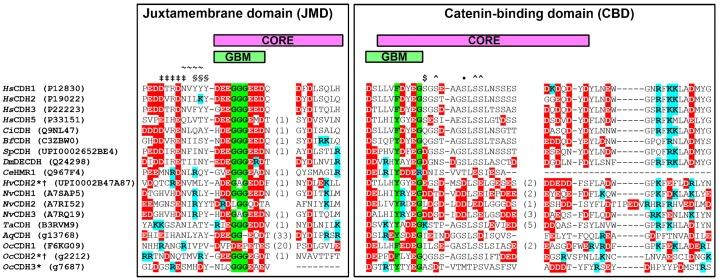
Vertebrate adherens junctions mediate cell-cell adhesion via a "classical" cadherin-catenin "core" complex, which is associated with and regulated by a functional network of proteins, collectively named the cadherin adhesome ("cadhesome"). The most basal metazoans have been shown to conserve the cadherin-catenin "core", but little is known about the evolution of the cadhesome. Using a bioinformatics approach based on both sequence and structural analysis, we have traced the evolution of this larger network in 26 organisms, from the uni-cellular ancestors of metazoans, through basal metazoans, to vertebrates. Surprisingly, we show that approximately 70% of the cadhesome, including proteins with similarity to the catenins, predate metazoans. We found that the transition to multicellularity was accompanied by the appearance of a small number of adaptor proteins, and we show how these proteins may have helped to integrate pre-metazoan sub-networks via PDZ domain-peptide interactions. Finally, we found the increase in network complexity in higher metazoans to have been driven primarily by expansion of paralogs. In summary, our analysis helps to explain how the complex protein network associated with cadherin at adherens junctions first came together in the first metazoan and how it evolved into the even more complex mammalian cadhesome.
脊椎动物的黏着连接通过一种“经典的”钙黏蛋白-连环蛋白“核心”复合体介导细胞间黏附,该复合体与一个蛋白质功能网络相关联并受其调控,这个蛋白质功能网络统称为钙黏蛋白黏附体(“黏附体”)。已表明最基础的后生动物保留了钙黏蛋白-连环蛋白“核心”,但对黏附体的进化了解甚少。利用基于序列和结构分析的生物信息学方法,我们追踪了这个更大网络在26种生物中的进化过程,从后生动物的单细胞祖先,到基础后生动物,再到脊椎动物。令人惊讶的是,我们发现约70%的黏附体,包括与连环蛋白相似的蛋白质,在中生动物之前就已存在。我们发现向多细胞性的转变伴随着少量衔接蛋白的出现,并且我们展示了这些蛋白质可能如何通过PDZ结构域-肽相互作用帮助整合后生动物前的子网。最后,我们发现高等后生动物中网络复杂性的增加主要是由旁系同源物的扩增驱动的。总之,我们的分析有助于解释与黏着连接处钙黏蛋白相关的复杂蛋白质网络最初是如何在第一种后生动物中聚集在一起的,以及它是如何进化成更加复杂的哺乳动物黏附体的。




 Zotero 插件