Jacob Rebekah R, Baker Elizabeth A, Allen Peg, Dodson Elizabeth A, Duggan Kathleen, Fields Robert, Sequeira Sonia, Brownson Ross C
BMC Health Serv Res. 2014 Nov 14;14:564. doi: 10.1186/s12913-014-0564-7.
Preparing the public health workforce to practice evidence-based decision making (EBDM) is necessary to effectively impact health outcomes. Few studies report on training needs in EBDM at the national level in the United States. We report competency gaps to practice EBDM based on four U.S. national surveys we conducted with the state and local public health workforce between 2008 and 2013.
We compared self-reported data from four U.S. national online surveys on EBDM conducted between 2008 and 2013. Participants rated the importance of each EBDM competency then rated how available the competency is to them when needed on a Likert scale. We calculated a gap score by subtracting availability scores from importance scores. We compared mean gaps across surveys and utilized independent samples t tests and Cohen's d values to compare state level gaps. In addition, participants in the 2013 state health department survey selected and ranked three items that "would most encourage you to utilize EBDM in your work" and items that "would be most useful to you in applying EBDM in your work". We calculated the percentage of participants who ranked each item among their top three.
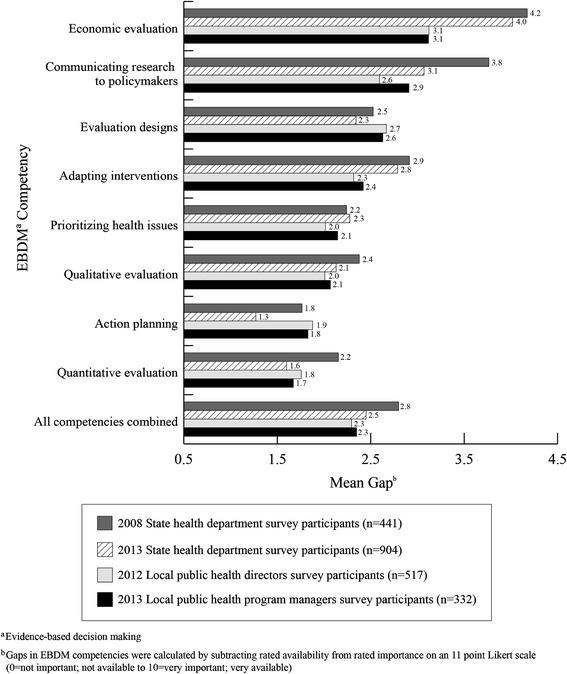
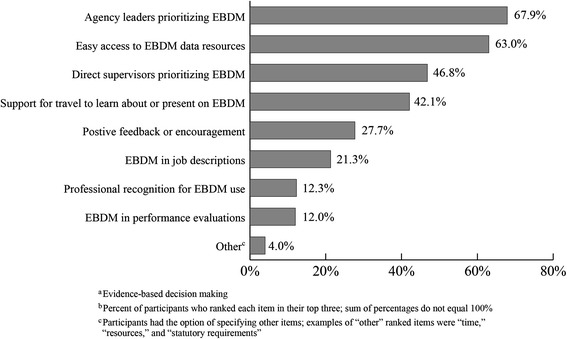
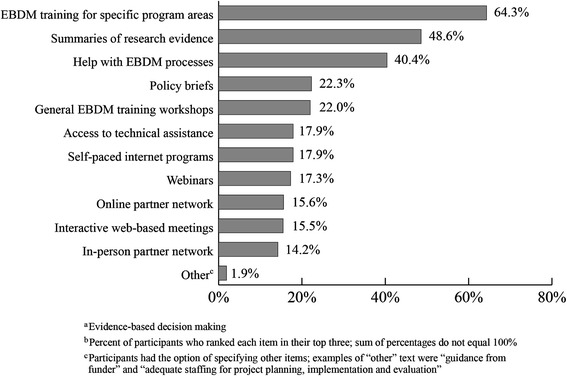
The largest competency gaps were consistent across all four surveys: economic evaluation, communicating research to policymakers, evaluation designs, and adapting interventions. Participants from the 2013 state level survey reported significantly larger mean importance and availability scores (p <0.001, d =1.00, and p <0.001, d = .78 respectively) and smaller mean gaps (p <0.01, d = .19) compared to the 2008 survey. Participants most often selected "leaders prioritizing EBDM" (67.9%) among top ways to encourage EBDM use. "EBDM training for specific areas" was most commonly ranked as important in applying EBDM (64.3%).
Perceived importance and availability of EBDM competencies may be increasing as supports for EBDM continue to grow through trends in funding, training, and resources. However, more capacity building is needed overall, with specific attention to the largest competency gaps. More work with public health departments to both situate trainings to boost competency in these areas and continued improvements for organizational practices (leadership prioritization) are possible next steps to sustain EBDM efforts.
培养公共卫生工作队伍以实施循证决策(EBDM)对于有效影响健康结果至关重要。在美国,很少有研究报告国家级层面的EBDM培训需求。我们根据2008年至2013年期间对州和地方公共卫生工作队伍开展的四项美国全国性调查,报告了实施EBDM的能力差距。
我们比较了2008年至2013年期间开展的四项关于EBDM的美国全国性在线调查的自我报告数据。参与者对每项EBDM能力的重要性进行评分,然后在李克特量表上对他们在需要时获得该能力的难易程度进行评分。我们通过用重要性得分减去可获得性得分来计算差距分数。我们比较了各项调查的平均差距,并利用独立样本t检验和科恩d值来比较州层面的差距。此外,2013年州卫生部门调查的参与者选择并排列了“最能鼓励你在工作中使用EBDM的三项内容”以及“在工作中应用EBDM对你最有用的内容”。我们计算了将每项内容排在前三位的参与者的百分比。
在所有四项调查中,最大的能力差距都是一致的:经济评估、向政策制定者传达研究成果、评估设计以及调整干预措施。与2008年的调查相比,2013年州层面调查的参与者报告的平均重要性得分和可获得性得分显著更高(分别为p<0.001,d = 1.00,以及p<0.001,d = 0.78),平均差距更小(p<0.01,d = 0.19)。在鼓励使用EBDM的主要方式中,参与者最常选择“领导重视EBDM”(67.9%)。在应用EBDM时,“特定领域的EBDM培训”最常被列为重要内容(64.3%)。
随着通过资金、培训和资源等方面的趋势,对EBDM的支持不断增加,EBDM能力的感知重要性和可获得性可能也在提高。然而,总体上仍需要更多的能力建设,尤其要关注最大的能力差距。下一步可能的工作是与公共卫生部门开展更多合作,既要安排培训以提高这些领域的能力,也要持续改进组织实践(领导重视程度),以维持EBDM工作。