Blair Carol D, Olson Ken E
Arthropod-borne and Infectious Diseases Laboratory, Department of Microbiology, Immunology & Pathology, Colorado State University.
Curr Opin Insect Sci. 2014 Sep 1;3:22-29. doi: 10.1016/j.cois.2014.07.005.
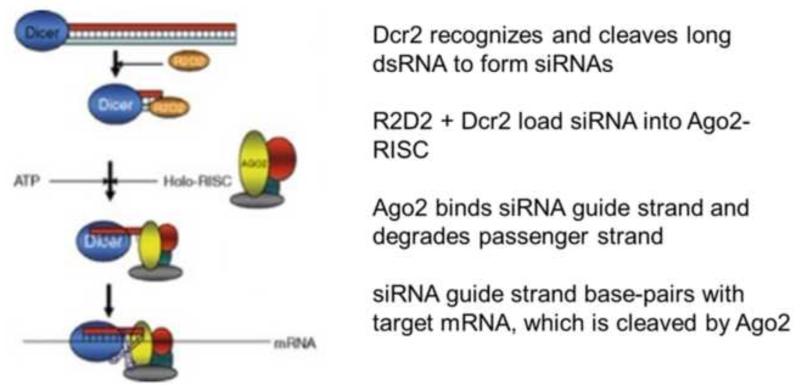
The principal mosquito innate immune response to virus infections, RNA interference (RNAi), differs substantially from the immune response to bacterial and fungal infections. The exo-siRNA pathway constitutes the major anti-arboviral RNAi response and its essential genetic components have been identified. Recent research has also implicated the Piwi-interacting RNA pathway in mosquito anti-arboviral immunity, but Piwi gene-family components involved are not well-defined. Arboviruses must evade or suppress RNAi without causing pathogenesis in the vector to maintain their transmission cycle, but little is known about mechanisms of arbovirus modulation of RNAi. Genetic manipulation of mosquitoes to enhance their RNAi response can limit arbovirus infection and replication and could be used in novel strategies for interruption of arbovirus transmission and greatly reduce disease.
蚊子对病毒感染的主要先天性免疫反应,即RNA干扰(RNAi),与对细菌和真菌感染的免疫反应有很大不同。外源性小干扰RNA(exo-siRNA)途径构成了主要的抗虫媒病毒RNAi反应,其关键的遗传成分已被确定。最近的研究还表明,Piwi相互作用RNA途径参与了蚊子的抗虫媒病毒免疫,但所涉及的Piwi基因家族成分尚未明确界定。虫媒病毒必须逃避或抑制RNAi,同时又不引起载体发病,以维持其传播周期,但关于虫媒病毒调节RNAi的机制知之甚少。对蚊子进行基因操作以增强其RNAi反应,可以限制虫媒病毒的感染和复制,并可用于中断虫媒病毒传播的新策略,从而大大减少疾病。