Mullick Satarupa, Mukherjee Anupam, Ghosh Santanu, Pazhani Gururaja P, Sur Dipika, Manna Byomkesh, Nataro James P, Levine Myron M, Ramamurthy Thandavarayan, Chawla-Sarkar Mamta
National Institute of Cholera and Enteric Diseases, Kolkata, India.
Department of Paediatrics, University of Virginia, School of Medicine, Charlottesville, Virginia, United States of America.
PLoS One. 2014 Nov 17;9(11):e112970. doi: 10.1371/journal.pone.0112970. eCollection 2014.
Group A Rotaviruses are a major etiologic agent of gastroenteritis in infants and young children (<5 years) worldwide. Although rotavirus vaccines have been successfully administered in many countries, in India the introduction of rotavirus vaccine in national immunization program was approved in 2014. Since high disease burden and large number of genetic variants have been reported from low income countries including India, monitoring of rotavirus was initiated prior to implementation of the vaccine in the region.
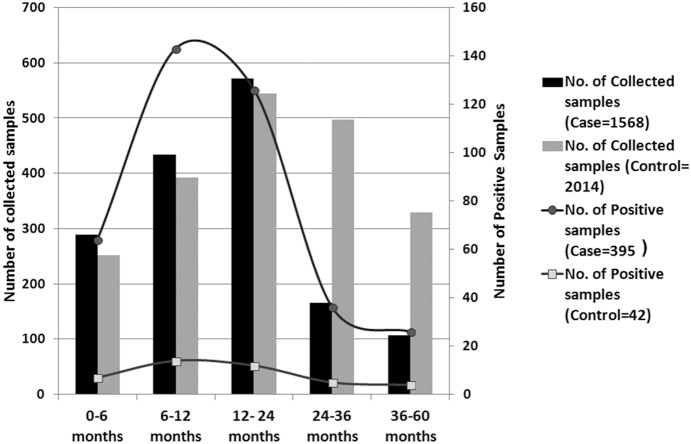
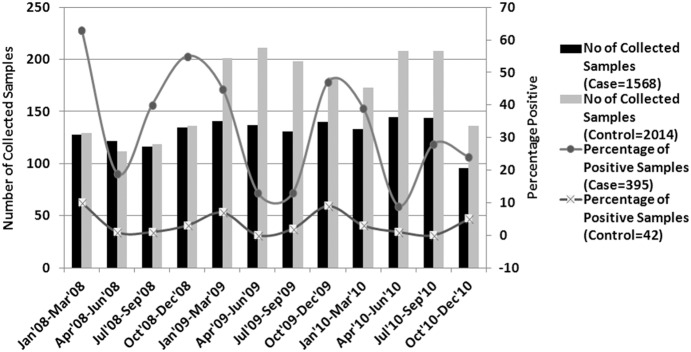
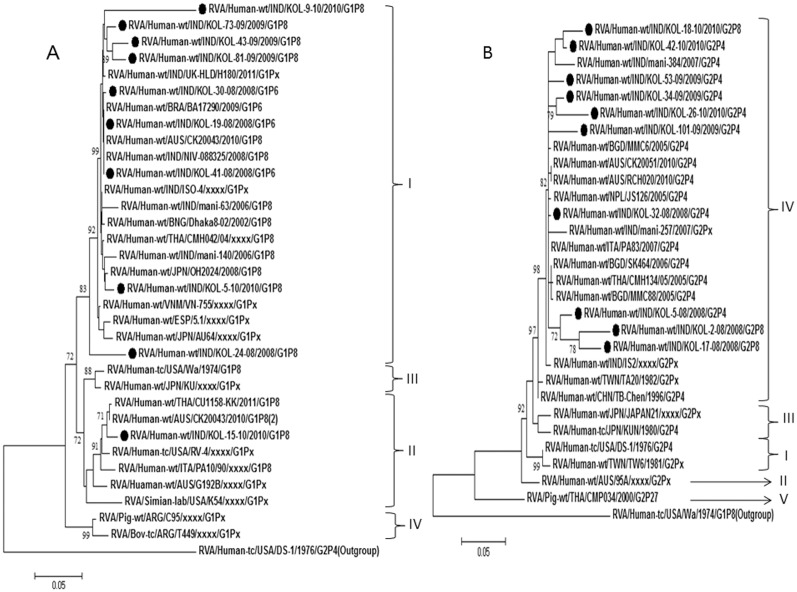
A total number of 3,582 stool samples were collected from an urban slum community in Kolkata, among which 1,568 samples were obtained from children of ≤ 5 years of age, with moderate to severe diarrhoea and 2,014 samples were collected from age-sex matched healthy neighbourhood controls. Rotavirus positive samples were typed by multiplex semi-nested PCR and nucleotide sequencing. Circulating strains were phylogenetically analyzed.
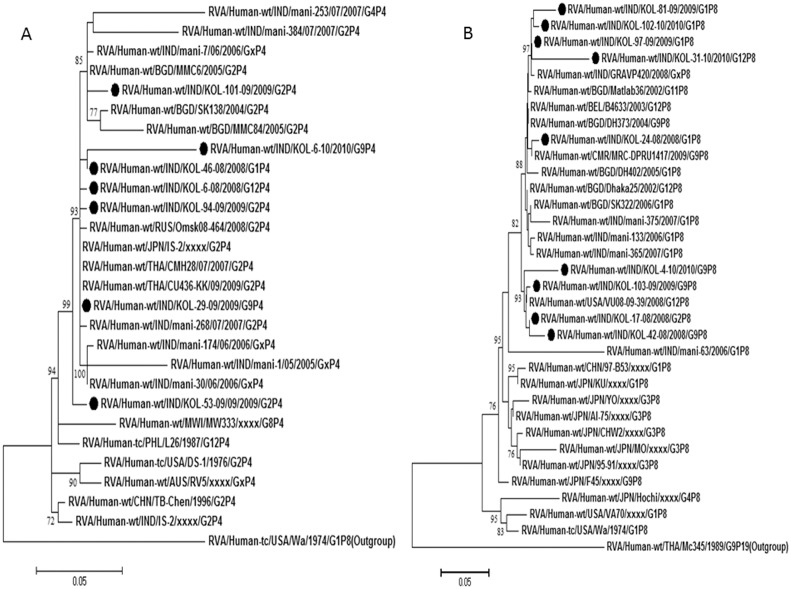
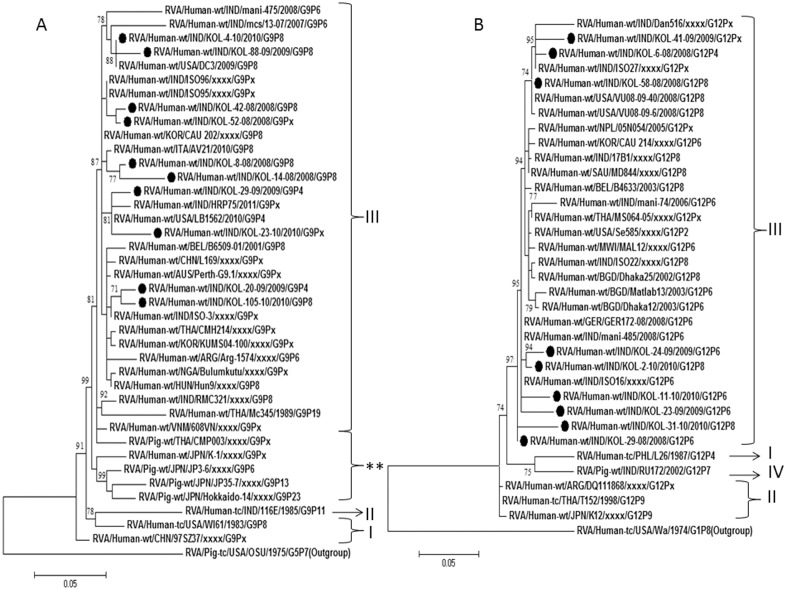
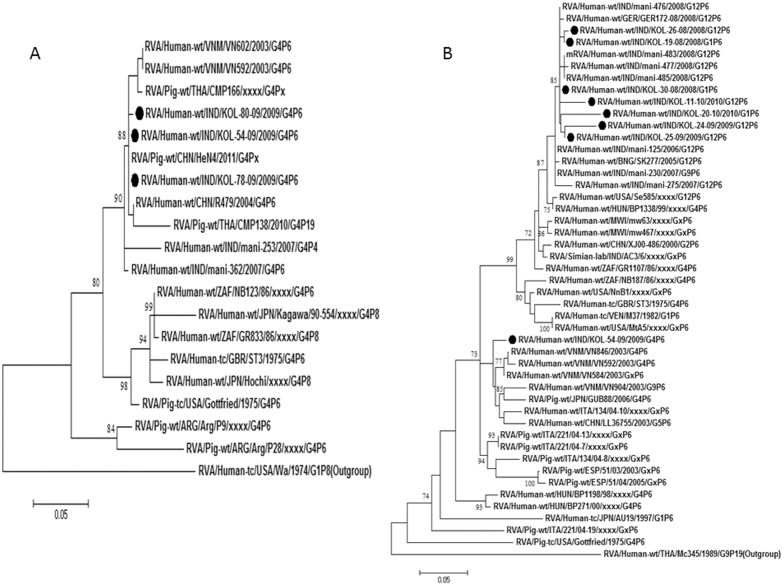
Among 1,568 children with diarrhoea, 395 (25.2%), and among 2,014 asymptomatic children, 42 (2%) were rotavirus positive. G1P[8] was identified as the most common strain (32%) followed by G9P[8] (16.9%), G2P[4] (13.5%) and G9P[4] (10.75%). G12 strains with combinations of P[4], P[6] and P[8] comprised 11.9% of total positive strains. The rest (<10%) were rare and uncommon strains like G1P[4], G1P[6], G2P[8] and animal-like strains G4P[6], G6P[14] and G11P[25]. The 42 rotavirus positive samples from asymptomatic children revealed common genotypes like G1, G2 and G9.
This community based case-control study showed increased predominance of genotype G9 in Kolkata. It also confirmed co-circulation of a large number of genetic variants in the community. Asymptomatic rotavirus positive children though low in number can also be a source of dispersal of infection in the community. This study provides background information to the policy makers for implementation of rotavirus vaccines in this region.
A 组轮状病毒是全球婴幼儿(<5 岁)肠胃炎的主要病原体。尽管轮状病毒疫苗已在许多国家成功接种,但在印度,2014 年国家免疫规划中才批准引入轮状病毒疫苗。由于包括印度在内的低收入国家报告了高疾病负担和大量基因变异,因此在该地区实施疫苗接种之前就开始了轮状病毒监测。
从加尔各答的一个城市贫民窟社区总共收集了 3582 份粪便样本,其中 1568 份样本来自年龄≤5 岁、患有中度至重度腹泻的儿童,2014 份样本来自年龄和性别匹配的健康邻里对照。轮状病毒阳性样本通过多重半巢式 PCR 和核苷酸测序进行分型。对流行菌株进行系统发育分析。
在 1568 名腹泻儿童中,395 名(25.2%)轮状病毒呈阳性,在 2014 名无症状儿童中,42 名(2%)轮状病毒呈阳性。G1P[8]被确定为最常见的毒株(32%),其次是 G9P[8](16.9%)、G2P[4](13.5%)和 G9P[4](10.75%)。携带 P[4]、P[6]和 P[8]组合的 G12 毒株占总阳性毒株的 11.9%。其余(<10%)为罕见和不常见的毒株,如 G1P[4]、G1P[6]、G2P[8]以及动物样毒株 G4P[6]、G6P[第十四条]和 G11P[25]。来自无症状儿童的 42 份轮状病毒阳性样本显示出常见基因型,如 G1、G2 和 G9。
这项基于社区的病例对照研究表明,加尔各答 G9 基因型的优势有所增加。它还证实了该社区中大量基因变异的共同流行。无症状的轮状病毒阳性儿童数量虽少,但也可能是社区中感染传播的一个来源。本研究为政策制定者在该地区实施轮状病毒疫苗提供了背景信息。