Dombrowski James E, Martin Ruth C
USDA-ARS, National Forage Seed Production Research Center, Oregon State University, 3450 SW Campus Way, Corvallis, Oregon 97331-7102, USA.
BMC Res Notes. 2014 Nov 18;7:807. doi: 10.1186/1756-0500-7-807.
Previously it has been shown that mechanical wounding, salinity and heat activated a 46 kDa and 44 kDa mitogen-activated protein kinases (MAPKs) in forage related grasses. Forage and turf related grasses are utilized in diverse environments where they are routinely subjected to herbicides and exposed to fire and volatiles after cutting, however very little is known concerning the perception or molecular responses to these different stresses or compounds.
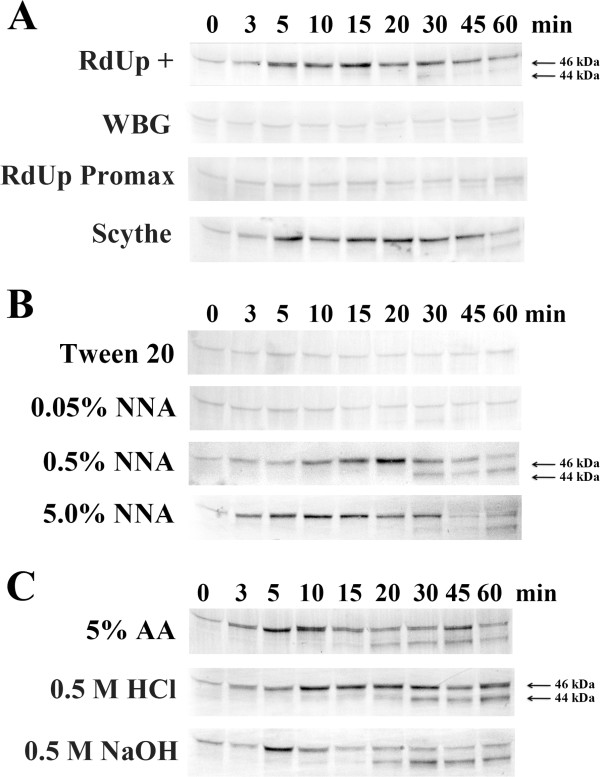
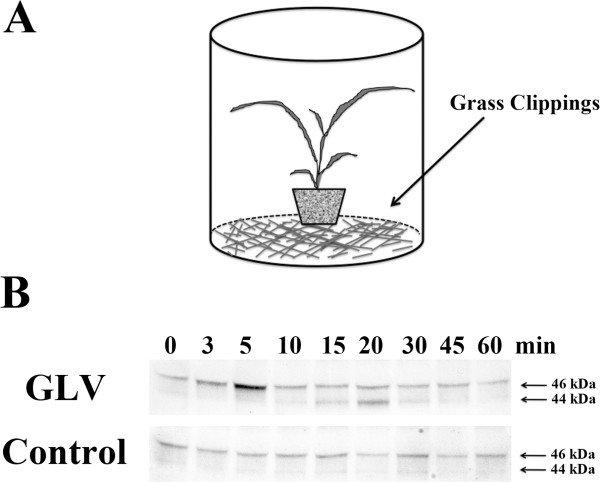
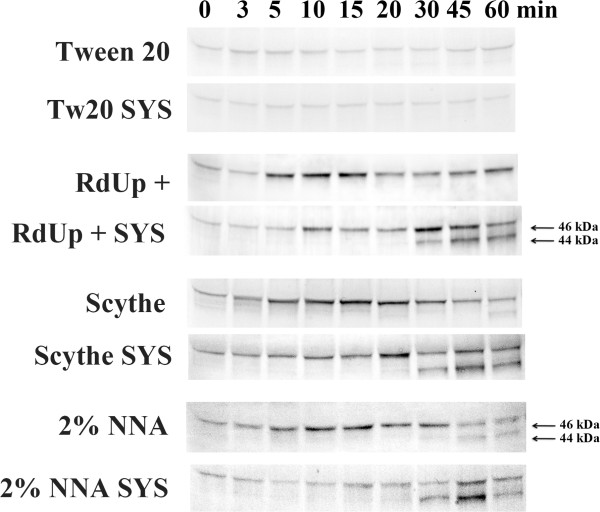
In the model grass species Lolium temulentum (Lt), a 46 kDa mitogen-activated protein kinase (MAPK) was activated in the leaves within 5 min and a 44 kDa MAPK 15 min after exposure to green leaf volatiles released from grass clippings. When the tips of leaves of Lt plants were scorched by fire, the 46 kDa MAPK and 44 kDa MAPK were rapidly activated within 5 min and 20 min respectively in the treated leaf, and 15 min systemically in an adjacent untreated tiller after exposure to fire. Nonanoic acid (pelargonic acid), a component in herbicides used on grasses, activated a 46 kDa MAPK in the treated leaves within 5 min of exposure and 15 min in systemic tissues. At concentrations normally used in the herbicides, nonanoic acid was found to only weakly activate the 44 kDa MAPK after an hour in treated leaves, but strongly activated it in the systemic tillers 30 min after treatment. Acetic acid, HCl and NaOH also were found to activate these MAPKs in treated tillers.
The rapid activation of these MAPKs to a wide range of stress stimuli, suggest that these MAPKs play a role in the perception and response to these stresses and compounds. The activation of the MAPK by green leaf volatiles indicates a role for these compounds in wound signaling in grasses.
此前研究表明,机械损伤、盐度和高温可激活饲用相关禾本科植物中的46 kDa和44 kDa促分裂原活化蛋白激酶(MAPK)。饲用和草坪用禾本科植物在多种环境中使用,经常接触除草剂,且在切割后会暴露于火灾和挥发物中,然而对于这些不同胁迫或化合物的感知或分子反应却知之甚少。
在模式禾本科植物毒麦(Lt)中,暴露于剪草释放的绿叶挥发物后,46 kDa促分裂原活化蛋白激酶(MAPK)在5分钟内在叶片中被激活,44 kDa MAPK在15分钟后被激活。当Lt植物的叶尖被火烧焦时,46 kDa MAPK和44 kDa MAPK分别在处理叶片的5分钟和20分钟内迅速被激活,在暴露于火灾后15分钟内在相邻未处理的分蘖中被系统激活。壬酸(壬酸)是用于禾本科植物的除草剂中的一种成分,在暴露5分钟内在处理叶片中激活46 kDa MAPK,在15分钟内在系统组织中激活。在除草剂通常使用的浓度下,发现壬酸在处理叶片中1小时后仅微弱激活44 kDa MAPK,但在处理30分钟后在系统分蘖中强烈激活它。还发现乙酸、HCl和NaOH也能在处理的分蘖中激活这些MAPK。
这些MAPK对多种胁迫刺激的快速激活表明,这些MAPK在对这些胁迫和化合物的感知和反应中起作用。绿叶挥发物对MAPK的激活表明这些化合物在禾本科植物伤口信号传导中起作用。