Deribe Kebede, Brooker Simon J, Pullan Rachel L, Sime Heven, Gebretsadik Abeba, Assefa Ashenafi, Kebede Amha, Hailu Asrat, Rebollo Maria P, Shafi Oumer, Bockarie Moses J, Aseffa Abraham, Reithinger Richard, Cano Jorge, Enquselassie Fikre, Newport Melanie J, Davey Gail
Am J Trop Med Hyg. 2015 Jan;92(1):148-158. doi: 10.4269/ajtmh.14-0446. Epub 2014 Nov 17.
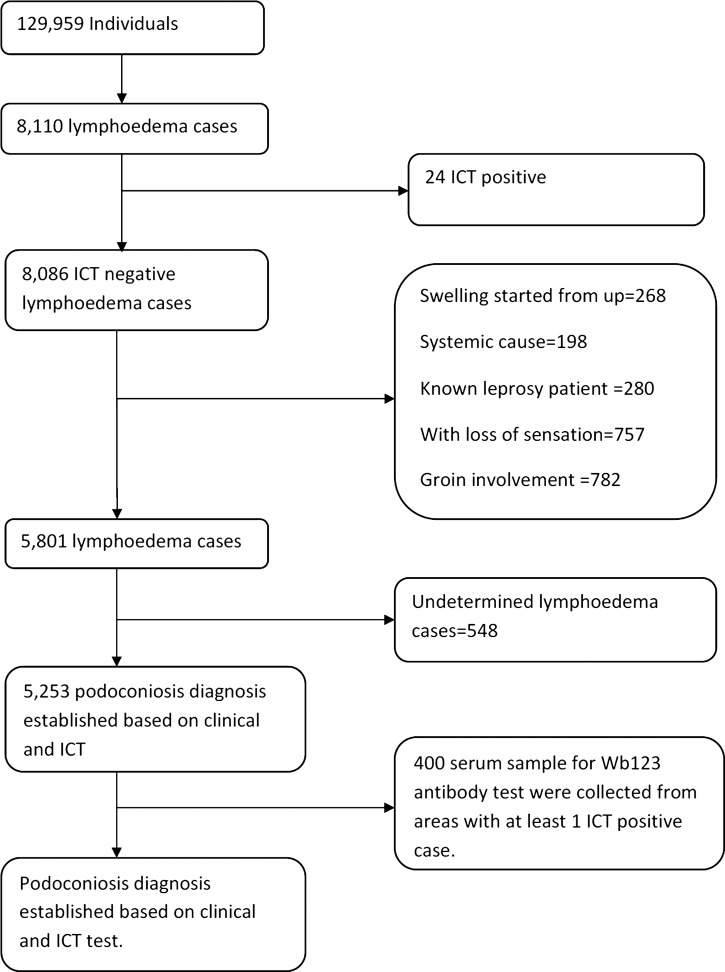
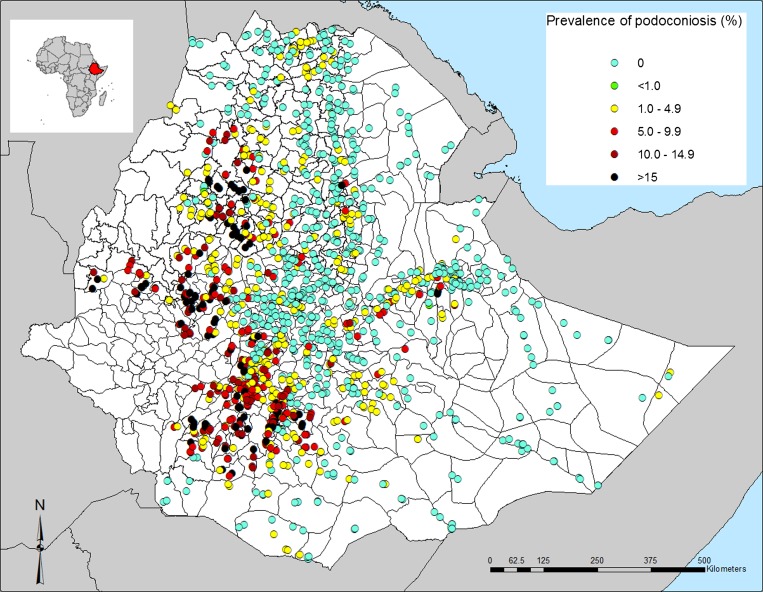
Although podoconiosis is one of the major causes of tropical lymphoedema and is endemic in Ethiopia its epidemiology and risk factors are poorly understood. Individual-level data for 129,959 individuals from 1,315 communities in 659 woreda (districts) were collected for a nationwide integrated survey of lymphatic filariasis and podoconiosis. Blood samples were tested for circulating Wuchereria bancrofti antigen using immunochromatographic card tests. A clinical algorithm was used to reach a diagnosis of podoconiosis by excluding other potential causes of lymphoedema of the lower limb. Bayesian multilevel models were used to identify individual and environmental risk factors. Overall, 8,110 of 129,959 (6.2%, 95% confidence interval [CI] 6.1-6.4%) surveyed individuals were identified with lymphoedema of the lower limb, of whom 5,253 (4.0%, 95% CI 3.9-4.1%) were confirmed to be podoconiosis cases. In multivariable analysis, being female, older, unmarried, washing the feet less frequently than daily, and being semiskilled or unemployed were significantly associated with increased risk of podoconiosis. Attending formal education and living in a house with a covered floor were associated with decreased risk of podoconiosis. Podoconiosis exhibits marked geographical variation across Ethiopia, with variation in risk associated with variation in rainfall, enhanced vegetation index, and altitude.
尽管地方性丝虫病是热带淋巴水肿的主要病因之一,且在埃塞俄比亚呈地方性流行,但对其流行病学和危险因素的了解却很少。为了开展一项关于淋巴丝虫病和地方性丝虫病的全国综合调查,收集了来自659个沃雷达(区)1315个社区的129,959人的个体层面数据。使用免疫层析卡试验对血样进行循环班氏吴策线虫抗原检测。通过排除下肢淋巴水肿的其他潜在病因,采用临床算法来诊断地方性丝虫病。使用贝叶斯多级模型来识别个体和环境危险因素。总体而言,在129,959名接受调查的个体中,有8110人(6.2%,95%置信区间[CI] 6.1 - 6.4%)被确定为下肢淋巴水肿,其中5253人(4.0%,95% CI 3.9 - 4.1%)被确诊为地方性丝虫病病例。在多变量分析中,女性、年龄较大、未婚、洗脚频率低于每天一次、半熟练或失业与地方性丝虫病风险增加显著相关。接受正规教育以及居住在有覆盖地板的房屋中与地方性丝虫病风险降低相关。地方性丝虫病在埃塞俄比亚各地呈现出明显的地理差异,风险差异与降雨量、增强植被指数和海拔高度的差异有关。