• 文献检索
  • 文档翻译
  • 深度研究
  • 学术资讯
  • Suppr Zotero 插件Zotero 插件
  • 邀请有礼
  • 套餐&价格
  • 历史记录
应用&插件
Suppr Zotero 插件Zotero 插件浏览器插件Mac 客户端Windows 客户端微信小程序
定价
高级版会员购买积分包购买API积分包
服务
文献检索文档翻译深度研究API 文档MCP 服务
关于我们
关于 Suppr公司介绍联系我们用户协议隐私条款
关注我们

Suppr 超能文献

核心技术专利:CN118964589B侵权必究
粤ICP备2023148730 号-1Suppr @ 2026

文献检索

告别复杂PubMed语法,用中文像聊天一样搜索,搜遍4000万医学文献。AI智能推荐,让科研检索更轻松。

立即免费搜索

文件翻译

保留排版,准确专业,支持PDF/Word/PPT等文件格式,支持 12+语言互译。

免费翻译文档

深度研究

AI帮你快速写综述,25分钟生成高质量综述,智能提取关键信息,辅助科研写作。

立即免费体验

欧洲一组市售抗菌纳米涂层的比较性能

Comparative performance of a panel of commercially available antimicrobial nanocoatings in Europe.

作者信息

Molling Johan W, Seezink Jacques W, Teunissen Birgit Ej, Muijrers-Chen Inhua, Borm Paul Ja

机构信息

Zuyd University of Applied Sciences, Heerlen, the Netherlands.

出版信息

Nanotechnol Sci Appl. 2014 Nov 7;7:97-104. doi: 10.2147/NSA.S70782. eCollection 2014.

DOI:10.2147/NSA.S70782
PMID:25404853
原文链接:https://pmc.ncbi.nlm.nih.gov/articles/PMC4230231/
Abstract

BACKGROUND

Bacterial resistance against the classic antibiotics is posing an increasing challenge for the prevention and treatment of infections in health care environments. The introduction of antimicrobial nanocoatings with active ingredients provides alternative measures for active killing of microorganisms, through a preventive hygiene approach.

PURPOSE

The purpose of this study was to investigate the antimicrobial activity of a panel of antimicrobial coatings available on the European market.

METHODS

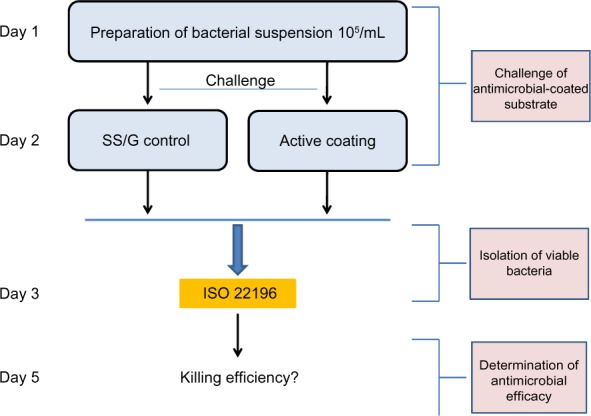
A comparative, biased selection of commercially available antimicrobial coatings was tested for antimicrobial efficiency. Suppliers were contacted to deliver their coatings on glass and/or stainless steel substrates. In total, 23 coatings from eleven suppliers were received, which were investigated for their effect on the growth of Escherichia coli, using the International Organization for Standardization (ISO) 22196 protocol.

RESULTS

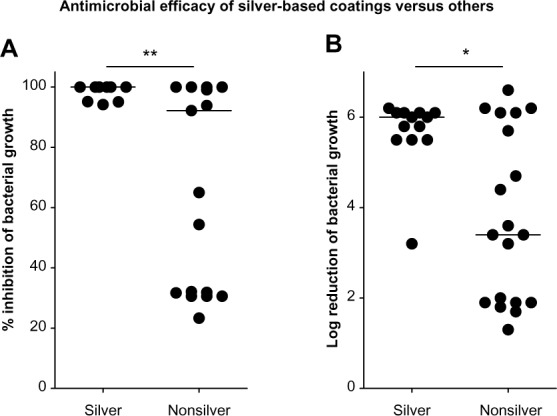
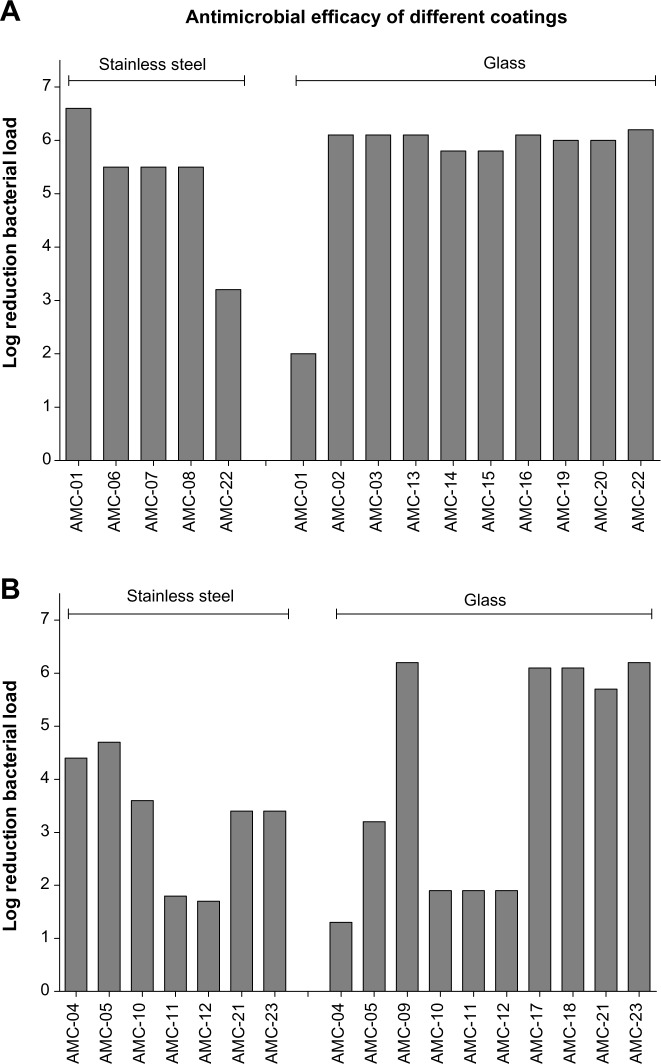
The majority of nanomaterial-containing coatings (n=13) contained nanosilver (n=12), while only one had photocatalytic TiO2 as the active particle. The differences in antimicrobial activity among all of the coatings, expressed as log reduction values, varied between 1.3 and 6.6, while the variation within the nanomaterial-based group was between 2.0 and 6.2. Although nanosilver coatings were on average very effective in reducing the number of viable bacteria after challenge, the strongest log reduction (6.6) was seen with a coating that has immobilized, covalently bound quaternary ammonium salt in its matrix. Besides these two compounds, coatings containing TiO2, poly(dimethylsiloxane), triclosan, or zinc pyrithione evoked 100% killing of E. coli.

CONCLUSION

Our findings indicate that nanosilver dominates the nanoparticle-based coatings and performs adequately. However, considering the unknowns in relation to ecotoxicological emission and effects, it needs further consideration before widespread application into different environments.

摘要

背景

细菌对经典抗生素的耐药性给医疗保健环境中感染的预防和治疗带来了越来越大的挑战。引入含有活性成分的抗菌纳米涂层,通过预防性卫生方法,为主动杀灭微生物提供了替代措施。

目的

本研究的目的是调查欧洲市场上一系列抗菌涂层的抗菌活性。

方法

对市售抗菌涂层进行了有偏向性的比较选择,以测试其抗菌效率。联系供应商提供其在玻璃和/或不锈钢基材上的涂层。总共收到了来自11家供应商的23种涂层,使用国际标准化组织(ISO)22196协议研究了它们对大肠杆菌生长的影响。

结果

大多数含纳米材料的涂层(n = 13)含有纳米银(n = 12),而只有一种以光催化TiO2作为活性颗粒。所有涂层之间的抗菌活性差异,以对数减少值表示,在1.3至6.6之间变化,而基于纳米材料的组内差异在2.0至6.2之间。尽管纳米银涂层在受到挑战后平均能非常有效地减少活菌数量,但在其基质中固定有共价结合季铵盐的涂层的对数减少最强(6.6)。除了这两种化合物外,含有TiO2、聚二甲基硅氧烷、三氯生或吡啶硫酮锌的涂层能使大肠杆菌100%死亡。

结论

我们的研究结果表明,纳米银在基于纳米颗粒的涂层中占主导地位且表现良好。然而,考虑到与生态毒理学排放和影响相关的未知因素,在广泛应用于不同环境之前需要进一步考虑。
https://cdn.ncbi.nlm.nih.gov/pmc/blobs/8d6a/4230231/f87ff6467ee5/nsa-7-097Fig3.jpg
https://cdn.ncbi.nlm.nih.gov/pmc/blobs/8d6a/4230231/600c787329fe/nsa-7-097Fig1.jpg
https://cdn.ncbi.nlm.nih.gov/pmc/blobs/8d6a/4230231/0c8d605daccd/nsa-7-097Fig2.jpg
https://cdn.ncbi.nlm.nih.gov/pmc/blobs/8d6a/4230231/f87ff6467ee5/nsa-7-097Fig3.jpg
https://cdn.ncbi.nlm.nih.gov/pmc/blobs/8d6a/4230231/600c787329fe/nsa-7-097Fig1.jpg
https://cdn.ncbi.nlm.nih.gov/pmc/blobs/8d6a/4230231/0c8d605daccd/nsa-7-097Fig2.jpg
https://cdn.ncbi.nlm.nih.gov/pmc/blobs/8d6a/4230231/f87ff6467ee5/nsa-7-097Fig3.jpg

相似文献

1
Comparative performance of a panel of commercially available antimicrobial nanocoatings in Europe.欧洲一组市售抗菌纳米涂层的比较性能
Nanotechnol Sci Appl. 2014 Nov 7;7:97-104. doi: 10.2147/NSA.S70782. eCollection 2014.
2
Development of Titanium Dioxide (TiO2 ) Nanocoatings on Food Contact Surfaces and Method to Evaluate Their Durability and Photocatalytic Bactericidal Property.食品接触表面二氧化钛(TiO₂)纳米涂层的开发及其耐久性和光催化杀菌性能的评估方法。
J Food Sci. 2015 Aug;80(8):N1903-11. doi: 10.1111/1750-3841.12962. Epub 2015 Jul 17.
3
Potential ecotoxicological effects of antimicrobial surface coatings: a literature survey backed up by analysis of market reports.抗菌表面涂层的潜在生态毒理学效应:基于市场报告分析的文献综述
PeerJ. 2019 Feb 11;7:e6315. doi: 10.7717/peerj.6315. eCollection 2019.
4
Antifouling and antimicrobial mechanism of tethered quaternary ammonium salts in a cross-linked poly(dimethylsiloxane) matrix studied using sum frequency generation vibrational spectroscopy.采用和频产生振动光谱研究交联聚二甲基硅氧烷基质中键合季铵盐的防污和抗菌机理。
Langmuir. 2010 Nov 2;26(21):16455-62. doi: 10.1021/la1001539.
5
Application of Novel 3,4-Dihydroxyphenylalanine-Containing Antimicrobial Polymers for the Prevention of Uropathogen Attachment to Urinary Biomaterials.新型含 3,4-二羟基苯丙氨酸的抗菌聚合物在预防尿路病原体黏附于尿生物材料中的应用。
J Endourol. 2019 Jul;33(7):590-597. doi: 10.1089/end.2019.0009.
6
Molybdenum doped titanium dioxide photocatalytic coatings for use as hygienic surfaces: the effect of soiling on antimicrobial activity.用作卫生表面的钼掺杂二氧化钛光催化涂层:污垢对抗菌活性的影响。
Biofouling. 2014 Sep;30(8):911-9. doi: 10.1080/08927014.2014.939959.
7
Recent Advances in Surface Nanoengineering for Biofilm Prevention and Control. Part II: Active, Combined Active and Passive, and Smart Bacteria-Responsive Antibiofilm Nanocoatings.用于生物膜预防与控制的表面纳米工程最新进展。第二部分:活性、活性与被动相结合以及智能细菌响应性抗生物膜纳米涂层
Nanomaterials (Basel). 2020 Aug 4;10(8):1527. doi: 10.3390/nano10081527.
8
Viable adhered Staphylococcus aureus highly reduced on novel antimicrobial sutures using chlorhexidine and octenidine to avoid surgical site infection (SSI).使用洗必泰和奥替尼啶的新型抗菌缝线可使存活的黏附金黄色葡萄球菌大量减少,从而避免手术部位感染(SSI)。
PLoS One. 2018 Jan 9;13(1):e0190912. doi: 10.1371/journal.pone.0190912. eCollection 2018.
9
Novel, UV-curable coatings containing a tethered biocide: Synthesis, characterization, and antimicrobial activity.新型含固定杀菌剂的紫外光固化涂料:合成、表征及抗菌活性。
J Biomed Mater Res A. 2010 Nov;95(2):486-94. doi: 10.1002/jbm.a.32876.
10
Antimicrobial efficacy and compatibility of solid copper alloys with chemical disinfectants.固体铜合金与化学消毒剂的抗菌效果和相容性。
PLoS One. 2018 Aug 10;13(8):e0200748. doi: 10.1371/journal.pone.0200748. eCollection 2018.

引用本文的文献

1
A realistic approach for evaluating antimicrobial surfaces for dry surface exposure scenarios.评估用于干燥表面暴露场景的抗菌表面的现实方法。
Appl Environ Microbiol. 2024 Oct 23;90(10):e0115024. doi: 10.1128/aem.01150-24. Epub 2024 Oct 4.
2
Evaluation of Aging Effect on the Durability of Antibacterial Treatments Applied on Textile Materials for the Automotive Industry.汽车工业用纺织材料抗菌处理耐久性的老化效应评估
ACS Omega. 2024 Jun 11;9(25):27169-27176. doi: 10.1021/acsomega.4c01272. eCollection 2024 Jun 25.
3
Assessing Antimicrobial Efficacy on Plastics and Other Non-Porous Surfaces: A Closer Look at Studies Using the ISO 22196:2011 Standard.

本文引用的文献

1
ESCMID guidelines for the management of the infection control measures to reduce transmission of multidrug-resistant Gram-negative bacteria in hospitalized patients.ESCMID 指南:管理感染控制措施以减少住院患者中多重耐药革兰氏阴性菌传播。
Clin Microbiol Infect. 2014 Jan;20 Suppl 1:1-55. doi: 10.1111/1469-0691.12427.
2
New hybrid materials based on poly(ethyleneoxide)-grafted polysilazane by hydrosilylation and their anti-fouling activities.基于聚(氧化乙烯)接枝聚硅氮烷的新型杂化材料的制备及其抗污染性能。
Beilstein J Nanotechnol. 2013 Oct 21;4:671-7. doi: 10.3762/bjnano.4.75. eCollection 2013.
3
Comparative toxicity assessment of nanosilver on three Daphnia species in acute, chronic and multi-generation experiments.
评估抗菌剂对塑料及其他无孔表面的功效:深入研究采用ISO 22196:2011标准的相关研究。
Biology (Basel). 2024 Jan 20;13(1):59. doi: 10.3390/biology13010059.
4
Effectiveness and Durability of a Quaternary Ammonium Compounds-Based Surface Coating to Reduce Surface Contamination.一种基于季铵化合物的表面涂层减少表面污染的有效性和耐久性
Biology (Basel). 2023 Apr 28;12(5):669. doi: 10.3390/biology12050669.
5
Bactericidal and Antiviral Bionic Metalized Nanocoatings.杀菌抗病毒仿生金属化纳米涂层
Nanomaterials (Basel). 2022 May 30;12(11):1868. doi: 10.3390/nano12111868.
6
Preliminary Study on Light-Activated Antimicrobial Agents as Photocatalytic Method for Protection of Surfaces with Increased Risk of Infections.光激活抗菌剂作为光催化方法用于保护感染风险增加的表面的初步研究。
Materials (Basel). 2021 Sep 14;14(18):5307. doi: 10.3390/ma14185307.
7
Antibacterial Composite Materials Based on the Combination of Polyhydroxyalkanoates With Selenium and Strontium Co-substituted Hydroxyapatite for Bone Regeneration.基于聚羟基脂肪酸酯与硒和锶共取代羟基磷灰石组合的用于骨再生的抗菌复合材料。
Front Bioeng Biotechnol. 2021 Apr 7;9:647007. doi: 10.3389/fbioe.2021.647007. eCollection 2021.
8
A Comparative Assessment of Nanotoxicity Induced by Metal (Silver, Nickel) and Metal Oxide (Cobalt, Chromium) Nanoparticles in .金属(银、镍)和金属氧化物(钴、铬)纳米颗粒在……中诱导的纳米毒性的比较评估
Nanomaterials (Basel). 2019 Feb 25;9(2):309. doi: 10.3390/nano9020309.
9
Surface deposited one-dimensional copper-doped TiO2 nanomaterials for prevention of health care acquired infections.表面沉积一维铜掺杂 TiO2 纳米材料预防医源性感染。
PLoS One. 2018 Jul 26;13(7):e0201490. doi: 10.1371/journal.pone.0201490. eCollection 2018.
10
Rapid in situ assessment of Cu-ion mediated effects and antibacterial efficacy of copper surfaces.快速原位评估铜离子介导的作用和铜表面的抗菌效果。
Sci Rep. 2018 May 25;8(1):8172. doi: 10.1038/s41598-018-26391-8.
纳米银对三种水蚤属物种在急性、慢性和多代实验中的毒性比较评估。
PLoS One. 2013 Oct 7;8(10):e75026. doi: 10.1371/journal.pone.0075026. eCollection 2013.
4
Evaluation of new in vitro efficacy test for antimicrobial surface activity reflecting UK hospital conditions.评价新的体外抗菌表面活性测试方法,以反映英国医院的实际情况。
J Hosp Infect. 2013 Dec;85(4):274-81. doi: 10.1016/j.jhin.2013.08.007. Epub 2013 Sep 18.
5
Strategies to minimize antibiotic resistance.抗生素耐药性最小化策略。
Int J Environ Res Public Health. 2013 Sep 12;10(9):4274-305. doi: 10.3390/ijerph10094274.
6
Heavy metal tolerance (Cr, Ag AND Hg) in bacteria isolated from sewage.从污水中分离的细菌对重金属的耐受性(Cr、Ag 和 Hg)。
Braz J Microbiol. 2012 Oct;43(4):1620-31. doi: 10.1590/S1517-838220120004000047. Epub 2012 Jun 1.
7
Systemic and immunotoxicity of silver nanoparticles in an intravenous 28 days repeated dose toxicity study in rats.静脉注射 28 天重复剂量毒性研究中银纳米粒子的全身和免疫毒性。
Biomaterials. 2013 Nov;34(33):8333-43. doi: 10.1016/j.biomaterials.2013.06.048. Epub 2013 Jul 22.
8
Nanosilver: weighing the risks and benefits.纳米银:权衡风险与益处
Environ Health Perspect. 2013 Jul;121(7):A220-5. doi: 10.1289/ehp.121-a220.
9
Silver enhances antibiotic activity against gram-negative bacteria.银增强了抗生素对革兰氏阴性菌的活性。
Sci Transl Med. 2013 Jun 19;5(190):190ra81. doi: 10.1126/scitranslmed.3006276.
10
State of the art in human risk assessment of silver compounds in consumer products: a conference report on silver and nanosilver held at the BfR in 2012.消费产品中银化合物人体风险评估的最新进展:2012 年在德国联邦风险评估研究所召开的关于银和纳米银的会议报告。
Arch Toxicol. 2013 Dec;87(12):2249-62. doi: 10.1007/s00204-013-1083-8. Epub 2013 Jun 19.