Han Yoonsun, Grogan-Kaylor Andrew, Delva Jorge, Xie Yu
Department of Child Psychology and Education, Sungkyunkwan University, 25-2 Sungkyunkwan-ro, Jongno-gu, Seoul 110-745, Korea.
School of Social Work, University of Michigan, 1080 South University Avenue, Ann Arbor, MI 48109, USA.
Int J Environ Res Public Health. 2014 Nov 17;11(11):11879-97. doi: 10.3390/ijerph111111879.
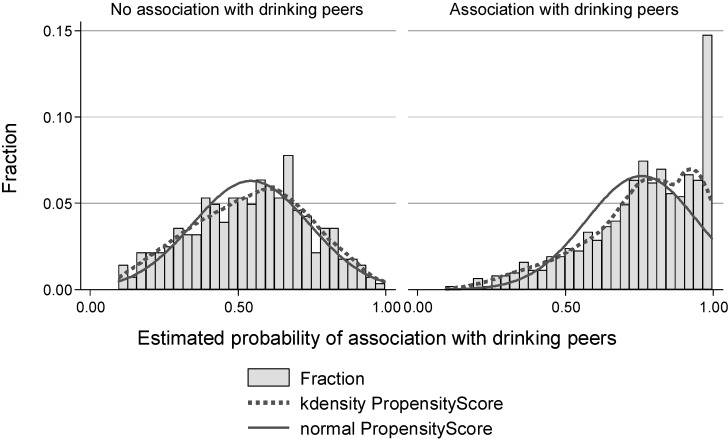
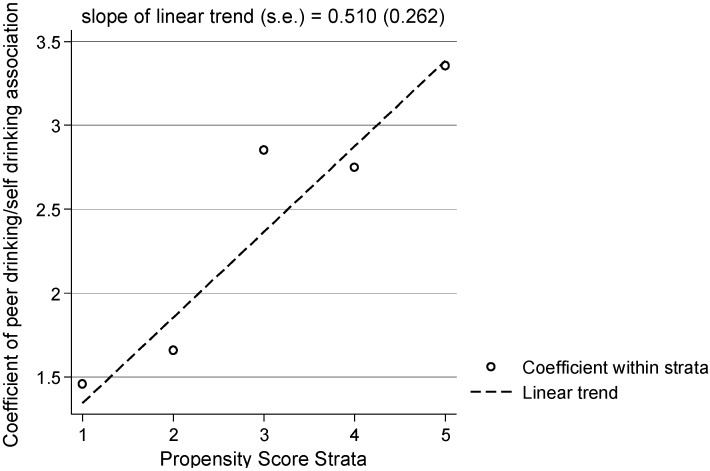
When estimating the association between peer and youth alcohol consumption, it is critical to account for possible differential levels of response to peer socialization processes across youth, in addition to variability in individual, family, and social factors. Failure to account for intrinsic differences in youth's response to peers may pose a threat of selection bias. To address this issue, we used a propensity score stratification method to examine whether the size of the association between peer and youth drinking is contingent upon differential predicted probabilities of associating with alcohol-consuming friends. Analyzing a Chilean youth sample (N = 914) of substance use, we found that youths are susceptible to the detrimental role of peer drinkers, but the harmful relationship with one's own drinking behavior may be exacerbated among youth who already have a high probability of socializing with peers who drink. In other words, computing a single weighted-average estimate for peer drinking would have underestimated the detrimental role of peers, particularly among at-risk youths, and overestimated the role of drinking peers among youths who are less susceptible to peer socialization processes. Heterogeneous patterns in the association between peer and youth drinking may shed light on social policies that target at-risk youths.
在估计同龄人饮酒与青少年饮酒之间的关联时,除了个体、家庭和社会因素的变异性之外,考虑青少年对同龄人社交过程可能存在的不同反应水平至关重要。未能考虑到青少年对同龄人的反应存在内在差异,可能会带来选择偏差的风险。为了解决这个问题,我们使用倾向得分分层方法来检验同龄人饮酒与青少年饮酒之间关联的大小是否取决于与饮酒朋友交往的不同预测概率。通过分析智利一个关于物质使用的青少年样本(N = 914),我们发现青少年容易受到同龄人饮酒的有害影响,但对于那些已经有很高概率与饮酒同龄人交往的青少年来说,与自身饮酒行为的有害关系可能会加剧。换句话说,计算同龄人饮酒的单一加权平均估计值会低估同龄人的有害影响,尤其是在高危青少年中,并且会高估饮酒同龄人对那些较不易受同龄人社交过程影响的青少年的作用。同龄人饮酒与青少年饮酒之间关联的异质性模式可能会为针对高危青少年的社会政策提供启示。