Marion Jason W, Lee Cheonghoon, Lee Chang Soo, Wang Qiuhong, Lemeshow Stanley, Buckley Timothy J, Saif Linda J, Lee Jiyoung
Division of Environmental Health Sciences, College of Public Health, The Ohio State University, Columbus, Ohio, United States of America.
Food Animal Health Research Program, Ohio Agricultural Research and Development Center, Department of Veterinary Preventive Medicine, The Ohio State University, Wooster, Ohio, United States of America.
PLoS One. 2014 Nov 19;9(11):e112029. doi: 10.1371/journal.pone.0112029. eCollection 2014.
BACKGROUND & OBJECTIVE: Recreational waters impacted by fecal contamination have been linked to gastrointestinal illness in swimmer populations. To date, few epidemiologic studies examine the risk for swimming-related illnesses based upon simultaneous exposure to more than one microbial surrogate (e.g. culturable E. coli densities, genetic markers). We addressed this research gap by investigating the association between swimming-related illness frequency and water quality determined from multiple bacterial and viral genetic markers.
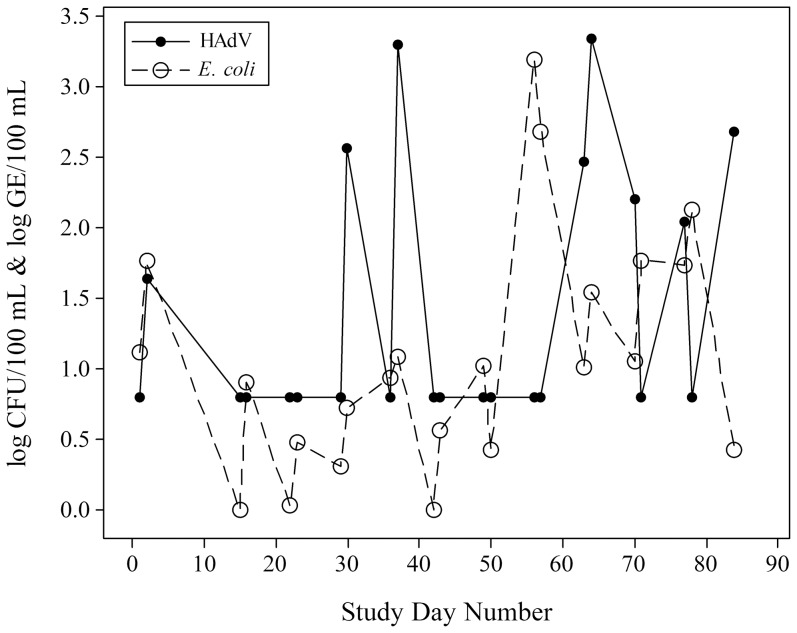
Viral and bacterial genetic marker densities were determined from beach water samples collected over 23 weekend days and were quantified using quantitative polymerase chain reaction (qPCR). These genetic marker data were paired with previously determined human exposure data gathered as part of a cohort study carried out among beach users at East Fork Lake in Ohio, USA in 2009. Using previously unavailable genetic marker data in logistic regression models, single- and multi-marker/multi-water quality indicator approaches for predicting swimming-related illness were evaluated for associations with swimming-associated gastrointestinal illness.
Data pertaining to genetic marker exposure and 8- or 9-day health outcomes were available for a total of 600 healthy susceptible swimmers, and with this population we observed a significant positive association between human adenovirus (HAdV) exposure and diarrhea (odds ratio = 1.6; 95% confidence interval: 1.1-2.3) as well as gastrointestinal illness (OR = 1.5; 95% CI: 1.0-2.2) upon adjusting for culturable E. coli densities in multivariable models. No significant associations between bacterial genetic markers and swimming-associated illness were observed.
This study provides evidence that a combined measure of recreational water quality that simultaneously considers both bacterial and viral densities, particularly HAdV, may improve prediction of disease risk than a measure of a single agent in a beach environment likely influenced by nonpoint source human fecal contamination.
受粪便污染影响的娱乐用水与游泳人群的胃肠道疾病有关。迄今为止,很少有流行病学研究基于同时接触多种微生物替代指标(如可培养的大肠杆菌密度、基因标记)来考察游泳相关疾病的风险。我们通过调查游泳相关疾病发生频率与多种细菌和病毒基因标记所确定的水质之间的关联,填补了这一研究空白。
从23个周末采集的海滩水样中测定病毒和细菌基因标记密度,并使用定量聚合酶链反应(qPCR)进行定量。这些基因标记数据与之前作为队列研究一部分收集的人体暴露数据配对,该队列研究于2009年在美国俄亥俄州东叉湖的海滩使用者中开展。在逻辑回归模型中使用之前未有的基因标记数据,评估用于预测游泳相关疾病的单标记/多水质指标方法和多标记/多水质指标方法与游泳相关胃肠道疾病的关联。
共有600名健康易感游泳者有基因标记暴露及8天或9天健康结局的数据,在该人群中,我们观察到在多变量模型中调整可培养的大肠杆菌密度后,人腺病毒(HAdV)暴露与腹泻(比值比=1.6;95%置信区间:1.1 - 2.3)以及胃肠道疾病(比值比=1.5;95%置信区间:1.0 - 2.2)之间存在显著正相关。未观察到细菌基因标记与游泳相关疾病之间的显著关联。
本研究提供的证据表明,在可能受非点源人类粪便污染影响的海滩环境中,同时考虑细菌和病毒密度,特别是HAdV的娱乐用水水质综合指标,可能比单一指标更能改善疾病风险预测。