Phelan Joan A, Abrams William R, Norman Robert G, Li Yihong, Laverty Maura, Corby Patricia M, Nembhard Jason, Neri Dinah, Barber Cheryl A, Aberg Judith A, Fisch Gene S, Poles Michael A, Malamud Daniel
Department of Oral and Maxillofacial Pathology, Radiology and Medicine, New York University College of Dentistry, New York, New York, United States of America.
Department of Basic Sciences and Craniofacial Biology, New York University College of Dentistry, New York, New York, United States of America.
PLoS One. 2014 Nov 19;9(11):e112901. doi: 10.1371/journal.pone.0112901. eCollection 2014.
The impaired host defense system in HIV infection impacts the oral and gastrointestinal microbiota and associated opportunistic infections. Antiretroviral treatment is predicted to partially restore host defenses and decrease the oral manifestation of HIV/AIDS. Well-designed longitudinal studies are needed to better understand the interactions of soluble host defense proteins with bacteria and virus in HIV/AIDS. "Crosstalk" was designed as a longitudinal study of host responses along the gastrointestinal (GI) tract and interactions between defense molecules and bacteria in HIV infection and subsequent therapy.
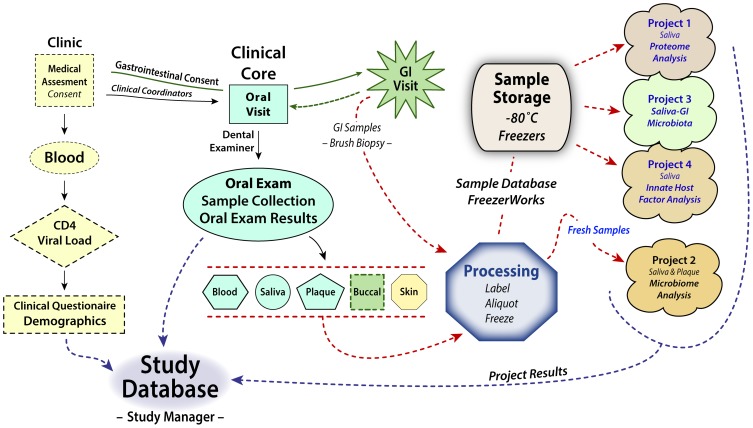
The clinical core formed the infrastructure for the study of the interactions between the proteome, microbiome and innate immune system. The core recruited and retained study subjects, scheduled visits, obtained demographic and medical data, assessed oral health status, collected samples, and guided analysis of the hypotheses. This manuscript presents a well-designed clinical core that may serve as a model for studies that combine clinical and laboratory data.
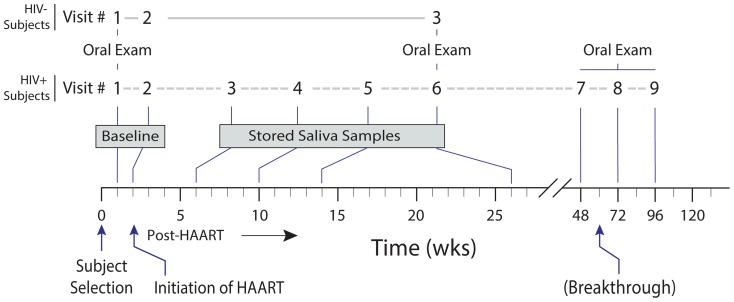
Crosstalk was a case-control longitudinal clinical study an initial planned enrollment of 170 subjects. HIV+ antiretroviral naïve subjects were followed for 9 visits over 96 weeks and HIV uninfected subjects for 3 visits over 24 weeks. Clinical prevalence of oral mucosal lesions, dental caries and periodontal disease were assessed.
During the study, 116 subjects (47 HIV+, 69 HIV-) were enrolled. Cohorts of HIV+ and HIV- were demographically similar except for a larger proportion of women in the HIV- group. The most prevalent oral mucosal lesions were oral candidiasis and hairy leukoplakia in the HIV+ group.
The clinical core was essential to enable the links between clinical and laboratory data. The study aims to determine specific differences between oral and GI tissues that account for unique patterns of opportunistic infections and to delineate the differences in their susceptibility to infection by HIV and their responses post-HAART.
HIV感染中受损的宿主防御系统会影响口腔和胃肠道微生物群以及相关的机会性感染。预计抗逆转录病毒治疗可部分恢复宿主防御功能,并减少HIV/AIDS的口腔表现。需要精心设计的纵向研究,以更好地了解HIV/AIDS中可溶性宿主防御蛋白与细菌和病毒之间的相互作用。“串扰”被设计为一项关于HIV感染及后续治疗过程中宿主沿胃肠道(GI)的反应以及防御分子与细菌之间相互作用的纵向研究。
临床核心为蛋白质组、微生物组和先天免疫系统之间相互作用的研究提供了基础设施。该核心招募并留住研究对象,安排就诊时间,获取人口统计学和医学数据,评估口腔健康状况,收集样本,并指导假设分析。本手稿介绍了一个精心设计的临床核心,它可作为结合临床和实验室数据的研究模型。
“串扰”是一项病例对照纵向临床研究,最初计划招募170名受试者。未接受过抗逆转录病毒治疗的HIV阳性受试者在96周内接受9次随访,未感染HIV的受试者在24周内接受3次随访。评估口腔黏膜病变、龋齿和牙周病的临床患病率。
在研究期间,共招募了116名受试者(47名HIV阳性,69名HIV阴性)。除HIV阴性组中女性比例较高外,HIV阳性和阴性队列在人口统计学上相似。HIV阳性组中最常见的口腔黏膜病变是口腔念珠菌病和毛状白斑。
临床核心对于建立临床和实验室数据之间的联系至关重要。该研究旨在确定口腔和胃肠道组织之间的特定差异,这些差异导致了机会性感染的独特模式,并描绘出它们对HIV感染的易感性差异以及HAART后的反应差异。