Benaglia Tatiana, Jackson Christopher H, Sharples Linda D
Department of Statistics, Universidade Estadual de Campinas, Sao Paulo, Brazil.
Stat Med. 2015 Feb 28;34(5):796-811. doi: 10.1002/sim.6375. Epub 2014 Nov 20.
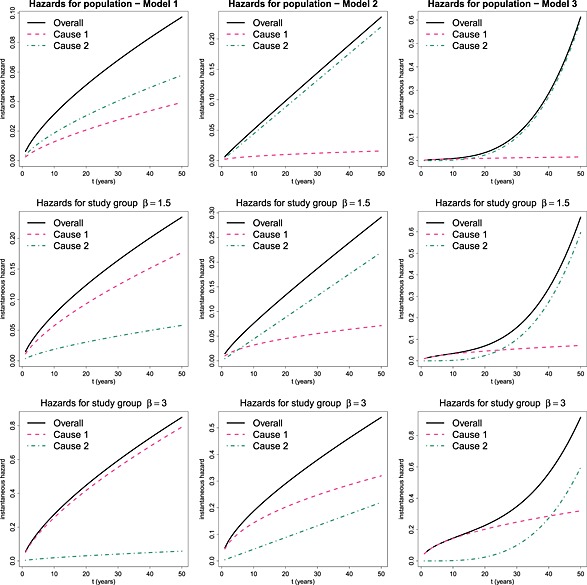
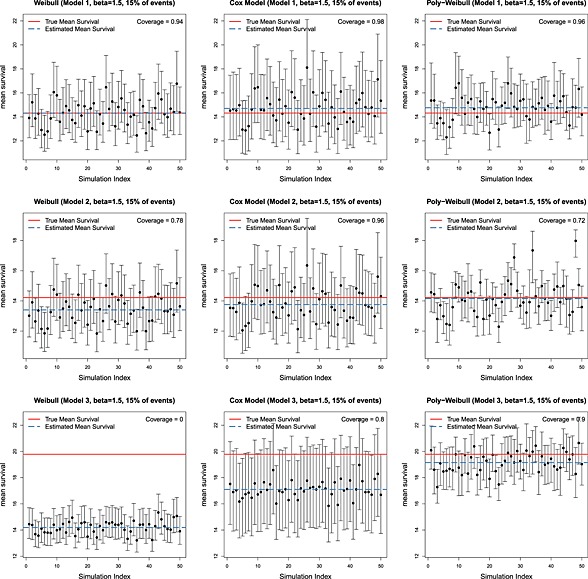
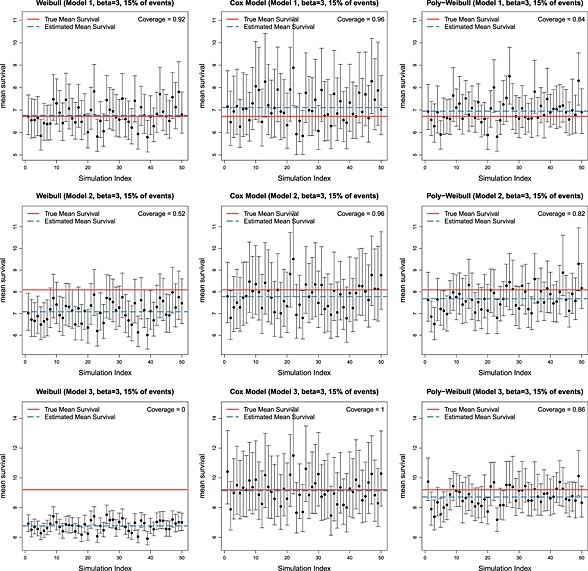
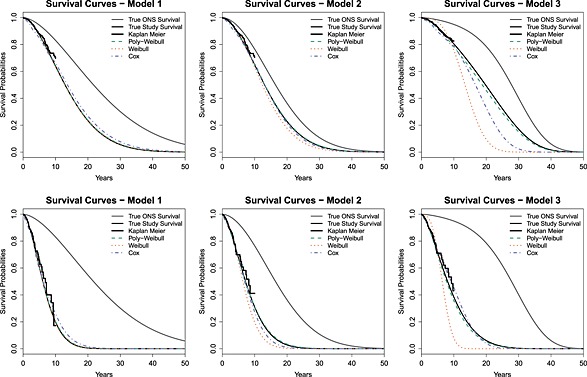
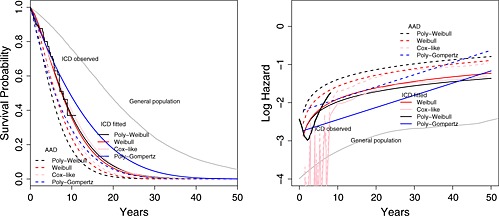
Health economic evaluations require estimates of expected survival from patients receiving different interventions, often over a lifetime. However, data on the patients of interest are typically only available for a much shorter follow-up time, from randomised trials or cohorts. Previous work showed how to use general population mortality to improve extrapolations of the short-term data, assuming a constant additive or multiplicative effect on the hazards for all-cause mortality for study patients relative to the general population. A more plausible assumption may be a constant effect on the hazard for the specific cause of death targeted by the treatments. To address this problem, we use independent parametric survival models for cause-specific mortality among the general population. Because causes of death are unobserved for the patients of interest, a polyhazard model is used to express their all-cause mortality as a sum of latent cause-specific hazards. Assuming proportional cause-specific hazards between the general and study populations then allows us to extrapolate mortality of the patients of interest to the long term. A Bayesian framework is used to jointly model all sources of data. By simulation, we show that ignoring cause-specific hazards leads to biased estimates of mean survival when the proportion of deaths due to the cause of interest changes through time. The methods are applied to an evaluation of implantable cardioverter defibrillators for the prevention of sudden cardiac death among patients with cardiac arrhythmia. After accounting for cause-specific mortality, substantial differences are seen in estimates of life years gained from implantable cardioverter defibrillators.
卫生经济评估需要估计接受不同干预措施的患者的预期生存期,通常是终生的生存期。然而,感兴趣的患者的数据通常仅在较短的随访期内可得,这些数据来自随机试验或队列研究。先前的研究表明了如何利用一般人群死亡率来改进短期数据的外推,假设相对于一般人群,研究患者的全因死亡率的风险具有恒定的相加或相乘效应。一个更合理的假设可能是对治疗所针对的特定死因的风险具有恒定效应。为了解决这个问题,我们对一般人群中特定死因的死亡率使用独立的参数生存模型。由于感兴趣的患者的死亡原因是未观察到的,因此使用多风险模型将他们的全因死亡率表示为潜在的特定死因风险之和。假设一般人群和研究人群之间特定死因风险成比例,那么我们就可以将感兴趣的患者的死亡率外推到长期。使用贝叶斯框架对所有数据来源进行联合建模。通过模拟,我们表明,当因感兴趣的原因导致的死亡比例随时间变化时,忽略特定死因风险会导致平均生存期的估计出现偏差。这些方法被应用于一项关于植入式心脏复律除颤器预防心律失常患者心脏性猝死的评估。在考虑特定死因死亡率后,从植入式心脏复律除颤器获得的生命年估计值出现了显著差异。