Statistical Innovation, AstraZeneca, Cambridge, UK.
Department of Population Health Sciences, University of Leicester, UK.
Med Decis Making. 2023 Aug;43(6):737-748. doi: 10.1177/0272989X231184247. Epub 2023 Jul 13.
Different parametric survival models can lead to widely discordant extrapolations and decision uncertainty in cost-effectiveness analyses. The use of excess hazard (EH) methods, which incorporate general population mortality data, has the potential to reduce model uncertainty. This review highlights key practical considerations of EH methods for estimating long-term survival.
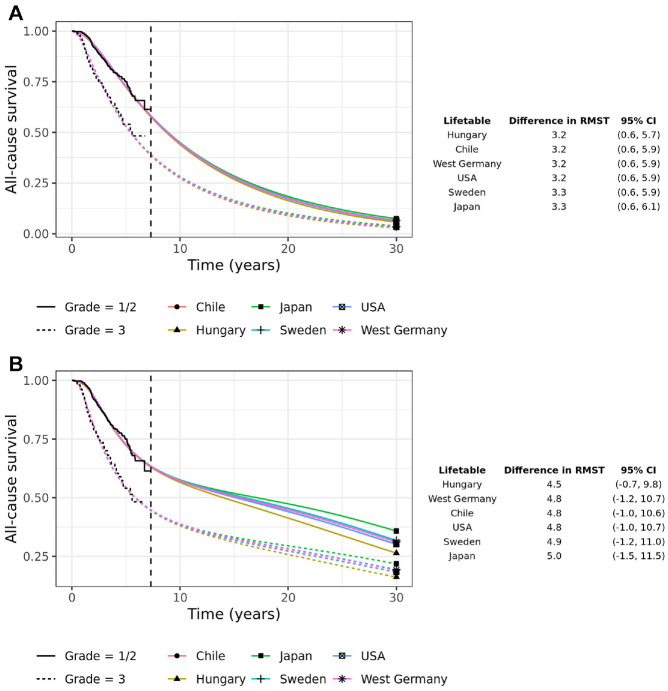
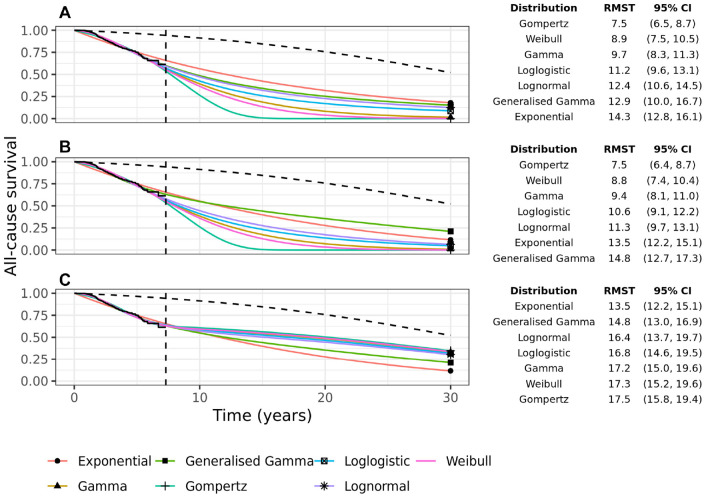
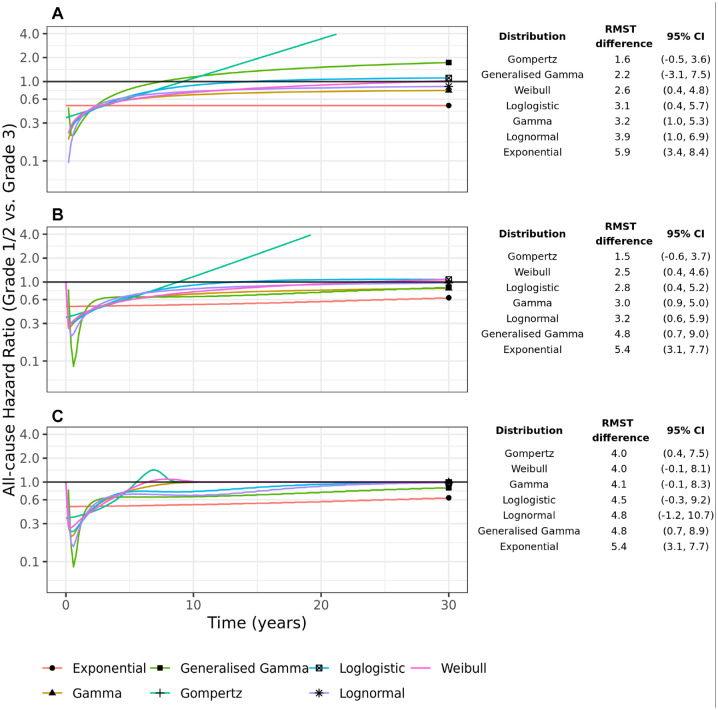
Demonstration of methods used a case study of 686 patients from the German Breast Cancer Study Group, followed for a maximum of 7.3 y and divided into low (1/2) and high (3) grade cancers. Seven standard parametric survival models were fit to each group separately. The same 7 distributions were then used in an EH framework, which incorporated general population mortality rates, and fitted both with and without a cure parameter. Survival extrapolations, restricted mean survival time (RMST), and difference in RMST between high and low grades were compared up to 30 years along with Akaike information criterion goodness-of-fit and cure fraction estimates. The sensitivity of the EH models to lifetable misspecification was investigated.
In our case study, variability in survival extrapolations was extensive across the standard models, with 30-y RMST ranging from 7.5 to 14.3 y. Incorporation of general population mortality rates using EH cure methods substantially reduced model uncertainty, whereas EH models without cure had less of an effect. Long-term treatment effects approached the null for most models but at varying rates. Lifetable misspecification had minimal effect on RMST differences.
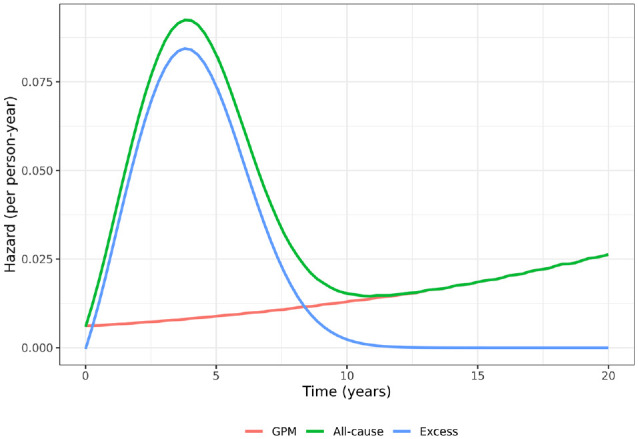
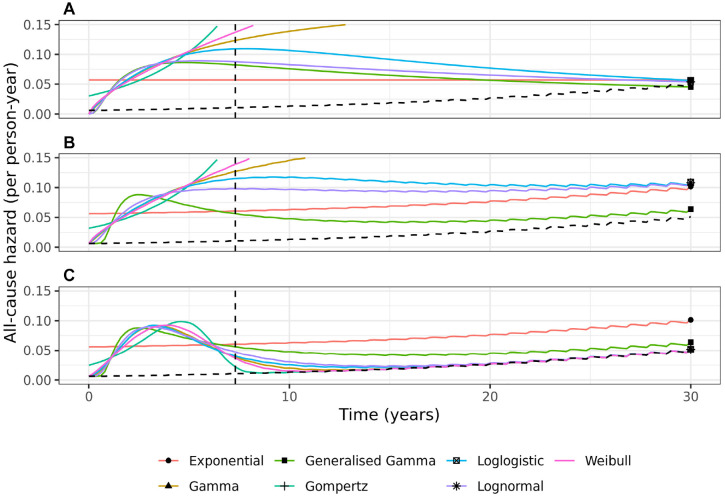
EH methods may be useful for survival extrapolation, and in cancer, EHs may decrease over time and be easier to extrapolate than all-cause hazards. EH cure models may be helpful when cure is plausible and likely to result in less extrapolation variability.
In health economic modeling, to help anchor long-term survival extrapolation, it has been recommended that survival models incorporate background mortality rates using excess hazard (EH) methods.We present a thorough description of EH methods with and without the assumption of cure and demonstrate user-friendly software to aid researchers wishing to use these methods.EH models are applied to a case study, and we demonstrate that EHs are easier to extrapolate and that the use of the EH cure model, when cure is plausible, can reduce extrapolation variability.EH methods are relatively robust to lifetable misspecification.
不同的参数生存模型可能导致成本效益分析中的广泛不一致的外推和决策不确定性。使用超额风险(EH)方法,该方法结合了一般人群的死亡率数据,有可能降低模型不确定性。本综述重点介绍了 EH 方法在估计长期生存方面的关键实际考虑因素。
使用来自德国乳腺癌研究组的 686 例患者的病例研究来说明方法,这些患者的随访时间最长为 7.3 年,分为低(1/2)和高(3)级癌症。分别为每个组拟合了七种标准参数生存模型。然后,在 EH 框架中使用相同的 7 种分布,该框架结合了一般人群的死亡率,并分别拟合了有和没有治愈参数的情况。将生存外推、限制平均生存时间(RMST)和高低级之间的 RMST 差异与 Akaike 信息准则拟合优度和治愈分数估计值一起比较长达 30 年。还研究了 EH 模型对生命表指定的敏感性。
在我们的病例研究中,标准模型之间的生存外推差异很大,30 年 RMST 范围从 7.5 年到 14.3 年不等。使用 EH 治愈方法结合一般人群死亡率可大大降低模型不确定性,而没有治愈的 EH 模型影响较小。大多数模型的长期治疗效果接近零,但速度不同。生命表指定的微小差异对 RMST 差异的影响很小。
EH 方法可能对生存外推有用,在癌症中,EH 可能随着时间的推移而减少,并且比全因风险更容易外推。当治愈合理且可能导致更少外推变异性时,EH 治愈模型可能会有所帮助。
在健康经济建模中,为了帮助确定长期生存外推,建议使用超额风险(EH)方法将生存模型纳入背景死亡率。我们介绍了带有和不带有治愈假设的 EH 方法的详细描述,并展示了用户友好的软件,以帮助希望使用这些方法的研究人员。EH 模型应用于病例研究,我们证明 EH 更容易外推,并且在治愈合理时使用 EH 治愈模型可以减少外推变异性。EH 方法对生命表指定具有相对鲁棒性。