Moura Tatiane, Costa Manoel, Oliveira Saulo, Júnior Marcos Barbosa, Ritti-Dias Raphael, Santos Marcos
Human Performance Evaluation Laboratory, Faculty of Physical Education, University of Pernambuco (LAPH/ESEF/UPE), Pernambuco, Brazil. ; School of Physical Education, University of Pernambuco, Pernambuco, Brazil.
Human Performance Evaluation Laboratory, Faculty of Physical Education, University of Pernambuco (LAPH/ESEF/UPE), Pernambuco, Brazil. ; Anthropometrist level 1 (Certification by ISAK). ; Department of Physical Education and Sports Science, Federal University of Pernambuco, Academic Center of Vitória de Santo Antão, Pernambuco, Brazil.
J Hum Kinet. 2014 Oct 10;42:277-84. doi: 10.2478/hukin-2014-0081. eCollection 2014 Sep 29.
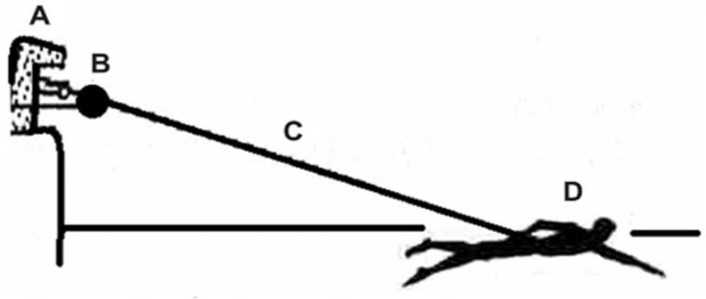
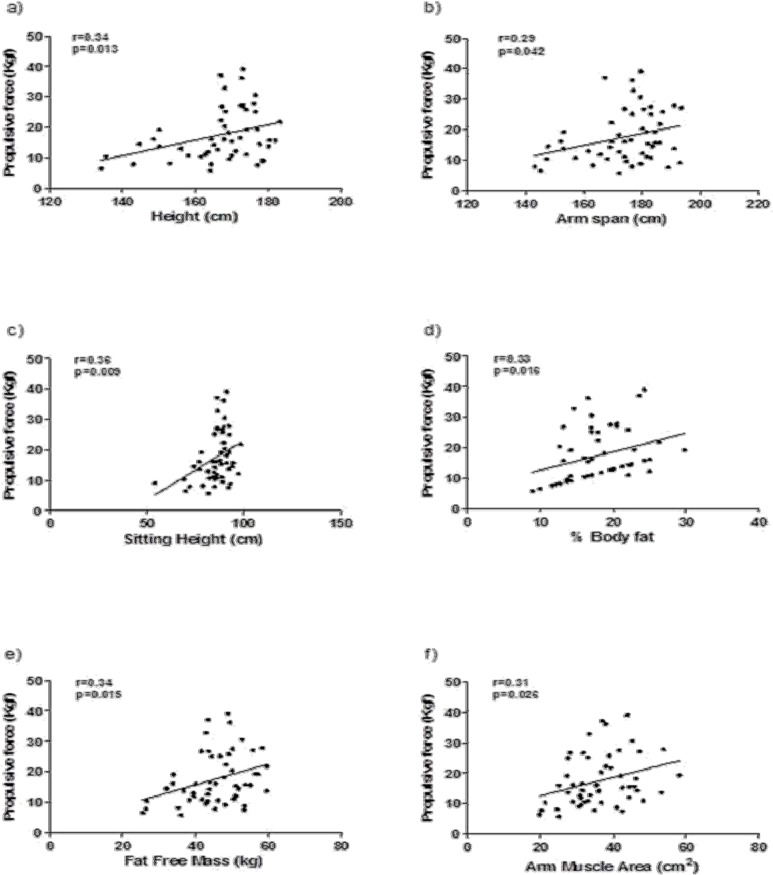
The aim of this study was to examine the relationship between anthropometric variables, body composition and propulsive force in swimmers aged 9-17 years. Anthropometric characteristics (body height and mass, sitting height, arm span, arm muscle area and body composition) and the propulsive force of the arm (tethered swimming test) were evaluated in 56 competitive male swimmers. Tanner's stages of genital maturation (P1-5) were used. The data analysis included correlations and multiple linear regression. The propulsive force of the arm was correlated with body height (r = 0.34; p =0.013), arm span (r = 0.29; p =0.042), sitting height (r = 0.36; p =0.009), % body fat (r = 0.33; p =0.016), lean body mass (r = 0.34; p =0.015) and arm muscle area (r = 0.31; p =0.026). Using multiple linear regression models, the percent body fat and height were identified as significant predictors of the propulsive force of the arm after controlling for the maturation stage. This model explained 22% (R2 = 0.22) of associations. In conclusion, the propulsive force of swimmers was related to body height and percent body fat.
本研究旨在探讨9至17岁游泳运动员的人体测量学变量、身体成分与推进力之间的关系。对56名男性竞技游泳运动员的人体测量学特征(身高、体重、坐高、臂展、臂肌面积和身体成分)以及手臂推进力(系绳游泳测试)进行了评估。采用坦纳生殖器成熟阶段(P1 - 5)。数据分析包括相关性分析和多元线性回归分析。手臂推进力与身高(r = 0.34;p = 0.013)、臂展(r = 0.29;p = 0.042)、坐高(r = 0.36;p = 0.009)、体脂百分比(r = 0.33;p = 0.016)、去脂体重(r = 0.34;p = 0.015)和臂肌面积(r = 0.31;p = 0.026)相关。使用多元线性回归模型,在控制成熟阶段后,体脂百分比和身高被确定为手臂推进力的显著预测因素。该模型解释了22%(R2 = 0.22)的关联。总之,游泳运动员的推进力与身高和体脂百分比有关。