Lamb Rebecca, Harrison Hannah, Hulit James, Smith Duncan L, Lisanti Michael P, Sotgia Federica
The Manchester Centre for Cellular Metabolism (MCCM), Institute of Cancer Sciences, University of Manchester. The Breakthrough Breast Cancer Research Unit, Institute of Cancer Sciences, University of Manchester.
The Cancer Research UK Manchester Institute, University of Manchester.
Oncotarget. 2014 Nov 30;5(22):11029-37. doi: 10.18632/oncotarget.2789.
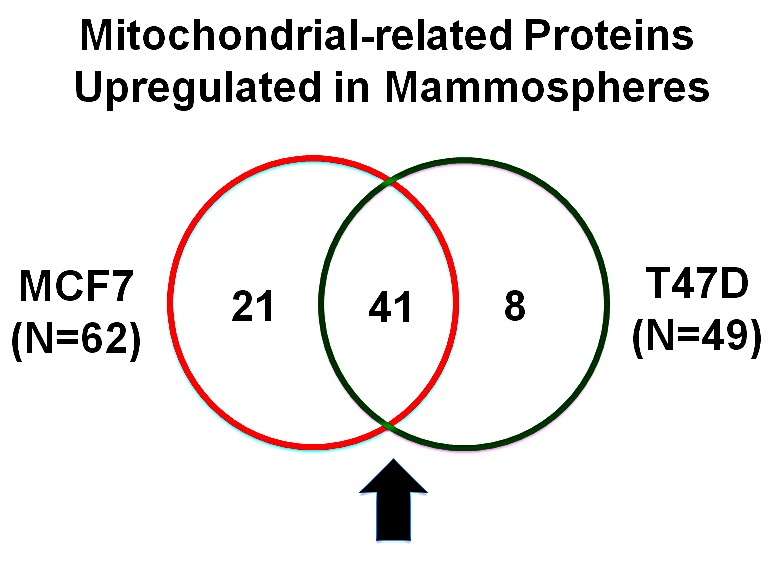
Here, we used quantitative proteomics analysis to identify novel therapeutic targets in cancer stem cells and/or progenitor cells. For this purpose, mammospheres from two ER-positive breast cancer cell lines (MCF7 and T47D) were grown in suspension using low-attachment plates and directly compared to attached monolayer cells grown in parallel. This allowed us to identify a subset of proteins that were selectively over-expressed in mammospheres, relative to epithelial monolayers. We focused on mitochondrial proteins, as they appeared to be highly upregulated in both MCF7 and T47D mammospheres. Key mitochondrial-related enzymes involved in beta-oxidation and ketone metabolism were significantly upregulated in mammospheres, as well as proteins involved in mitochondrial biogenesis, and specific protein inhibitors of autophagy/mitophagy. Overall, we identified >40 "metabolic targets" that were commonly upregulated in both MCF7 and T47D mammospheres. Most of these "metabolic targets" were also transcriptionally upregulated in human breast cancer cells in vivo, validating their clinical relevance. Based on this analysis, we propose that increased mitochondrial biogenesis and decreased mitochondrial degradation could provide a novel mechanism for the accumulation of mitochondrial mass in cancer stem cells. To functionally validate our observations, we utilized a specific MCT1/2 inhibitor (AR-C155858), which blocks the cellular uptake of two types of mitochondrial fuels, namely ketone bodies and L-lactate. Our results indicate that inhibition of MCT1/2 function effectively reduces mammosphere formation, with an IC-50 of ~1 µM, in both ER-positive and ER-negative breast cancer cell lines. Very similar results were obtained with oligomycin A, an inhibitor of the mitochondrial ATP synthase. Thus, the proliferative clonal expansion of cancer stem cells appears to require oxidative mitochondrial metabolism, related to the re-use of monocarboxylic acids, such as ketones or L-lactate. Our findings have important clinical implications for exploiting mitochondrial metabolism to eradicate cancer stem cells and to prevent recurrence, metastasis and drug resistance in cancer patients. Importantly, a related MCT1/2 inhibitor (AZD3965) is currently in phase I clinical trials in patients with advanced cancers: http://clinicaltrials.gov/show/NCT01791595.
在此,我们运用定量蛋白质组学分析来鉴定癌症干细胞和/或祖细胞中的新型治疗靶点。为此,我们使用低附着板在悬浮状态下培养了来自两种雌激素受体阳性乳腺癌细胞系(MCF7和T47D)的乳腺球,并将其与平行培养的贴壁单层细胞直接进行比较。这使我们能够鉴定出相对于上皮单层细胞在乳腺球中选择性过度表达的一组蛋白质。我们聚焦于线粒体蛋白,因为它们在MCF7和T47D乳腺球中似乎都高度上调。参与β氧化和酮代谢的关键线粒体相关酶在乳腺球中显著上调,参与线粒体生物发生的蛋白以及自噬/线粒体自噬的特异性蛋白抑制剂也是如此。总体而言,我们鉴定出40多个在MCF7和T47D乳腺球中均普遍上调的“代谢靶点”。这些“代谢靶点”中的大多数在体内的人乳腺癌细胞中也在转录水平上上调,证实了它们的临床相关性。基于此分析,我们提出线粒体生物发生增加和线粒体降解减少可能为癌症干细胞中线粒体质量的积累提供一种新机制。为了从功能上验证我们的观察结果,我们使用了一种特异性的MCT1/2抑制剂(AR - C155858),它能阻断两种线粒体燃料即酮体和L - 乳酸的细胞摄取。我们的结果表明,抑制MCT1/2功能可有效减少乳腺球形成,在雌激素受体阳性和阴性乳腺癌细胞系中的半数抑制浓度(IC - 50)约为1 μM。使用线粒体ATP合酶抑制剂寡霉素A也获得了非常相似的结果。因此,癌症干细胞的增殖性克隆扩增似乎需要与单羧酸(如酮或L - 乳酸)的再利用相关的氧化线粒体代谢。我们的发现对于利用线粒体代谢来根除癌症干细胞以及预防癌症患者的复发、转移和耐药性具有重要的临床意义。重要的是,一种相关的MCT1/2抑制剂(AZD3965)目前正在晚期癌症患者中进行I期临床试验:http://clinicaltrials.gov/show/NCT01791595 。